Thank you for visiting SNEWPapers!
Sign up free
Editorial
May 7, 1864
Brownlow's Knoxville Whig, And Rebel Ventilator
Knoxville, Knox County, Tennessee
What is this article about?
The editorial defends negro suffrage in Tennessee by detailing historical facts: free negroes voted under the 1796 constitution, influencing elections for figures like John Bell, Andrew Jackson, and Governor Carroll, until disfranchised in 1835. It criticizes current opposition and prefers Union negro governance over disloyal whites.
Clipping
OCR Quality
98%
Excellent
Full Text
Negro Suffrage in Tennessee.
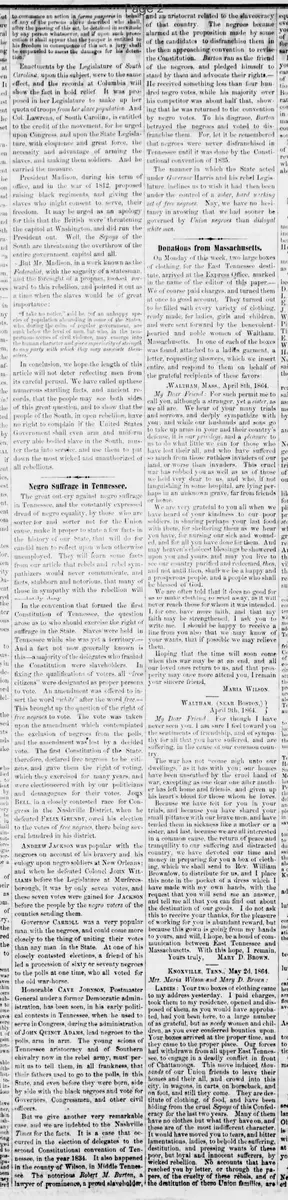
The great out-cry against negro suffrage in Tennessee, and the constantly expressed dread of negro equality, by those who are sorter for and sorter not for the Union cause, make it proper to state a few facts in the history of our State, that will do for candid men to reflect upon when otherwise unemployed. They will learn some facts from our article that rebels and rebel sympathizers would never communicate, and facts, stubborn and notorious, that many of those in sympathy with the rebellion will stoutly deny.
In the convention that formed the first Constitution of Tennessee, the question arose as to who should exercise the right of suffrage in the State. Slaves were held in Tennessee while she was yet a territory.—And a fact not now generally known is this—a majority of the delegates who framed the Constitution were slaveholders. In fixing the qualifications of voters, all "free citizens" were designated as proper persons to vote. An amendment was offered to insert the word "white" after the word free.—This brought up the question of the right of free negroes to vote. The vote was taken upon the amendment which contemplated the exclusion of negroes from the polls and the amendment was lost by a decided vote. The first Constitution of the State therefore, declared free negroes to be citizens, and gave them the right of voting which they exercised for many years, and were electioneered with by our politicians and demagogues for their votes. John Bell, in a closely contested race for Congress in the Nashville District, when he defeated Felix Grundy, owed his election to the votes of free negroes, there being several hundred in his district.
Andrew Jackson was popular with the negroes on account of his bravery and his eulogy upon negro soldiers at New Orleans and when he defeated Colonel John Williams before the Legislature at Murfreesborough, it was by only seven votes, and these seven votes were gained for Jackson before the people by the negro voters of the counties sending them.
Governor Carroll was a very popular man with the negroes, and could come more closely to the thing of uniting their votes than any man in the State. At one of his closely contested elections, a friend of his led a procession of sixty or seventy negroes to the polls at one time, who all voted for the old war-horse.
Honorable Cave Johnson, Postmaster General under a former Democratic administration, has been seen, in his early political contests in Tennessee, when he used to serve in Congress, during the administration of John Quincy Adams, lead negroes to the polls, arm in arm. The young scions of Tennessee aristocracy and of Southern chivalry now in the rebel army, must permit us to tell them, in all frankness, that their fathers used to go to the polls, in this State, and even before they were born, side by side with the black negroes and vote for Governors, Congressmen, and other civil officers.
But we give another very remarkable case, and we are indebted to the Nashville Times for the facts. It is a case that occurred in the election of delegates to the second Constitutional convention of Tennessee, in the year 1834. It also happened in the county of Wilson, in Middle Tennessee. The notorious Robert M. Burton, a lawyer of prominence, a proud slaveholder, and an aristocrat related to the slaveocracy of that country. The negroes became alarmed at the proposition made by some of the candidates to disfranchise them in the then approaching convention to revise the Constitution. Burton ran as the friend of the negroes, and pledged himself to stand by them and advocate their rights.—He received something less than four hundred negro votes, while his majority over his competitor was about half that, showing that he was returned to the convention by negro votes. To his disgrace, Burton betrayed the negroes and voted to disfranchise them. For, let it be remembered that negroes were never disfranchised in Tennessee until it was done by the Constitutional convention of 1835.
The manner in which the State acted under Governor Harris and his rebel Legislature, inclines us to wish it had then been under the control of a sober, hard working set of free negroes. Nay, we have no hesitancy in avowing that we had sooner be governed by Union negroes than disloyal white men.
The great out-cry against negro suffrage in Tennessee, and the constantly expressed dread of negro equality, by those who are sorter for and sorter not for the Union cause, make it proper to state a few facts in the history of our State, that will do for candid men to reflect upon when otherwise unemployed. They will learn some facts from our article that rebels and rebel sympathizers would never communicate, and facts, stubborn and notorious, that many of those in sympathy with the rebellion will stoutly deny.
In the convention that formed the first Constitution of Tennessee, the question arose as to who should exercise the right of suffrage in the State. Slaves were held in Tennessee while she was yet a territory.—And a fact not now generally known is this—a majority of the delegates who framed the Constitution were slaveholders. In fixing the qualifications of voters, all "free citizens" were designated as proper persons to vote. An amendment was offered to insert the word "white" after the word free.—This brought up the question of the right of free negroes to vote. The vote was taken upon the amendment which contemplated the exclusion of negroes from the polls and the amendment was lost by a decided vote. The first Constitution of the State therefore, declared free negroes to be citizens, and gave them the right of voting which they exercised for many years, and were electioneered with by our politicians and demagogues for their votes. John Bell, in a closely contested race for Congress in the Nashville District, when he defeated Felix Grundy, owed his election to the votes of free negroes, there being several hundred in his district.
Andrew Jackson was popular with the negroes on account of his bravery and his eulogy upon negro soldiers at New Orleans and when he defeated Colonel John Williams before the Legislature at Murfreesborough, it was by only seven votes, and these seven votes were gained for Jackson before the people by the negro voters of the counties sending them.
Governor Carroll was a very popular man with the negroes, and could come more closely to the thing of uniting their votes than any man in the State. At one of his closely contested elections, a friend of his led a procession of sixty or seventy negroes to the polls at one time, who all voted for the old war-horse.
Honorable Cave Johnson, Postmaster General under a former Democratic administration, has been seen, in his early political contests in Tennessee, when he used to serve in Congress, during the administration of John Quincy Adams, lead negroes to the polls, arm in arm. The young scions of Tennessee aristocracy and of Southern chivalry now in the rebel army, must permit us to tell them, in all frankness, that their fathers used to go to the polls, in this State, and even before they were born, side by side with the black negroes and vote for Governors, Congressmen, and other civil officers.
But we give another very remarkable case, and we are indebted to the Nashville Times for the facts. It is a case that occurred in the election of delegates to the second Constitutional convention of Tennessee, in the year 1834. It also happened in the county of Wilson, in Middle Tennessee. The notorious Robert M. Burton, a lawyer of prominence, a proud slaveholder, and an aristocrat related to the slaveocracy of that country. The negroes became alarmed at the proposition made by some of the candidates to disfranchise them in the then approaching convention to revise the Constitution. Burton ran as the friend of the negroes, and pledged himself to stand by them and advocate their rights.—He received something less than four hundred negro votes, while his majority over his competitor was about half that, showing that he was returned to the convention by negro votes. To his disgrace, Burton betrayed the negroes and voted to disfranchise them. For, let it be remembered that negroes were never disfranchised in Tennessee until it was done by the Constitutional convention of 1835.
The manner in which the State acted under Governor Harris and his rebel Legislature, inclines us to wish it had then been under the control of a sober, hard working set of free negroes. Nay, we have no hesitancy in avowing that we had sooner be governed by Union negroes than disloyal white men.
What sub-type of article is it?
Suffrage
Slavery Abolition
What keywords are associated?
Negro Suffrage
Tennessee Constitution
Free Negroes Voting
Historical Elections
Disfranchisement 1835
Union Cause
What entities or persons were involved?
John Bell
Felix Grundy
Andrew Jackson
Colonel John Williams
Governor Carroll
Cave Johnson
Robert M. Burton
Governor Harris
Editorial Details
Primary Topic
Historical Negro Suffrage In Tennessee
Stance / Tone
Supportive Of Negro Suffrage And Critical Of Opposition
Key Figures
John Bell
Felix Grundy
Andrew Jackson
Colonel John Williams
Governor Carroll
Cave Johnson
Robert M. Burton
Governor Harris
Key Arguments
Free Negroes Were Granted Voting Rights In Tennessee's First 1796 Constitution After An Amendment To Exclude Them Failed.
Free Negro Votes Influenced Key Elections, Such As John Bell's Defeat Of Felix Grundy.
Andrew Jackson's Victory Over John Williams Was Secured By Seven Negro Votes.
Governor Carroll Received Strong Support From Negro Voters, Including Processions To The Polls.
Cave Johnson Led Negroes To Vote Arm In Arm In Early Contests.
Robert M. Burton Won A 1834 Convention Delegate Seat With Negro Votes But Betrayed Them By Voting For Disfranchisement In 1835.
Current Opposition To Negro Suffrage Ignores This History; Prefer Union Negroes Over Disloyal Whites For Governance.