Thank you for visiting SNEWPapers!
Sign up free
Editorial
December 16, 1789
Gazette Of The United States
New York, New York County, New York
What is this article about?
This editorial from The American Mercury argues that preserving public liberty in the United States requires widespread education and general diffusion of knowledge among the people, beyond reliance on constitutions, to prevent tyranny and ensure informed citizenship, with references to France's enlightenment.
Clipping
OCR Quality
98%
Excellent
Full Text
FROM THE AMERICAN MERCURY
THE OBSERVER. No. VIII.
On the means of preserving Public Liberty.
When a system of national freedom hath been established by great exertions, it becomes an interesting enquiry how it shall be best preserved. The speculative Philosopher, and the practical Statesman have united their endeavors to answer this question.
A natural thirst for power in the human mind, with the emoluments springing from authority, tend to a general encroachment on the rights of human nature—Even patriots and honest men have their weaknesses, passions, and appetites, and in little instances may be tyrants, while they wish for general freedom.
Many systems have been formed which in theory appear almost perfect; many checks have been devised; till there are, and we must expect there will be, abuses of power, until the nature of man is delivered from its present imperfections. In every state, some person or persons must be representatives of the public, in whose hands the power of the whole is lodged, for general protection; and without this investiture of public authority, to restrain and punish, the wicked will be a scourge to all within their reach; and it is also possible, that the very persons who are clothed with public power, may become cruel and unjust. Without power in some national head, anarchy will be the state of man, every one will retaliate and abuse as his passions dictate, which is the worst of tyrannies: With power the rulers of a nation may do injury, for man is frail; great men may misjudge; good men may fall.
To give any man unlimited power, is a greater temptation than ought to be placed before a frail being: at the same time, placing too many checks on rulers is in effect dismembering the body, and destroys its energy of action and of defence, both against foreign enemies and its own evil subjects. So far as we may judge from American experience, a nation of freemen, in modelling their government, are more apt to err in overlimiting, than in giving too great scope to the power of rulers. In both cases the consequence is nearly the same; for when the citizens find their constitutional government cannot protect and do justice, they will throw themselves into the hands of some bold usurper, who promises much to them, but intends only for himself; and in this way very many free states have lost their liberties. The forming a constitution of government is a serious matter—the spirit of deliberation and concession, with which it hath been taken up by the citizens at large, and thus far carried into effect, is a new event in the history of mankind.
The present constitution of the United States, appears to embrace the essential principles both of freedom and energy in national operations; still very little dependence is to be made on this Constitution, as a future safeguard to the American liberties. I would by no means undervalue those systematic productions, which we call the Constitutions of the several States, and of the Union—they express our present ideas of the rulers' power and duty, and the subjects' rights—they are a written basis on which national habits will be formed, and in this way will cherish sentiments of freedom and retard the rise of oppression—on these your children will look as maxims of their fathers' wisdom; but if they have no other protection, the lust of those who have opportunity will undermine their privileges. Every generation must assert its own liberties; and for this the collective body of the people must be informed. A general diffusion of science, in every class of people, is the true cause of that new series of events which have taken place in the United States. In every other country, a great proportion of the people are unacquainted with letters—In several great and civilized kingdoms of Europe, it is but a comparative few who can read and write. The vast number of well meaning and ignorant people, become instruments of superior policy, to oppose every effort of national freedom; but in America there is no order or great number of people, who can be made subservient to such ungenerous purposes. The late war, was a war of the people—general information convinced them of its justice and that their all was endangered; hence sprang their unanimity, exertion and patience; and a traitor could in no part of the country find either asylum or aid.
The formation of our present government, by the deliberation of three million of citizens, is the highest evidence of, and the greatest effect we have yet seen from general information.
The same causes which have given you victory and a constitution, combining the rights of man with the powers of government, will certainly be sufficient to preserve national liberty, and make your children as free as their fathers. A few enlightened citizens may be dangerous—let all be enlightened, and oppression must cease, by the influence of a ruling majority—for it can never be their interest to indulge a system incompatible with the rights of freemen. Those institutions are the most effectual guards to public liberty, which diffuse the rudiments of literature among a people.
Let the most perfect constitution finite wisdom can devise, be adopted; succeeding generations become ignorant—if a large part of the people are destitute of letters, their precious patrimony will be cheated from their hands—not perhaps, by violence, but by a course of artful measures, against which ignorant men have no defence.
A man declaiming for liberty, and suffering his children to grow up without education, acts most absurdly, and prepares them to be licentious, but not free.
The road to preferment is open to all, and the common citizen may see his children possess the first offices of State, if endowed with genius, honesty, and science; having such incentives to fidelity, the remiss parent is unpardonable. As the best preservative of national liberty, the public ought to patronize institutions to instruct the children of poor people; for, give them knowledge, and they will never be the instruments of injuring mankind. A few incautious expressions in our Constitution, or a few salaries of office too great for the contracted feelings of those who do not know the worth of merit and integrity, can never injure the United States, while literature is generally diffused, and the plain citizen and planter reads and judges for himself.
The American Legislature could not do an act more favorable to general humanity, liberty and virtue, than to endow the Universities, rising in almost every State, with such funds in the unlocated territory, as would enable them to furnish the best means of instruction, and at an easy rate, to the sons of those who have moderate wealth.
Disseminate science through all grades of people, and it will forever vindicate your rights, which are now well understood, and firmly fixed. Science will do more than this—it will break the chains, and unbolt the prison doors of despotism.
At the present moment, France is an instance of its influence: The wealthy subjects of that country are become enlightened, and thus determined to be free—O France! I love thee, and thy sons. When my nightly supplication forgets to ask a blessing on thy great exertions, and on thy councils, I shall lose my claim of being a christian.—August Empire! Many of thy sons are among the learned: How often have I drank improvement and pleasure from their pens; but I fear, I greatly fear, that the vast mass of thy subjects are not sufficiently informed in the nature of freedom, to receive from Heaven and preserve so rich a gift.
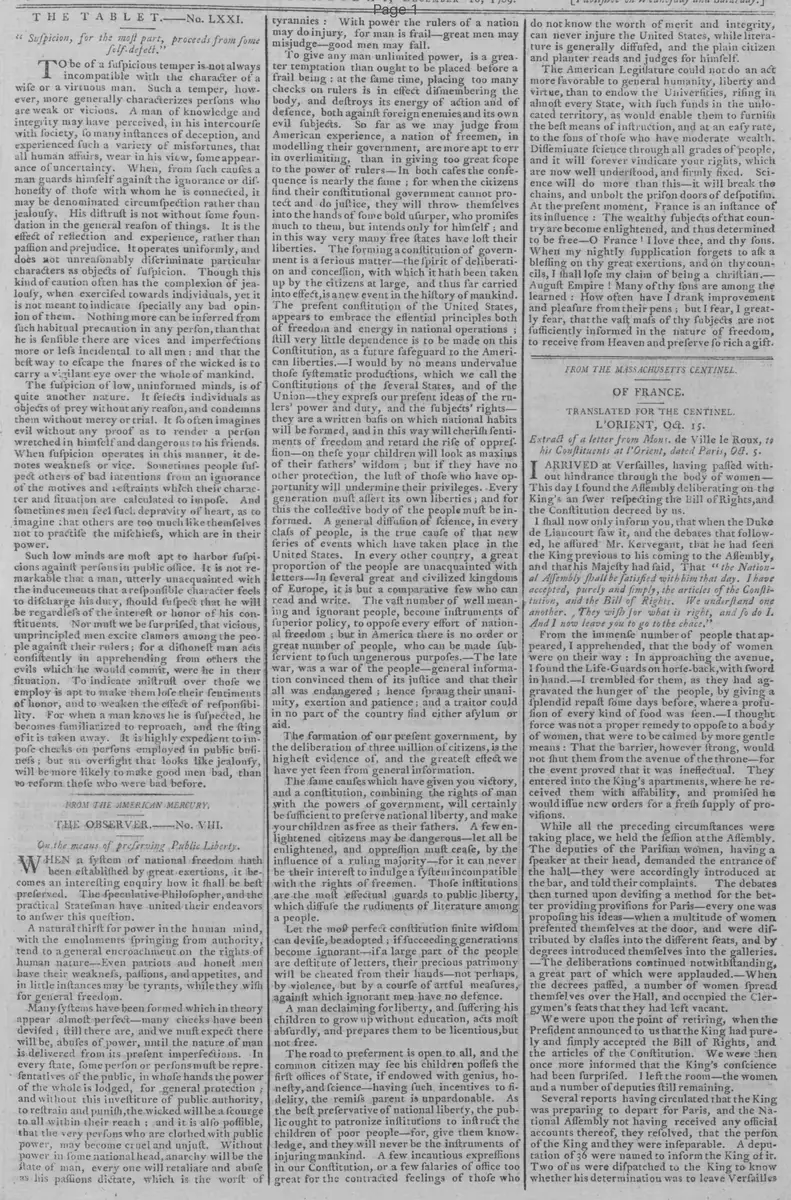
THE OBSERVER. No. VIII.
On the means of preserving Public Liberty.
When a system of national freedom hath been established by great exertions, it becomes an interesting enquiry how it shall be best preserved. The speculative Philosopher, and the practical Statesman have united their endeavors to answer this question.
A natural thirst for power in the human mind, with the emoluments springing from authority, tend to a general encroachment on the rights of human nature—Even patriots and honest men have their weaknesses, passions, and appetites, and in little instances may be tyrants, while they wish for general freedom.
Many systems have been formed which in theory appear almost perfect; many checks have been devised; till there are, and we must expect there will be, abuses of power, until the nature of man is delivered from its present imperfections. In every state, some person or persons must be representatives of the public, in whose hands the power of the whole is lodged, for general protection; and without this investiture of public authority, to restrain and punish, the wicked will be a scourge to all within their reach; and it is also possible, that the very persons who are clothed with public power, may become cruel and unjust. Without power in some national head, anarchy will be the state of man, every one will retaliate and abuse as his passions dictate, which is the worst of tyrannies: With power the rulers of a nation may do injury, for man is frail; great men may misjudge; good men may fall.
To give any man unlimited power, is a greater temptation than ought to be placed before a frail being: at the same time, placing too many checks on rulers is in effect dismembering the body, and destroys its energy of action and of defence, both against foreign enemies and its own evil subjects. So far as we may judge from American experience, a nation of freemen, in modelling their government, are more apt to err in overlimiting, than in giving too great scope to the power of rulers. In both cases the consequence is nearly the same; for when the citizens find their constitutional government cannot protect and do justice, they will throw themselves into the hands of some bold usurper, who promises much to them, but intends only for himself; and in this way very many free states have lost their liberties. The forming a constitution of government is a serious matter—the spirit of deliberation and concession, with which it hath been taken up by the citizens at large, and thus far carried into effect, is a new event in the history of mankind.
The present constitution of the United States, appears to embrace the essential principles both of freedom and energy in national operations; still very little dependence is to be made on this Constitution, as a future safeguard to the American liberties. I would by no means undervalue those systematic productions, which we call the Constitutions of the several States, and of the Union—they express our present ideas of the rulers' power and duty, and the subjects' rights—they are a written basis on which national habits will be formed, and in this way will cherish sentiments of freedom and retard the rise of oppression—on these your children will look as maxims of their fathers' wisdom; but if they have no other protection, the lust of those who have opportunity will undermine their privileges. Every generation must assert its own liberties; and for this the collective body of the people must be informed. A general diffusion of science, in every class of people, is the true cause of that new series of events which have taken place in the United States. In every other country, a great proportion of the people are unacquainted with letters—In several great and civilized kingdoms of Europe, it is but a comparative few who can read and write. The vast number of well meaning and ignorant people, become instruments of superior policy, to oppose every effort of national freedom; but in America there is no order or great number of people, who can be made subservient to such ungenerous purposes. The late war, was a war of the people—general information convinced them of its justice and that their all was endangered; hence sprang their unanimity, exertion and patience; and a traitor could in no part of the country find either asylum or aid.
The formation of our present government, by the deliberation of three million of citizens, is the highest evidence of, and the greatest effect we have yet seen from general information.
The same causes which have given you victory and a constitution, combining the rights of man with the powers of government, will certainly be sufficient to preserve national liberty, and make your children as free as their fathers. A few enlightened citizens may be dangerous—let all be enlightened, and oppression must cease, by the influence of a ruling majority—for it can never be their interest to indulge a system incompatible with the rights of freemen. Those institutions are the most effectual guards to public liberty, which diffuse the rudiments of literature among a people.
Let the most perfect constitution finite wisdom can devise, be adopted; succeeding generations become ignorant—if a large part of the people are destitute of letters, their precious patrimony will be cheated from their hands—not perhaps, by violence, but by a course of artful measures, against which ignorant men have no defence.
A man declaiming for liberty, and suffering his children to grow up without education, acts most absurdly, and prepares them to be licentious, but not free.
The road to preferment is open to all, and the common citizen may see his children possess the first offices of State, if endowed with genius, honesty, and science; having such incentives to fidelity, the remiss parent is unpardonable. As the best preservative of national liberty, the public ought to patronize institutions to instruct the children of poor people; for, give them knowledge, and they will never be the instruments of injuring mankind. A few incautious expressions in our Constitution, or a few salaries of office too great for the contracted feelings of those who do not know the worth of merit and integrity, can never injure the United States, while literature is generally diffused, and the plain citizen and planter reads and judges for himself.
The American Legislature could not do an act more favorable to general humanity, liberty and virtue, than to endow the Universities, rising in almost every State, with such funds in the unlocated territory, as would enable them to furnish the best means of instruction, and at an easy rate, to the sons of those who have moderate wealth.
Disseminate science through all grades of people, and it will forever vindicate your rights, which are now well understood, and firmly fixed. Science will do more than this—it will break the chains, and unbolt the prison doors of despotism.
At the present moment, France is an instance of its influence: The wealthy subjects of that country are become enlightened, and thus determined to be free—O France! I love thee, and thy sons. When my nightly supplication forgets to ask a blessing on thy great exertions, and on thy councils, I shall lose my claim of being a christian.—August Empire! Many of thy sons are among the learned: How often have I drank improvement and pleasure from their pens; but I fear, I greatly fear, that the vast mass of thy subjects are not sufficiently informed in the nature of freedom, to receive from Heaven and preserve so rich a gift.
What sub-type of article is it?
Education
Constitutional
Social Reform
What keywords are associated?
Public Liberty
Education
Constitution
General Information
National Freedom
Diffusion Of Science
American Enlightenment
What entities or persons were involved?
United States Constitution
American People
France
Editorial Details
Primary Topic
Means Of Preserving Public Liberty Through Education
Stance / Tone
Advocacy For Widespread Education To Safeguard Liberty
Key Figures
United States Constitution
American People
France
Key Arguments
Natural Thirst For Power Leads To Encroachments On Rights
Constitutions Provide Basis But Not Sufficient Safeguard Alone
General Diffusion Of Science And Education Is Essential For Preserving Liberty
Informed Citizenry Prevents Tyranny And Ensures Justice
American Revolution Succeeded Due To General Information
Education Opens Paths To Preferment And Fidelity
Public Should Patronize Institutions For Poor Children's Education
Enlightenment In France Exemplifies Science's Power Against Despotism