Thank you for visiting SNEWPapers!
Sign up free
The New Hampshire Gazette
Portsmouth, Rockingham County, New Hampshire
What is this article about?
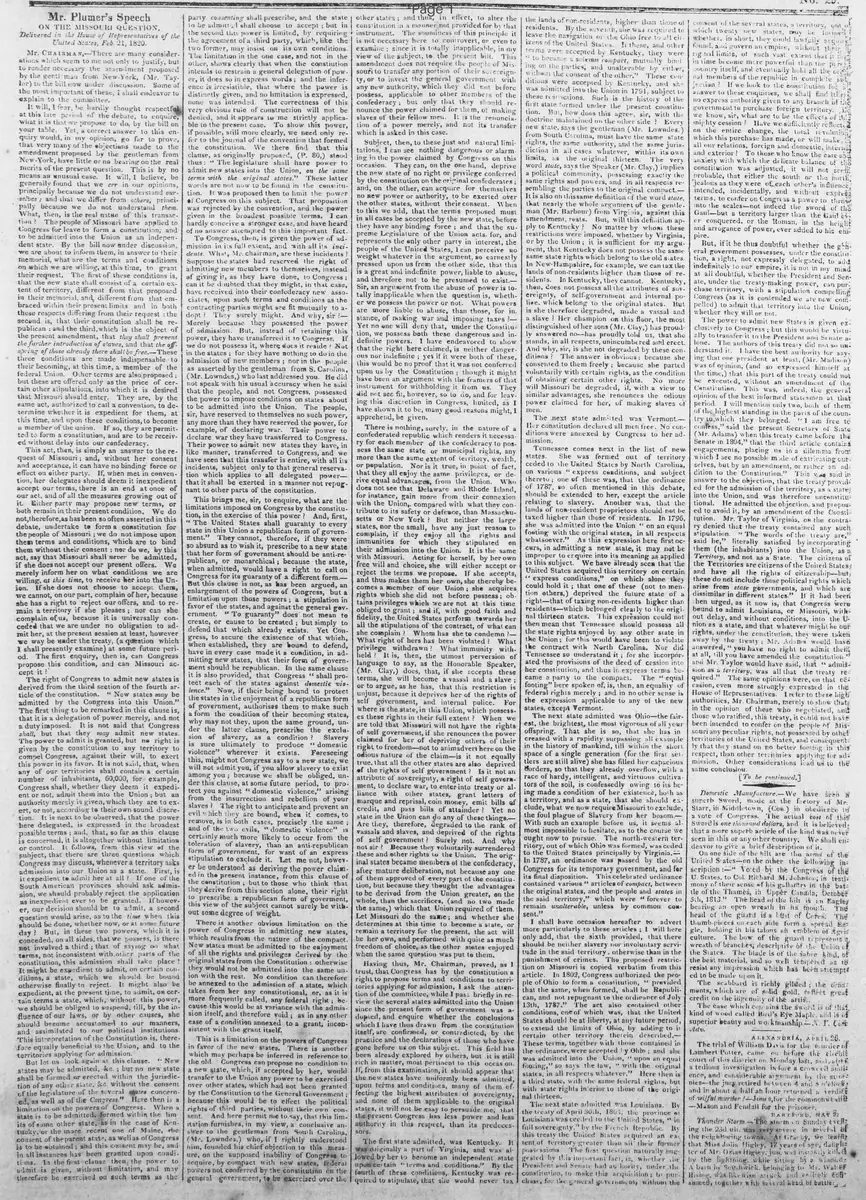
On February 21, 1820, a speaker in the U.S. House of Representatives delivered a speech supporting an amendment by Mr. Taylor of New York to the Missouri statehood bill, arguing Congress's constitutional authority to impose conditions like restricting slavery, reviewing historical precedents of conditional admissions.
Clipping
OCR Quality
Full Text
Delivered in the House of Representatives of the United States, Feb. 21, 1820.
Mr. CHAIRMAN,—There are many considerations which seem to me not only to justify, but to render necessary the amendment proposed by the gentleman from New-York, (Mr. Taylor) to the bill now under discussion. Some of the most important of these, I shall endeavor to explain to the committee.
It will, I fear, be hardly thought respectful at this late period of the debate, to enquire, what it is that we propose to do, by the bill on your table. Yet, a correct answer to this enquiry would, in my opinion, go far to prove, that very many of the objections made to the amendment proposed by the gentleman from New-York, have little or no bearing on the real merits of the present question. This is by no means an unusual case. It will, I believe, be generally found that we err in our opinions, principally because we do not understand ourselves; and that we differ from others, principally because we do not understand them.
What, then, is the real nature of this transaction? The people of Missouri have applied to Congress for leave to form a constitution, and to be admitted into the Union as an independent state. By the bill now under discussion, we are about to inform them, in answer to their memorial, what are the terms and conditions on which we are willing, at this time, to grant their request. The first of these conditions is, that the new state shall consist of a certain extent of territory, different from that proposed in their memorial, and different from that embraced within their present limits and in both these respects differing from their request: the second is, that their constitution shall be republican: and the third, which is the object of the present amendment, that they shall prevent the further introduction of slaves, and that the offspring of those already there shall be free.—These three conditions are made indispensable to their becoming, at this time, a member of the federal Union. Other terms are also proposed; but these are offered only as the price of certain other stipulations, into which it is desired that Missouri should enter. They are, by the same act, authorized to call a convention, to determine whether it is expedient for them, at this time, and upon these conditions, to become a member of the union. If so, they are permitted to form a constitution, and are to be received without delay into our confederacy.
This act, then, is simply an answer to the request of Missouri; and, without her consent and acceptance, it can have no binding force or effect on either party. If, when met in convention, her delegates should deem it inexpedient accept our terms, there is an end at once of our act, and of all the measures growing out of it. Either party may propose new terms, or both remain in their present condition. We do not, therefore, as has been so often asserted in this debate, undertake to form a constitution for the people of Missouri; we do not impose upon them terms and conditions, which are to bind them without their consent; nor do we, by this act, say that Missouri shall never be admitted, if she does not accept our present offers. We merely inform her on what conditions we are willing, at this time, to receive her into the Union. If she does not choose to accept them, we cannot, on our part, complain of her, because she has a right to reject our offers, and to remain a territory if she pleases; nor can she complain of us, because it is universally conceded that we are under no obligation to admit her, at the present session at least, however we may be under the treaty, (a question which I shall presently examine) at some future period. The first enquiry, then is, can Congress propose this condition, and can Missouri accept it?
The right of Congress to admit new states is derived from the third section of the fourth article of the constitution. "New states may be admitted by the Congress into this Union." The first thing to be remarked in this clause is, that it is a delegation of power merely, and not a duty imposed. It is not said that Congress shall, but that they may admit new states. The power to admit is granted, but no right is given by the constitution to any territory to compel Congress, against their will, to exert this power in its favor. It is not said, that, when any of our territories shall contain a certain number of inhabitants, 60,000, for example, Congress shall, whether they deem it expedient or not, admit them into the Union; but an authority merely is given, which they are to exert, or not, according to their own sound discretion. It is next to be observed, that the power here delegated, is expressed in the broadest possible terms; and, that, so far as this clause is concerned, it is altogether without limitation or control. It follows, from this view of the subject, that there are three questions which Congress may discuss, whenever a territory asks admission into our Union as a state. First, is it expedient to admit her at all? If one of the South American provinces should ask admission, we should probably reject the application as inexpedient ever to be granted. If however, our decision should be to admit, a second question would arise, as to the time when this should be done, whether now, or at some future day? But, in these two powers, which it is conceded, on all sides, that we possess, is there not involved a third; that of saying on what terms, not inconsistent with, other parts of the constitution, this admission shall take place? It might be expedient to admit, on certain conditions, a state, which we should be bound otherwise finally to reject. It might also be expedient, at the present time, to admit, on certain terms a state, which, without this power, we should be obliged to suspend, till, by the influence of our laws, or by other causes, she should become accustomed to our manners, and assimilated to our political institutions. This interpretation of the Constitution is, therefore equally beneficial to the Union, and to the territories applying for admission.
But let us look again at this clause. "New states may be admitted, &c.; but no new state shall be formed or erected within the jurisdiction of any other state, &c without the consent of the legislature of the several states concerned, as well as of the Congress." Here then is a limitation on the powers of Congress. When a state is to be admitted, formed within the limits of some other state, as in the case of Kentucky, or the more recent one of Maine, the consent of the parent state, as well as of Congress is to be obtained; and this consent may be, and in all instances has been granted upon conditions. In the first clause then the power to admit is given, without limitation, and may therefore be exercised on such terms as the party consenting shall prescribe, and the state to be admitted shall choose to accept; but in the second this power is limited, by requiring the agreement of a third party, which, like the two former, may insist on its own conditions. The limitation in the one case, and not in the other, shows clearly that when the constitution intends to restrain a general delegation of power, it does so in express words; and the inference is irresistible, that where the power is distinctly given, and no limitation is expressed, none was intended. The correctness of this very obvious rule of construction will not be denied, and it appears to me strictly applicable to the present case. To show this power, if possible, still more clearly, we need only refer to the journal of the convention that formed the constitution. We there find that this clause, as originally proposed, (P. 80,) stood thus: The legislature shall have power to admit new states into the Union, on the same terms with the original states." These latter words are not now to be found in the constitution. It was proposed then to limit the power of Congress on this subject. That proposition was rejected by the convention, and the power given in the broadest possible terms. I can hardly conceive a stronger case, and have heard of no answer attempted to this important fact.
To Congress, then, is given the power of admission in its full extent, and with all its incidents. What, Mr. chairman, are these incidents? Suppose the states had reserved the right of admitting new members to themselves, instead of giving it, as they have done, to Congress; can it be doubted that they might, in that case, have received into their confederacy new associates, upon such terms and conditions as the contracting parties might see fit mutually to adopt? They surely might. And why, sir?—Merely because they possessed the power of admission. But, instead of retaining this power, they have transferred it to Congress. If we do not possess it, where does it reside? Not in the states; for they have nothing to do in the admission of new members; nor in the people as asserted by the gentleman from S. Carolina, (Mr. Lowndes,) who last addressed you. He did not speak with his usual accuracy when he said that the people, and not Congress, possessed the power to impose conditions on states about to be admitted into the Union. The people, sir, have reserved to themselves no such power, any more than they have reserved the power, for example, of declaring war. Their power to declare war they have transferred to Congress. Their power to admit new states they have, in like manner, transferred to Congress, and we have seen that this transfer is entire, with all its incidents, subject only to that general reservation which applies to all delegated power—that it shall be exerted in a manner not repugnant to other parts of the constitution.
This brings me, sir, to enquire, what are the limitations imposed on Congress by the constitution, in the exercise of this power? And, first, "The United States shall guaranty to every state in this Union a republican form of government." They cannot, therefore, if they were so absurd as to wish it, prescribe to a new state that her form of government should be anti-republican, or monarchical; because the state, when admitted, would have a right to call on Congress for its guaranty of a different form. But this clause is not, as has been argued, an enlargement of the powers of Congress, but a limitation upon those powers; a stipulation in favor of the states, and against the general government. "To guaranty" does not mean to create, or cause to be created; but simply to defend that which already exists. Yet Congress, to secure the existence of that which, when established, they are bound to defend, have in every case made it a condition, in admitting new states, that their form of government should be republican. In the same clause it is also provided, that Congress "shall protect each of the states against domestic violence." Now, if their being bound to protect the states in the enjoyment of a republican form of government, authorises them to make such a form the condition of their becoming states, why may not they, upon the same ground, under the latter clause, prescribe the exclusion of slavery, as a condition? Slavery is sure ultimately to produce "domestic violence" wherever it exists. Foreseeing this, might not Congress say to a new state, we will not admit you, if you allow slavery to exist among you; because we shall be obliged, under this clause, at some future period, to protect you against "domestic violence," arising from the insurrection and rebellion of your slaves? The right to anticipate and prevent an evil which they are bound, when it comes, to remove, is in both cases, precisely the same; and of the two evils, "domestic violence" is certainly much more likely to occur from the toleration of slavery, than an anti-republican form of government, for want of an express stipulation to exclude it. Let me not, however, be understood as deriving the power claimed in the present instance, from this clause of the constitution; but to those who think that they derive from this section alone, their right to prescribe a republican form of government, this view of the subject cannot surely be without some degree of weight.
There is another obvious limitation on the power of Congress in admitting new states, which results from the nature of the compact. New states must be admitted to the enjoyment of all the rights and privileges derived by the original states from the Constitution: otherwise they would not be admitted into the same union with the rest. No condition can therefore be annexed to the admission of a state, which takes from her any constitutional, or, as it is more frequently called, any federal right; because this would be at variance with the admission itself, and therefore void; as in any other case of a condition annexed to a grant, inconsistent with the grant itself.
This is a limitation on the powers of Congress in favor of the new states. There is another which may perhaps be inferred in reference to the old. Congress can propose no condition to a new state, which, if accepted by her, would transfer to the Union any power to be exercised over other states, which had not been granted by the Constitution to the General Government; because this would be to effect the political rights of third parties, without their own consent. And here permit me to say, that this limitation furnishes, in my view, a conclusive answer to the gentleman from South Carolina, (Mr. Lowndes,) who, if I rightly understood him, founded his chief objection to this measure, on the supposed inability of Congress to acquire, by compact with new states, federal powers not conferred by the constitution on the general government, to be exercised over the other states; and thus, in effect, to alter the constitution in a manner not provided for by that instrument. The soundness of this principle it is not necessary here to controvert, or even to examine; since it is totally inapplicable, in my view of the subject, to the present bill. This amendment does not require the people of Missouri to transfer any portion of their sovereignty, or to invest the general government with any new authority, which they did not before possess, applicable to other members of the confederacy; but only that they should renounce the power claimed for them, of making slaves of their fellow men. It is the renunciation of a power merely, and not its transfer which is asked in this case.
Subject, then, to these just and natural limitations, I can see nothing dangerous or alarming in the power claimed by Congress on this occasion. They can, on the one hand, deprive the new state of no right or privilege conferred by the constitution on the original confederates; and, on the other, can acquire for themselves no new power or authority, to be exerted over the other states, without their consent. When to this we add, that the terms proposed must in all cases be accepted by the new state, before they have any binding force; and that the supreme Legislature of the Union acts, for, and represents the only other party in interest, the people of the United States, I can perceive no weight whatever in the argument, so earnestly pressed upon us from the other side, that this is a great and indefinite power, liable to abuse, and therefore not to be presumed to exist.—Sir, an argument from the abuse of power is totally inapplicable when the question is, whether we possess the power or not. What powers are more liable to abuse, than those, for instance, of making war and imposing taxes?—Yet no one will deny that, under the Constitution, we possess both these dangerous and indefinite powers. I have endeavored to show that the right here claimed, is neither dangerous nor indefinite; yet if it were both of these, this would be no proof that it was not conferred upon us by the Constitution; though it might have been an argument with the framers of that instrument for withholding it from us. They did not see fit, however, so to do, and for leaving this discretion in Congress, limited, as I have shown it to be, many good reasons might, I apprehend, be given.
There is nothing, surely, in the nature of a confederated republic which renders it necessary for each member of the confederacy to possess the same state or municipal rights, any more than the same extent of territory, wealth, or population. Nor is it true, in point of fact, that they all enjoy the same privileges, or derive equal advantages, from the Union. Who does not see that Delaware and Rhode Island, for instance, gain more from their connexion with the Union, compared with what they contribute to its safety or defence, than Massachusetts or New York? But neither the large states, nor the small, have any just reason to complain, if they enjoy all the rights and immunities for which they stipulated on their admission into the Union. It is the same with Missouri. Acting for herself, by her own free will and choice, she will either accept or reject the terms we propose. If she accepts, and thus makes them her own, she thereby becomes a member of our Union; she acquires rights which she did not before possess; obtains privileges which we are not at this time obliged to grant; and if, with good faith and fidelity, the United States perform towards her all the stipulations of the contract, of what can she complain? Whom has she to condemn?—What right of hers has been violated? What privilege withdrawn? What immunity withheld? It is, then, the utmost perversion of language to say, as the Honorable Speaker, (Mr. Clay,) does, that, if she accepts these terms, she will become a vassal and a slave; or to argue, as he has, that this restriction is unjust, because it deprives her of the rights of self government, and internal police. For where is the state, in this Union, which possesses these rights in their full extent? When we are told that Missouri will not have the rights of self government, if she renounces the power claimed for her of depriving others of their right to freedom—not to animadvert here on the odious nature of the claim—is it not equally true, that all the other states are also deprived of the rights of self government? Is it not an attribute of sovereignty, a right of self government, to declare war, to enter into treaty or alliance with other states, grant letters of marque and reprisal, coin money, emit bills of credit, and pass bills of attainder? Yet no state in the Union can do any of these things.—Are they, therefore, degraded to the rank of vassals and slaves, and deprived of the rights of self government? Surely not. And why not sir? "Because they voluntarily surrendered these and other rights to the Union. The original states became members of the confederacy, after mature deliberation, not because any one of them approved of every part of the constitution, but because they thought the advantages to be derived from the Union greater, on the whole, than the sacrifices, (and no two made the same,) which that Union required of them. Let Missouri do the same; and whether she determines at this time to become a state, or remain a territory for the present, the act will be her own, and performed with quite as much freedom of choice, as the other states enjoyed when the same question was put to them.
Having thus, Mr. Chairman, proved, as I trust, that Congress has by the constitution a right to propose terms and conditions to territories applying for admission, I ask the attention of the committee, while I pass briefly in review the several states admitted into the Union since the present form of government was adopted, and enquire whether the conclusions which I have thus drawn from the constitution itself, are confirmed, or contradicted, by the practice and the declarations of those who have gone before us on this subject. This field has been already explored by others, but it is still rich in matter, most pertinent to this occasion. If, from this examination, it should appear that the new states have uniformly been admitted, upon terms and conditions, many of them affecting the highest attributes of sovereignty, and none of them applicable to the original states, it will not be easy to persuade me, that the present Congress has less power and less authority in this respect, than its predecessors.
The first state admitted, was Kentucky. It was originally a part of Virginia, and was allowed by her to become an independent state upon certain "terms and conditions." By the fourth of these conditions, Kentucky was required to stipulate, that she would never tax the lands of non-residents, higher than those of residents. By the seventh, she was required to leave the navigation of the Ohio free to all citizens of the United States. In these, and other terms were accepted by Kentucky, they were "to become a solemn compact, mutually binding on the parties, and unalterable by either, without the consent of the other." These conditions were accepted by Kentucky, and she was admitted into the Union in 1791, subject to these restrictions. Such is the history of the first state formed under the present constitution. But, how does this agree, sir, with the doctrine maintained on the other side? Every new state, says the gentleman (Mr. Lowndes,) from South Carolina, must have the same state rights, the same authority, and the same jurisdiction in all cases whatever, within its own limits, as the original thirteen. The very word state, says the Speaker (Mr. Clay,) implies a political community, possessing exactly the same rights and powers, and in all respects resembling the parties to the original compact.—It is also on this same definition of the word state, that nearly the whole argument of the gentleman (Mr. Barbour) from Virginia, against this amendment, rests. "But, will this definition apply to Kentucky? No matter by whom these restrictions were imposed, whether by Virginia, or by the Union; it is sufficient for my argument, that Kentucky does not possess the same state rights which belong to the old states. In New-Hampshire, for example, we can tax the lands of non-residents higher than those of residents. In Kentucky, they cannot. Kentucky, then, does not possess all the attributes of sovereignty, of self-government and internal police, which belong to the original states. But is she therefore degraded, made a vassal and a slave? Her champion on this floor, the most distinguished of her sons (Mr. Clay,) has proudly answered no—has proudly told us, that she stands, in all respects, unencumbered and erect. And why, sir, is she not degraded by these conditions? The answer is obvious: because she consented to them freely; because she parted voluntarily with certain rights, as the condition of obtaining certain other rights. No more will Missouri be degraded, if, with a view to similar advantages, she renounces the odious power claimed for her, of making slaves of her fellow men.
The next state admitted was Vermont.—Her constitution declared all men free. No conditions were annexed by Congress to her admission.
Tennessee comes next in the list of new states. She was formed out of territory ceded to the United States by North Carolina, on various "express conditions, and subject thereto; one of these was, that the ordinance of 1787, so often mentioned in this debate, should be extended to her, except the article relating to slavery. Another was, that the lands of non-resident proprietors should not be taxed higher than those of residents. In 1796, she was admitted into the Union "on an equal footing with the original states, in all respects whatsoever." As this expression here first occurs, in admitting a new state, it may not be improper to enquire into its meaning as applied to this subject. We have already seen that the United States acquired this territory on certain "express conditions," on which alone they could hold it; that one of these (not to mention others,) deprived the future state of a right—that of taxing non-residents higher than residents—which belonged clearly to the original thirteen states. This expression could not then mean that Tennessee should possess all the state rights enjoyed by any other state in the Union; for this would have been to violate the contract with North Carolina. Nor did Tennessee so understand it; for she incorporated the provisions of the deed of cession into her constitution, and thus in express terms became a party to the compact. The "equal footing" here spoken of, is, then, an equality of federal rights merely: and in no other sense is the expression applicable to any of the new states, except Vermont.
The next state admitted was Ohio—the fairest, the brightest, the most vigorous of all your offspring. That she is so, that she has increased with a rapidity surpassing all example in the history of mankind, till within the short space of a single generation (for the first settlers are still alive) she has filled her capacious borders, so that they already overflow, with a race of hardy, intelligent, and virtuous cultivators of the soil, is confessedly owing to its being made a condition of her existence, both as a territory, and as a state, that she should exclude, what we now require Missouri to exclude, the foul plague of Slavery from her bosom.—With such an example before us, it seems almost impossible to hesitate, as to the course we ought now to pursue. The north-western territory, out of which Ohio was formed, was ceded to the United States principally by Virginia.—In 1787, an ordinance was passed by the old Congress for its temporary government. and for its final disposition. This celebrated ordinance contained various "articles of compact, between the original states, and the people and states in the said territory," which were "forever to remain unalterable, unless by common consent." I shall have occasion hereafter to advert more particularly to these articles; I will here only add, that the sixth provided, that there should be neither slavery nor involuntary servitude in the said territory, otherwise than in the punishment of crimes. The proposed restriction on Missouri is copied verbatim from this article. In 1802, Congress authorized the people of Ohio to form a constitution, "provided that the same, when formed, shall be Republican, and not repugnant to the ordinance of July 13th, 1787," The act also contained other conditions, one of which was, that the United States should be at liberty, at any future period, to extend the limits of Ohio, by adding to it certain other territory therein described.—These terms, together with those contained in the ordinance, were accepted by Ohio; and she was admitted into the Union, "upon an equal footing," so says the law, "with the original states, in all respects whatever." Here then is a third state, with the same federal rights, but with state rights inferior to those of the original thirteen.
The next state admitted was Louisiana. By the treaty of April 30th, 1803, the province of Louisiana was ceded to the United States, "in full sovereignty," by the French Republic. By this treaty the United States acquired an extent of territory greater than all their former possessions The first question naturally suggested by this important fact, is, whether the President and Senate had authority, under the constitution, to make this acquisition; to purchase, for the general government, without the consent of the several states, a territory, out of which twenty new states, may be formed whether, in short, they could lawfully acquire, found, and govern an empire, without their original limits, of such vast extent that it might in time become more powerful than the parent country itself, and eventually hold all the original members of the republic in complete subjection? If we look to the constitution for an answer to these enquiries, we shall find there no express authority given to any branch of the government to purchase foreign territory. we know, sir, what are to be the effects of this mighty cession? Have we sufficiently reflected on the entire change, the total revolution, which this purchase has made, or will make, in all our relations, foreign and domestic, internal and exterior? To those who know the care and anxiety with which the delicate balance of the constitution was adjusted, it will not seem probable, that either the south or the north jealous as they were of each other's influence intended, incidentally, and without express terms, to confer on Congress a power to throw into the scales—not indeed the sword of the Gaul—but a territory larger than the Gaul ever conquered. or the Roman, in the height and arrogance of power, ever added to his empire.
But, if it be thus doubtful whether the general government possesses, under the constitution, a right, not expressly delegated, to add indefinitely to our empire, it is not in my mind at all doubtful, whether the President and Senate, under the treaty-making power, can purchase territory, with a stipulation compelling Congress (as it is contended we are now compelled) to admit that territory into the Union, whether they will or not. The power to admit new States is given exclusively to Congress; but this would be virtually to transfer it to the President and Senate alone. The authors of this treaty did not so understand it. I have the best authority for saying that one president at least, (Mr. Madison) was of opinion, (and so expressed himself at the time,) that this part of the treaty could not be executed, without an amendment of the Constitution. This was, indeed, the general opinion of the best informed statesmen at that period. I will mention only two, both of them of the highest standing in the parts of the country to which they belonged. "I am free to confess," said the present Secretary of State (Mr. Adams) when this treaty came before the Senate in 1803," that the third article contains engagements, placing us in a dilemma from which I see no possible mode of extricating ourselves, but by an amendment, or rather an addition to the Constitution." This was said in answer to the objection, that the treaty provided for the admission of the territory, as a state into the Union, and was therefore unconstitutional. He admitted the objection, and proposed to avoid it, by an amendment of the Constitution. Mr. Taylor of Virginia, on the contrary denied that the treaty contained any such stipulation. "The words of the treaty are," said he," literally satisfied by incorporating them (the inhabitants) into the Union, as a Territory, and not as a State. The citizens of the Territories are citizens of the United States and have all the rights of citizenship—but, these do not include those political rights which arise from state governments, and which are dissimilar in different states." If it had been then urged, as it now is, that Congress were bound to admit Louisiana, or Missouri, without delay, and without conditions, into the Union as a state, and that whatever might be our rights, under the constitution, they were taken away by the treaty; Mr. Adams would have answered, "you have no right to admit them at all, till you have amended the constitution." and Mr. Taylor would have said, that "admission as a territory, was all that the treaty required." The same opinions were, on that occasion, even more strongly expressed in the House of Representatives. I refer to these high authorities, Mr. Chairman, merely to show that, in the opinion of those who negotiated, and those who ratified, this treaty, it could not have been intended to confer on the people of Missouri any peculiar rights, not possessed by other territories of the United States, and consequently that they stand on no better footing in this respect, than other territories applying for admission. Other considerations lead us to the same conclusion.
To be continued.
What sub-type of article is it?
What keywords are associated?
What entities or persons were involved?
Where did it happen?
Domestic News Details
Primary Location
House Of Representatives Of The United States
Event Date
Feb. 21, 1820
Key Persons
Event Details
A speech defending the amendment proposed by Mr. Taylor to restrict slavery in Missouri's statehood application, arguing Congress's constitutional power to impose conditions on new states' admission, reviewing historical precedents like Kentucky, Vermont, Tennessee, Ohio, and Louisiana, and refuting opponents' claims.