Thank you for visiting SNEWPapers!
Sign up free
Story
April 18, 1868
The Weekly Caucasian
Lexington, Lafayette County, Missouri
What is this article about?
Edward De Leon reveals in a letter that Sir Henry De Houghton donated over £200,000 to the Confederacy and held a large share of the fraudulent cotton loan, which benefited agents more than the treasury but offered temporary support to the Southern cause.
Clipping
OCR Quality
95%
Excellent
Full Text
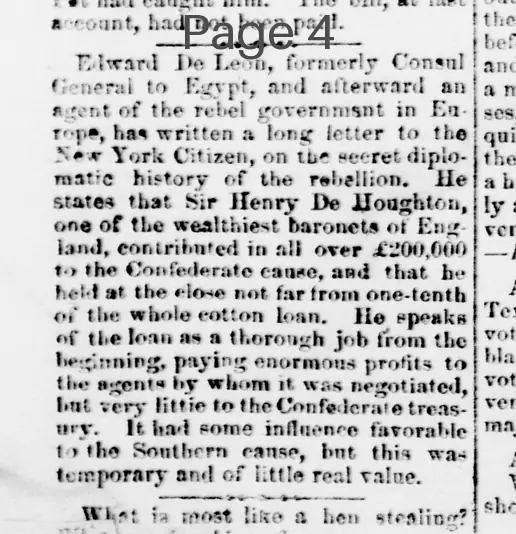
Edward De Leon, formerly Consul General to Egypt, and afterward an agent of the rebel government in Europe, has written a long letter to the New York Citizen, on the secret diplomatic history of the rebellion. He states that Sir Henry De Houghton, one of the wealthiest baronets of England, contributed in all over £200,000 to the Confederate cause, and that he held at the close not far from one-tenth of the whole cotton loan. He speaks of the loan as a thorough job from the beginning, paying enormous profits to the agents by whom it was negotiated, but very little to the Confederate treasury. It had some influence favorable to the Southern cause, but this was temporary and of little real value.
What sub-type of article is it?
Historical Event
Deception Fraud
What themes does it cover?
Deception
Crime Punishment
What keywords are associated?
Confederate Cause
Cotton Loan
Sir Henry De Houghton
Edward De Leon
Rebel Government
Diplomatic History
What entities or persons were involved?
Edward De Leon
Sir Henry De Houghton
Story Details
Key Persons
Edward De Leon
Sir Henry De Houghton
Story Details
Edward De Leon writes about secret diplomatic history of the rebellion, stating Sir Henry De Houghton contributed over £200,000 to the Confederate cause and held nearly one-tenth of the cotton loan, which was a fraudulent scheme profiting agents more than the treasury but providing temporary favorable influence.