Thank you for visiting SNEWPapers!
Sign up free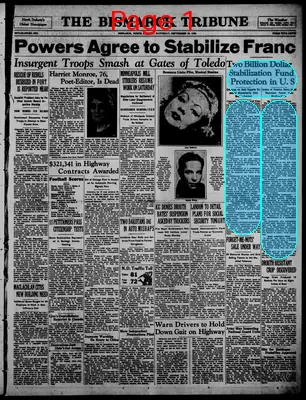
The Bismarck Tribune
Bismarck, Mandan, Burleigh County, Morton County, North Dakota
What is this article about?
France prepares to devalue the franc by 24-33%, impose gold export embargo, and establish a 10 billion franc stabilization fund amid financial crisis. Collaboration with US and UK announced; Russian actions depress pound; reactions from other European nations.
Clipping
OCR Quality
Full Text
Embargo on Gold Exports Expected Momentarily from Action of Russian State Bank Depresses Pound from Blum's Cabinet $5.02 to $4.91
(Copyright, 1936, by Associated Press)
Paris, Sept. 26.--Financially-harassed France, allied with Great Britain and the United States in a "monetary equilibrium" program, looked ahead Friday to a formal embargo on gold exports preliminary to proposed devaluation of the franc.
Members of Premier Leon Blum's cabinet and the governing board of the Bank of France labored to prepare measures for submission to a special session of parliament today.
The proposed statutes, an official announcement declared, would reduce "approximately one-third" the franc's gold content.
The bourse-stock market-was closed "for several days" as details of the suggested monetary revision were worked out. Informed quarters expected the gold embargo, which must bear approval of the governor of the Bank of France, would be proclaimed formally Friday to halt the flow of gold from the country.
Would Reduce Gold Content
Prospective parliamentary action would be directed toward two specific projects:
1. Reduction of the gold content of the franc, now 65.5 milligrams, to between 49 and 43 milligrams, a percentage devaluation of between 24 and 33 per cent.
2. Establishment of a stabilization fund of 10,000,000,000 francs to maintain the proposed new value of the franc.
Collaboration of the United States and Great Britain was announced after a series of official conferences in Paris which brought rapid-fire developments in the financial crisis.
The accord was termed "a declaration of an economic and monetary entente of three democracies" by Vincent Auriol, minister of finance in Socialist Premier Blum's cabinet.
Additional proposals in the French plan--besides devaluation, establishment of the stabilisation fund, and the gold embargo--included these:
Postpone Gold Payments
Postponement of payments by debtors who owe sums which were scheduled to be paid in gold or foreign currencies.
Financial assistance to aid French political subdivisions, individuals and corporations which might suffer losses through reduction in the value of the franc.
Devaluation advocates characterized the "monetary equilibrium" accord of the three-power agreement as a boon to France, whose foreign trade has suffered in competition with other countries whose currency is of less value.
The $3,000,000,000 American stabilization fund was immediately brought into play Saturday to protect the dollar in the world exchange markets, as France, after an understanding with England and the United States moved to devalue its currency.
Secretary Morgenthau revealed in Washington that although foreign exchange dealings were virtually at a standstill, the Russian State bank had moved to depress the British pound by offering 1,000,000 pounds "at any price."
Morgenthau said he immediately bought the sterling, but this was not until in unofficial trading in New York the pound had dropped to $4.91 from Friday's close of $5.02. Wall Street exchange quarters said they had no knowledge of the reasons for the Russian move. The pound quickly rallied to around $4.96.
British Pound Important
Wall Street exchange circles said American authorities were much more interested in the level of the pound, in terms of the dollar, than in any other foreign currency, since declines in the pound have tended to depress American prices.
Securities prices in the New York stock exchange-the major world market open-trended upward, however, as Wall Street experts hailed the French move as constructive and London bankers looked for revival of world trade. In Amsterdam, the stock exchange was quiet, with American issues in demand.
The decision to devalue the franc appeared virtually to have ended the European gold bloc, that group of nations maintaining currencies at pre-depression levels, but the Netherlands authorities indicated that they would continue to maintain the parity of their currency.
Swiss Summon Parliament
In Switzerland, third member of the gold bloc, however, parliament was summoned to convene at the same time the French chamber meets to bring the Swiss franc into line with the devalued French franc.
The French government proposed a plan of devaluation similar to that adopted by the United States three years ago, involving seizure of all gold in the country at its present value, and establishment of a stabilisation fund.
The devaluation plan immediately provoked some opposition from both right and left political circles in France. In Washington and London the American and British treasuries had arranged in advance to cooperate with France to restore world equilibrium.
Reich Authorities Silent
In Berlin, the Reich authorities watched closely but failed to indicate what steps they would take.
In Rome, opinion was divided but some experts thought the lira would be devalued along with the French currency.
Belgium gave its full approval of the plan. Polish authorities announced they stood ready to cooperate, but would not devalue.
What sub-type of article is it?
What keywords are associated?
What entities or persons were involved?
Where did it happen?
Foreign News Details
Primary Location
Paris
Event Date
Sept. 26, 1936
Key Persons
Outcome
devaluation of franc by 24-33% (gold content from 65.5 to 49-43 milligrams); establishment of 10,000,000,000 franc stabilization fund; gold export embargo; postponement of gold payments; financial assistance for losses; international cooperation with us and uk; pound drops to $4.91 then rallies to $4.96.
Event Details
Financially-harassed France, allied with Great Britain and United States in monetary equilibrium program, prepares formal embargo on gold exports and devaluation of franc. Premier Blum's cabinet and Bank of France board work on measures for parliament: reduce franc's gold content by approx. one-third, establish stabilization fund. Bourse closed. US $3B fund protects dollar; Russian State Bank depresses pound. Three-power economic entente declared. Additional proposals: postpone gold payments, aid for franc devaluation losses. Ends European gold bloc; Switzerland to align, Netherlands maintains parity. Opposition in France; approval from Belgium, Poland; silence from Germany; possible Italian devaluation.