Thank you for visiting SNEWPapers!
Sign up free
Literary
December 3, 1847
Carroll Free Press
Carrollton, Carroll County, Ohio
What is this article about?
A satirical short story about a cunning lawyer, S—, who, after joining the church, uses deceitful schemes to force wealthy parishioners to buy pews and pay off the church's massive debt, exposing his hypocritical nature unchanged by religion.
Merged-components note: These three components form the complete short story 'DYED IN THE WOOL.' by John Jones, Jr., continued across columns in reading order.
Clipping
OCR Quality
95%
Excellent
Full Text
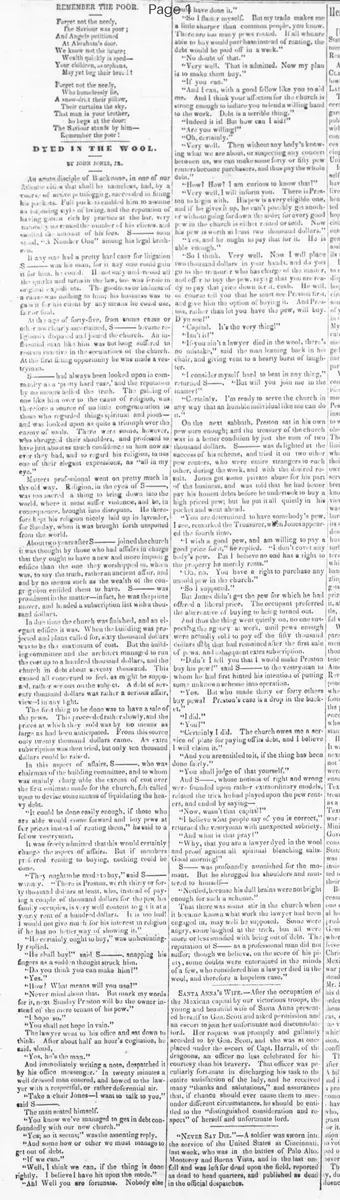
DYED IN THE WOOL.
BY JOHN JONES, JR.
An astute disciple of Blackstone, in one of our Atlantic cities that shall be nameless, had, by a course of active pettifogging, succeeded in filling his pockets. Flush of pelf, he was enabled to assume an imposing style of living, and the reputation of having gotten rich by practice at the bar, very naturally increased the number of his clients, and swelled the amount of his fees. Soon he stood, "A Number One" among his legal brethren.
If any one had a pretty hard case for litigation—he was his man, for any one could gain it for him, he could. He not only understood all the quirks and turns in the law, but was fertile in original expedients. The goodness or badness of a case was nothing to him; his business was to gain it for his client by any means he could use, fair or foul.
At the age of forty-five, from some cause or other not clearly ascertained, S— became religiously disposed and joined the church. An influential man like him was not long suffered to remain inactive in the secularities of the church. At the first fitting opportunity he was made a vestryman.
S— had always been looked upon in community as a 'pretty hard case,' and the reputation by no means belied the truth. The gaining of one like him over to the cause of religion, was therefore a source of no little congratulation to those who regarded things spiritual and pious—and was looked upon as quite a triumph over the enemy of souls. There were some, however, who shrugged their shoulders, and professed to have just about as much confidence in him now as ever they had, and to regard his religion, to use one of their elegant expressions, as "all in my eye."
Matters professional went on pretty much in the old way. Religion, in the eyes of S—, was too sacred a thing to bring down into the world, where it must suffer violence, and be, in consequence, brought into disrepute. He therefore kept his religion nicely laid up in lavender, for Sunday, when it was brought forth unspotted from the world.
About two years after S— joined the church, it was thought by those who had affairs in charge that they ought to have a new and more imposing edifice than the one they worshipped in, which was, to say the truth, rather an ancient affair, and by no means such as the wealth of the congregation entitled them to have. S— was prominent in the matter—in fact, he was the prime mover, and headed a subscription list with a thousand dollars.
In due time the church was finished, and an elegant edifice it was. When the building was projected and plans called for, sixty thousand dollars was to be the maximum of cost. But the building committee and the architect managed to run the cost up to a hundred thousand dollars, and the church in debt about seventy thousand. This caused all concerned to feel, as might be supposed, rather serious on the subject. A debt of seventy thousand dollars was rather a serious affair, viewed in any light.
The first thing to be done was to have a sale of the pews. This proceeded rather slowly, and the prices at which they sold was by no means as large as had been anticipated. From this source only twenty thousand dollars came. An extra subscription was then tried, but only ten thousand dollars could be raised.
In this aspect of affairs, S—, who was chairman of the building committee, and to whom was mainly chargeable the excess of cost over the first estimates made for the church, felt called upon to devise some means of liquidating the heavy debt.
"It could be done easily enough, if those who are able would come forward and buy pews at fair prices instead of renting them," he said to a fellow vestryman.
It was freely admitted that this would certainly change the aspect of affairs. But if members preferred renting to buying, nothing could be done.
"They ought to be made to buy," said S— warmly. "There is Preston, worth thirty or forty thousand dollars at least, who, instead of paying a couple of thousand dollars for the pew his family occupies, is very well content to get it at a yearly rent of a hundred dollars. It is too bad! I would not give much for his interest in religion if he has no better way of showing it."
"He certainly ought to buy," was unhesitatingly replied.
"He shall buy!" said S—, snapping his fingers as a sudden thought struck him.
"Do you think you can make him?"
"Yes."
"How? What means will you use?"
"Never mind about that. But mark my words, for it, next Sunday Preston will be the owner instead of the mere tenant of his pew."
"I hope so."
"You shall not hope in vain."
The lawyer went to his office and sat down to think. After about half an hour's cogitation, he said, aloud,
"Yes, he's the man."
And immediately writing a note, despatched it by his office messenger. In twenty minutes a well dressed man entered, and bowed to the lawyer with a respectful, or rather deferential air.
"Take a chair Jones—I want to talk to you," said S—.
The man seated himself.
"You know we've managed to get in debt confoundedly with our new church."
"Yes; so it seems;" was the assenting reply.
"And some how or other we must manage to get out of debt."
"If we can."
"Well, I think we can, if the thing is done rightly. I believe I have hit upon the mode."
"Ah! Well you are fortunate. Nobody else
"So I flatter myself. But my trade makes me a little sharper than common people, you know. There are too many pews rented. If all who are able to buy would purchase instead of renting, the debt would be paid off in a week."
"No doubt of that."
"Very well. That is admitted. Now my plan is to make them buy."
"If you can."
"And I can, with a good fellow like you to aid me. And I think your affection for the church is strong enough to induce you to lend a willing hand to the work. Debt is a terrible thing."
"Indeed it is! But how can I aid?"
"Are you willing!"
"Oh, certainly."
"Very well. Then without anybody's knowing what we are about, or suspecting any concert between us, we can make some forty or fifty pew renters become purchasers, and thus pay the whole debt."
"How? How? I am curious to know that?"
"Very well. I will inform you. There is Preston to begin with. His pew is a very eligible one, and if he gives it up, he can't possibly get another without going far down the aisle; for every good pew in the church is either rented or sold. Now his pew is worth at least two thousand dollars."
"Yes, and he ought to pay that for it. He is able enough."
"So I think. Very well. Now I will place two thousand dollars in your hands, and do you go to the treasurer who has charge of the matter, and offer to buy the pew, saying that you are ready to pay that price down for it, cash. He will, of course tell you that he must see Preston first and give him the option of buying it. And Preston, rather than let you have the pew, will buy. Do ye see?"
"Capital. It's the very thing!"
"Isn't it!"
"If you ain't a lawyer dyed in the wool, there's no mistake," said the man leaning back in his chair, and giving vent to a hearty burst of laughter.
"I consider myself hard to beat in any thing," returned S—.
"But will you join me in the matter!"
"Certainly. I'm ready to serve the church in any way that an humble individual like me can do it."
On the next sabbath, Preston sat in his own pew sure enough; and the treasury of the church was in a better condition by just the sum of two thousand dollars.
S— was delighted at the success of his scheme, and tried it on two other pew renters, who were entire strangers to each other, during the week, and with the desired result. Jones got some private abuse for his part of the business, and was told that he had better pay his honest debts before he undertook to buy a high priced pew; but he put it all quietly in his pocket and went ahead.
"You are determined to have somebody's pew, I see," remarked the Treasurer, when Jones appeared the fourth time.
"I wish a good pew, and am willing to pay a good price for it," he replied. "I don't covet anybody's pew. But I believe no one has a right to the property he merely rents."
"Oh, no. You have a right to purchase any unsold pew in the church."
"So I supposed."
But Jones didn't get the pew for which he had offered a liberal price. The occupant preferred the alternative of buying to being turned out.
And thus the thing went quietly on, no one suspecting the agency at work, until pews enough were actually sold to pay off the fifty thousand dollars debt that had remained after the first sale of pews, and subsequent extra subscription.
"Didn't I tell you that I would make Preston buy his pew?" said S— to the vestryman to whom he had first hinted his intention of putting some unknown scheme into operation.
"Yes. But who made thirty or forty others buy pews? Preston's case is a drop in the bucket."
"I did."
"You?"
"Certainly I did. The church owes me a service of plate for paying off its debt, and I believe I will claim it."
"And you are entitled to it, if the thing has been done fairly."
"You shall judge of that yourself,"
And S—, whose notions of right and wrong were founded upon rather extraordinary models, related the trick he had played upon the pew renters, and ended by saying—
"Now, wasn't that capital?"
"I believe what people say of you is correct," returned the vestryman with unexpected sobriety.
"And what is that pray!"
"Why, that you are a lawyer dyed in the wool and proof against all spiritual bleachingsalts.
Good morning!"
S— was profoundly astonished for the moment. But he shrugged his shoulders and muttered to himself—
"Jealous, because his dull brains were not bright enough for such a scheme."
That there was some stir in the church when it became known what work the lawyer had been engaged in, may well be supposed. Some were angry, some laughed at the trick, but all were more or less satisfied with being out of debt. The reputation of S— as a professional man did not suffer; though we believe, on the score of his piety, some doubts were entertained in the minds of a few, who considered him a lawyer dyed in the wool, and therefore a hopeless case.
BY JOHN JONES, JR.
An astute disciple of Blackstone, in one of our Atlantic cities that shall be nameless, had, by a course of active pettifogging, succeeded in filling his pockets. Flush of pelf, he was enabled to assume an imposing style of living, and the reputation of having gotten rich by practice at the bar, very naturally increased the number of his clients, and swelled the amount of his fees. Soon he stood, "A Number One" among his legal brethren.
If any one had a pretty hard case for litigation—he was his man, for any one could gain it for him, he could. He not only understood all the quirks and turns in the law, but was fertile in original expedients. The goodness or badness of a case was nothing to him; his business was to gain it for his client by any means he could use, fair or foul.
At the age of forty-five, from some cause or other not clearly ascertained, S— became religiously disposed and joined the church. An influential man like him was not long suffered to remain inactive in the secularities of the church. At the first fitting opportunity he was made a vestryman.
S— had always been looked upon in community as a 'pretty hard case,' and the reputation by no means belied the truth. The gaining of one like him over to the cause of religion, was therefore a source of no little congratulation to those who regarded things spiritual and pious—and was looked upon as quite a triumph over the enemy of souls. There were some, however, who shrugged their shoulders, and professed to have just about as much confidence in him now as ever they had, and to regard his religion, to use one of their elegant expressions, as "all in my eye."
Matters professional went on pretty much in the old way. Religion, in the eyes of S—, was too sacred a thing to bring down into the world, where it must suffer violence, and be, in consequence, brought into disrepute. He therefore kept his religion nicely laid up in lavender, for Sunday, when it was brought forth unspotted from the world.
About two years after S— joined the church, it was thought by those who had affairs in charge that they ought to have a new and more imposing edifice than the one they worshipped in, which was, to say the truth, rather an ancient affair, and by no means such as the wealth of the congregation entitled them to have. S— was prominent in the matter—in fact, he was the prime mover, and headed a subscription list with a thousand dollars.
In due time the church was finished, and an elegant edifice it was. When the building was projected and plans called for, sixty thousand dollars was to be the maximum of cost. But the building committee and the architect managed to run the cost up to a hundred thousand dollars, and the church in debt about seventy thousand. This caused all concerned to feel, as might be supposed, rather serious on the subject. A debt of seventy thousand dollars was rather a serious affair, viewed in any light.
The first thing to be done was to have a sale of the pews. This proceeded rather slowly, and the prices at which they sold was by no means as large as had been anticipated. From this source only twenty thousand dollars came. An extra subscription was then tried, but only ten thousand dollars could be raised.
In this aspect of affairs, S—, who was chairman of the building committee, and to whom was mainly chargeable the excess of cost over the first estimates made for the church, felt called upon to devise some means of liquidating the heavy debt.
"It could be done easily enough, if those who are able would come forward and buy pews at fair prices instead of renting them," he said to a fellow vestryman.
It was freely admitted that this would certainly change the aspect of affairs. But if members preferred renting to buying, nothing could be done.
"They ought to be made to buy," said S— warmly. "There is Preston, worth thirty or forty thousand dollars at least, who, instead of paying a couple of thousand dollars for the pew his family occupies, is very well content to get it at a yearly rent of a hundred dollars. It is too bad! I would not give much for his interest in religion if he has no better way of showing it."
"He certainly ought to buy," was unhesitatingly replied.
"He shall buy!" said S—, snapping his fingers as a sudden thought struck him.
"Do you think you can make him?"
"Yes."
"How? What means will you use?"
"Never mind about that. But mark my words, for it, next Sunday Preston will be the owner instead of the mere tenant of his pew."
"I hope so."
"You shall not hope in vain."
The lawyer went to his office and sat down to think. After about half an hour's cogitation, he said, aloud,
"Yes, he's the man."
And immediately writing a note, despatched it by his office messenger. In twenty minutes a well dressed man entered, and bowed to the lawyer with a respectful, or rather deferential air.
"Take a chair Jones—I want to talk to you," said S—.
The man seated himself.
"You know we've managed to get in debt confoundedly with our new church."
"Yes; so it seems;" was the assenting reply.
"And some how or other we must manage to get out of debt."
"If we can."
"Well, I think we can, if the thing is done rightly. I believe I have hit upon the mode."
"Ah! Well you are fortunate. Nobody else
"So I flatter myself. But my trade makes me a little sharper than common people, you know. There are too many pews rented. If all who are able to buy would purchase instead of renting, the debt would be paid off in a week."
"No doubt of that."
"Very well. That is admitted. Now my plan is to make them buy."
"If you can."
"And I can, with a good fellow like you to aid me. And I think your affection for the church is strong enough to induce you to lend a willing hand to the work. Debt is a terrible thing."
"Indeed it is! But how can I aid?"
"Are you willing!"
"Oh, certainly."
"Very well. Then without anybody's knowing what we are about, or suspecting any concert between us, we can make some forty or fifty pew renters become purchasers, and thus pay the whole debt."
"How? How? I am curious to know that?"
"Very well. I will inform you. There is Preston to begin with. His pew is a very eligible one, and if he gives it up, he can't possibly get another without going far down the aisle; for every good pew in the church is either rented or sold. Now his pew is worth at least two thousand dollars."
"Yes, and he ought to pay that for it. He is able enough."
"So I think. Very well. Now I will place two thousand dollars in your hands, and do you go to the treasurer who has charge of the matter, and offer to buy the pew, saying that you are ready to pay that price down for it, cash. He will, of course tell you that he must see Preston first and give him the option of buying it. And Preston, rather than let you have the pew, will buy. Do ye see?"
"Capital. It's the very thing!"
"Isn't it!"
"If you ain't a lawyer dyed in the wool, there's no mistake," said the man leaning back in his chair, and giving vent to a hearty burst of laughter.
"I consider myself hard to beat in any thing," returned S—.
"But will you join me in the matter!"
"Certainly. I'm ready to serve the church in any way that an humble individual like me can do it."
On the next sabbath, Preston sat in his own pew sure enough; and the treasury of the church was in a better condition by just the sum of two thousand dollars.
S— was delighted at the success of his scheme, and tried it on two other pew renters, who were entire strangers to each other, during the week, and with the desired result. Jones got some private abuse for his part of the business, and was told that he had better pay his honest debts before he undertook to buy a high priced pew; but he put it all quietly in his pocket and went ahead.
"You are determined to have somebody's pew, I see," remarked the Treasurer, when Jones appeared the fourth time.
"I wish a good pew, and am willing to pay a good price for it," he replied. "I don't covet anybody's pew. But I believe no one has a right to the property he merely rents."
"Oh, no. You have a right to purchase any unsold pew in the church."
"So I supposed."
But Jones didn't get the pew for which he had offered a liberal price. The occupant preferred the alternative of buying to being turned out.
And thus the thing went quietly on, no one suspecting the agency at work, until pews enough were actually sold to pay off the fifty thousand dollars debt that had remained after the first sale of pews, and subsequent extra subscription.
"Didn't I tell you that I would make Preston buy his pew?" said S— to the vestryman to whom he had first hinted his intention of putting some unknown scheme into operation.
"Yes. But who made thirty or forty others buy pews? Preston's case is a drop in the bucket."
"I did."
"You?"
"Certainly I did. The church owes me a service of plate for paying off its debt, and I believe I will claim it."
"And you are entitled to it, if the thing has been done fairly."
"You shall judge of that yourself,"
And S—, whose notions of right and wrong were founded upon rather extraordinary models, related the trick he had played upon the pew renters, and ended by saying—
"Now, wasn't that capital?"
"I believe what people say of you is correct," returned the vestryman with unexpected sobriety.
"And what is that pray!"
"Why, that you are a lawyer dyed in the wool and proof against all spiritual bleachingsalts.
Good morning!"
S— was profoundly astonished for the moment. But he shrugged his shoulders and muttered to himself—
"Jealous, because his dull brains were not bright enough for such a scheme."
That there was some stir in the church when it became known what work the lawyer had been engaged in, may well be supposed. Some were angry, some laughed at the trick, but all were more or less satisfied with being out of debt. The reputation of S— as a professional man did not suffer; though we believe, on the score of his piety, some doubts were entertained in the minds of a few, who considered him a lawyer dyed in the wool, and therefore a hopeless case.
What sub-type of article is it?
Prose Fiction
Satire
What themes does it cover?
Moral Virtue
Religious
Social Manners
What keywords are associated?
Lawyer Hypocrisy
Church Debt
Pew Trickery
Religious Satire
Moral Vice
Vestryman Scheme
What entities or persons were involved?
By John Jones, Jr.
Literary Details
Title
Dyed In The Wool.
Author
By John Jones, Jr.
Key Lines
"If You Ain't A Lawyer Dyed In The Wool, There's No Mistake," Said The Man Leaning Back In His Chair, And Giving Vent To A Hearty Burst Of Laughter.
"Why, That You Are A Lawyer Dyed In The Wool And Proof Against All Spiritual Bleachingsalts.
Good Morning!"
Some Doubts Were Entertained In The Minds Of A Few, Who Considered Him A Lawyer Dyed In The Wool, And Therefore A Hopeless Case.