Thank you for visiting SNEWPapers!
Sign up free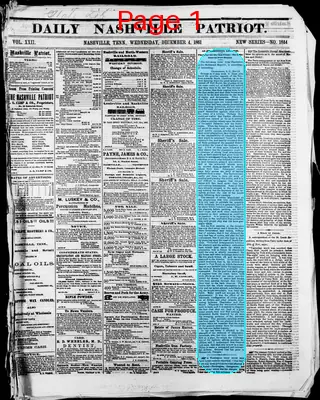
Daily Nashville Patriot
Nashville, Davidson County, Tennessee
What is this article about?
A letter from Charleston describes the Union invasion at Port Royal, South Carolina, where unprepared planters abandoned plantations, leaving cotton and slaves behind. Yankees seized the cotton and forced slaves to work. Planters now destroy crops and evacuate to prevent further losses, with defenses strengthened in Charleston and Savannah.
Clipping

OCR Quality
Full Text
The War on the Sea-Coast—the Yankees at Port Royal.
The following letter from Charleston, to the Richmond Enquirer, is exceedingly interesting:
CHARLESTON, S. C., Nov 21.
Strange as it may seem to those who know the peculiar rancor of the Yankees towards South Carolina, up to the very morning when the great armada anchored off Port Royal, the planters along our coast could not, or would not, believe that they were to be the first victims of the invader, that their negroes were to be the first stolen, and that their broad acres were to be the first selected for the work of rapine and devastation. When the blow fell, it found them unprepared. In blind reliance upon our scanty coast defenses, they had been quietly prosecuting their planting operations, without taking even the most obviously prudent steps to guard themselves against utter ruin in the event of a reverse. Perhaps they could not realize that Yankee effrontery would even extend so far as to attempt to plant a puritan colony upon the shores of the hated Palmetto and the Rattlesnake. When the delusion had vanished, amid the smoke and roar of a hundred hostile cannon, reverberating over their quiet plantations, they thought only of the impossibility of remaining where they might be presumed "loyal" to their country's foe, and hastily retreated from all those portions of the assailed district not within the lines of the Southern army. A few of them were followed by their slaves; but the plantation negro is a creature of strong local attachments, and, as their masters had given them the choice to accompany them, they knew not whether or no to stay behind; the slaves, in most instances, amazed and confounded at the unwonted events going on around them, preferred to remain where they were. Subsequent events have fully proven the folly of having suffered them to stay. The Yankees have coolly put them to their old work of picking and ginning the cotton, and it is not difficult to imagine that the poor slaves will fare hard under their new and ruthless taskmasters. Some of them have already escaped to the main, and say nothing but the bayonets of the invaders prevent the rest of the hands from following their example.
The amount of cotton abandoned on the plantations was very considerable. It is not easy to estimate the quantity with certainty, but it is generally said to be about fifteen hundred bales. Many of the planters, before quitting, set fire to their crops and such other combustible property on their premises as could not be removed. It is certainly to be regretted that, in the confusion that prevailed, this very proper step was not more generally taken.
But the first surprise at the invasion has now died away, and I think the Northern Government may reckon, without fear of mistake, that it has obtained the very last bag of cotton, and also the last contraband, that it can ever hope to seize by pouncing upon the coast of South Carolina. Concerted arrangements between the planters and the military authorities have wisely been made by which no plantation will in future be abandoned until the crop is utterly consumed, the gin house and other buildings destroyed, the live stock driven off, and the hands removed to the interior. In the most exposed localities, that is, the islands adjacent to Port Royal, on which the enemy may at any moment make his appearance, the work of destruction is already consummated. For the past few days gangs of negroes from the coast, laden with such effects as they can carry, and followed by droves of mules and horses, have been passing through this city on their way to the back country. Night before last the whole atmosphere in the city and for miles around, notwithstanding the bright moonlight, was hazy and lurid. Many could not account for the phenomenon. It was the effect of the wholesale conflagration of cotton going on at Edisto and other islands, intervening between Charleston and Port Royal. Wherever the marauders choose next to land, and it is useless to disguise the fact that they can land at a great many points, they will find nothing but devastated fields, deserted by all save the avenging presence of the partizan rifleman. The patriotic sacrifice which has been made by our planters is all the greater when we consider that the crops of the present season have far exceeded the best ever before known.
In my last letter I alluded to the strength of the defenses of Charleston. Savannah, also, has been strongly fortified on a plan, for which the conformation of its harbor affords peculiar facilities, and I understand that General Lee says that that city is now in a condition to make a protracted and successful defense. General Lee has gone to Brunswick, Georgia.
A Washington letter writer says Lord Lyons recently remarked "that there were only three ports on the coast effectually blockaded—Washington, Georgetown and Alexandria;" which was the sharpest thing that that rather dull nobleman ever said.
What sub-type of article is it?
What themes does it cover?
What keywords are associated?
What entities or persons were involved?
Where did it happen?
Story Details
Key Persons
Location
Port Royal, South Carolina; Charleston, S.C.; Edisto Island; Savannah, Georgia; Brunswick, Georgia
Event Date
Nov 21
Story Details
Confederate letter details Union invasion at Port Royal, unprepared planters fleeing and leaving cotton and slaves; Yankees seize assets and force labor; planters now systematically destroy property and evacuate to deny enemy gains; defenses bolstered in key cities.