Thank you for visiting SNEWPapers!
Sign up free
Editorial
September 20, 1826
The Massachusetts Spy, And Worcester County Advertiser
Worcester, Worcester County, Massachusetts
What is this article about?
Editorial on parental government, arguing that harsh punishment for innocent mistakes teaches children to lie and fosters bad passions; advocates reason, benevolence, and controlled discipline to instill virtue and mildness in youth.
Merged-components note: These two sequential editorial components continue the same piece on parental government and child discipline.
Clipping
OCR Quality
95%
Excellent
Full Text
Miscellaneous.
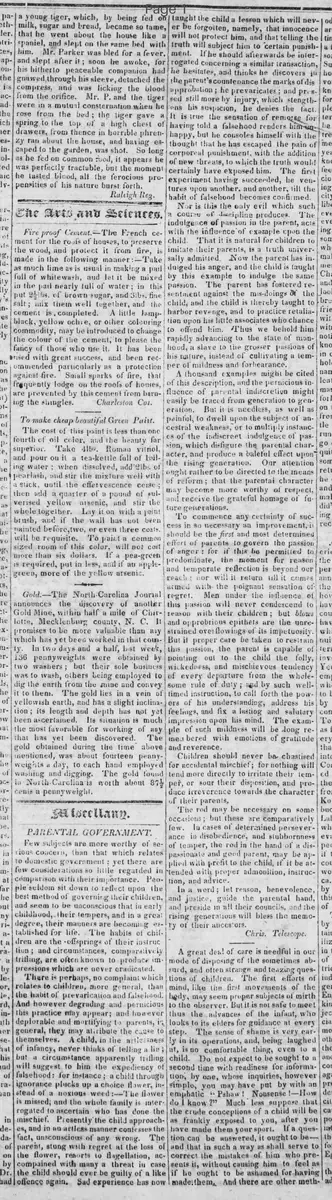
PARENTAL GOVERNMENT
Few subjects are more worthy of serious concern, than that which relates to domestic government: yet there are few considerations so little regarded in comparison with their importance. People seldom sit down to reflect upon the best method of governing their children, and seem to be unconscious that in early childhood,--their tempers, and in a great degree, their manners are becoming established for life. The habits of children are the offsprings of their instruction; and circumstances, comparatively trifling, are often known to produce impressions which are never eradicated.
There is perhaps, no complaint which relates to children, more general, than the habit of prevarication and falsehood. And however degrading and pernicious this practice may appear; and however deplorable and mortifying to parents, it in general, they may attribute the cause to themselves. A child, in the artlessness of infancy, never thinks of telling a lie; but a circumstance apparently trifling will suggest to him the expediency of falsehood: for instance; a child through ignorance plucks up a choice flower, instead of a noxious weed:--The flower is missed; and the whole family is interrogated to ascertain who has done the mischief. Presently the child approaches, and in an artless manner confesses the fact, unconscious of any wrong. The parent, stung with regret at the loss of the flower, resorts to flagellation, accompanied with many a threat in case the child should ever be guilty of a like offence again. Sad experience has now taught the child a lesson which will never be forgotten, namely, that innocence will not protect him, and that telling the truth will subject him to certain punishment. If he should afterwards be interrogated concerning a similar transaction, he hesitates, and thinks he discovers in the parent's countenance the marks of disapprobation; he prevaricates; and pressed still more by injury, which strengthens his suspicion, he denies the fact.
It is true the sensation of remorse for having told a falsehood renders him unhappy, but he consoles himself with the thought that he has escaped the pain of corporeal punishment, with the addition of new threats, to which the truth would certainly have exposed him. The first experiment having succeeded, he ventures upon another, and another, till the habit of falsehood becomes confirmed.
Nor is this the only evil which such a course of discipline produces. The indulgence of passion in the parent, acts with the influence of example upon the child. That it is natural for children to imitate their parents, is a truth universally admitted. Now the parent has indulged his anger, and the child is taught by this example to indulge the same passion. The parent has fostered resentment against the mis-doings of the child, and the child is thereby taught to harbor revenge, and to practice retaliation upon his little associates who chance to offend him. Thus we behold him rapidly advancing to the state of manhood, a slave to the grosser passions of his nature, instead of cultivating a temper of mildness and forbearance.
A thousand examples might be cited of this description, and the pernicious influence of parental indiscretion might easily be traced from generation to generation. But it is needless, as well as painful, to dwell upon the subject of ancestral weakness, or to multiply instances of the indiscreet indulgence of passion, which disfigure the parental character, and produce a baleful effect upon the rising generation. Our attention ought rather to be directed to the means of reform; that the parental character may become more worthy of respect, and receive the grateful homage of future generations.
To commence any certainty of success in so necessary an improvement, it should be the first and most determined effort of parents to govern the passion of anger: for if this be permitted to predominate, the moment for reason and temperate reflection is beyond our reach; nor will it return till it comes armed with the poignant sensation of regret. Men under the influence of this passion will never condescend to reason with their children; but blows and opprobrious epithets are the unrestrained overflowings of its impetuosity.
But if proper care be taken to restrain this passion, the parent is capable of pointing out to the child the folly, wickedness, and mischievous tendency of every departure from the wholesome rule of duty; and by such well-timed instruction, to call forth the powers of his understanding, address his feelings, and fix a lasting and salutary impression upon his mind. The example of such mildness will be long remembered with emotions of gratitude and reverence.
Children should never be chastised for accidental mischief; for nothing will tend more directly to irritate their temper, or sour their disposition, and produce irreverence towards the character of their parents.
The rod may be necessary on some occasions; but these are comparatively few. In cases of determined perseverance in disobedience, and stubbornness of temper, the rod in the hand of a dispassionate and good parent, may be applied with profit to the child, if it be attended with proper admonition, instruction, and advice.
In a word; let reason, benevolence, and justice, guide the parental hand, and preside in all their councils, and the rising generations will bless the memory of their ancestors.
Chris. Telescope.
PARENTAL GOVERNMENT
Few subjects are more worthy of serious concern, than that which relates to domestic government: yet there are few considerations so little regarded in comparison with their importance. People seldom sit down to reflect upon the best method of governing their children, and seem to be unconscious that in early childhood,--their tempers, and in a great degree, their manners are becoming established for life. The habits of children are the offsprings of their instruction; and circumstances, comparatively trifling, are often known to produce impressions which are never eradicated.
There is perhaps, no complaint which relates to children, more general, than the habit of prevarication and falsehood. And however degrading and pernicious this practice may appear; and however deplorable and mortifying to parents, it in general, they may attribute the cause to themselves. A child, in the artlessness of infancy, never thinks of telling a lie; but a circumstance apparently trifling will suggest to him the expediency of falsehood: for instance; a child through ignorance plucks up a choice flower, instead of a noxious weed:--The flower is missed; and the whole family is interrogated to ascertain who has done the mischief. Presently the child approaches, and in an artless manner confesses the fact, unconscious of any wrong. The parent, stung with regret at the loss of the flower, resorts to flagellation, accompanied with many a threat in case the child should ever be guilty of a like offence again. Sad experience has now taught the child a lesson which will never be forgotten, namely, that innocence will not protect him, and that telling the truth will subject him to certain punishment. If he should afterwards be interrogated concerning a similar transaction, he hesitates, and thinks he discovers in the parent's countenance the marks of disapprobation; he prevaricates; and pressed still more by injury, which strengthens his suspicion, he denies the fact.
It is true the sensation of remorse for having told a falsehood renders him unhappy, but he consoles himself with the thought that he has escaped the pain of corporeal punishment, with the addition of new threats, to which the truth would certainly have exposed him. The first experiment having succeeded, he ventures upon another, and another, till the habit of falsehood becomes confirmed.
Nor is this the only evil which such a course of discipline produces. The indulgence of passion in the parent, acts with the influence of example upon the child. That it is natural for children to imitate their parents, is a truth universally admitted. Now the parent has indulged his anger, and the child is taught by this example to indulge the same passion. The parent has fostered resentment against the mis-doings of the child, and the child is thereby taught to harbor revenge, and to practice retaliation upon his little associates who chance to offend him. Thus we behold him rapidly advancing to the state of manhood, a slave to the grosser passions of his nature, instead of cultivating a temper of mildness and forbearance.
A thousand examples might be cited of this description, and the pernicious influence of parental indiscretion might easily be traced from generation to generation. But it is needless, as well as painful, to dwell upon the subject of ancestral weakness, or to multiply instances of the indiscreet indulgence of passion, which disfigure the parental character, and produce a baleful effect upon the rising generation. Our attention ought rather to be directed to the means of reform; that the parental character may become more worthy of respect, and receive the grateful homage of future generations.
To commence any certainty of success in so necessary an improvement, it should be the first and most determined effort of parents to govern the passion of anger: for if this be permitted to predominate, the moment for reason and temperate reflection is beyond our reach; nor will it return till it comes armed with the poignant sensation of regret. Men under the influence of this passion will never condescend to reason with their children; but blows and opprobrious epithets are the unrestrained overflowings of its impetuosity.
But if proper care be taken to restrain this passion, the parent is capable of pointing out to the child the folly, wickedness, and mischievous tendency of every departure from the wholesome rule of duty; and by such well-timed instruction, to call forth the powers of his understanding, address his feelings, and fix a lasting and salutary impression upon his mind. The example of such mildness will be long remembered with emotions of gratitude and reverence.
Children should never be chastised for accidental mischief; for nothing will tend more directly to irritate their temper, or sour their disposition, and produce irreverence towards the character of their parents.
The rod may be necessary on some occasions; but these are comparatively few. In cases of determined perseverance in disobedience, and stubbornness of temper, the rod in the hand of a dispassionate and good parent, may be applied with profit to the child, if it be attended with proper admonition, instruction, and advice.
In a word; let reason, benevolence, and justice, guide the parental hand, and preside in all their councils, and the rising generations will bless the memory of their ancestors.
Chris. Telescope.
What sub-type of article is it?
Moral Or Religious
Education
Social Reform
What keywords are associated?
Parental Government
Child Discipline
Falsehood Habit
Moral Instruction
Anger Control
Family Education
Editorial Details
Primary Topic
Parental Discipline And Preventing Falsehood In Children
Stance / Tone
Advisory And Reformative
Key Arguments
Harsh Punishment For Innocent Acts Teaches Children To Lie To Avoid Pain
Parental Anger Models Bad Passions For Children To Imitate
Parents Should Control Anger And Use Reason In Discipline
Avoid Chastising For Accidents To Prevent Sour Dispositions
Rod Only For Stubborn Disobedience, With Instruction
Reason, Benevolence, And Justice Should Guide Parenting