Thank you for visiting SNEWPapers!
Sign up free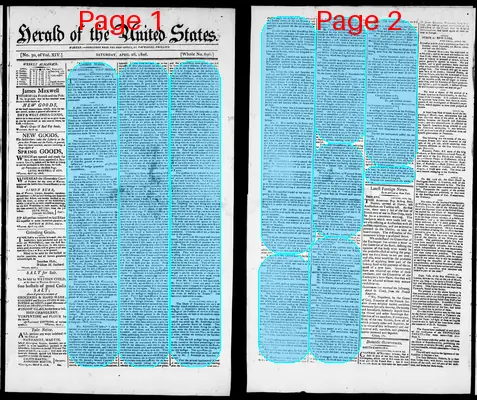
Herald Of The United States
Warren, Bristol County, Rhode Island
What is this article about?
Report on U.S. House of Representatives proceedings from April 7-12, 1806, covering bills on witness compensation, adjournments, treasury reports on exports and Florida purchases, resignations, army appropriations, prohibitions on military officers holding civil offices, navy estimates, and debates on publishing a secret presidential message regarding Spanish affairs and potential Florida purchase.
Merged-components note: Continuation of detailed congressional proceedings narrative across pages; relabeled to domestic_news as it covers national political events.
Clippings
1 of 2
OCR Quality
Full Text
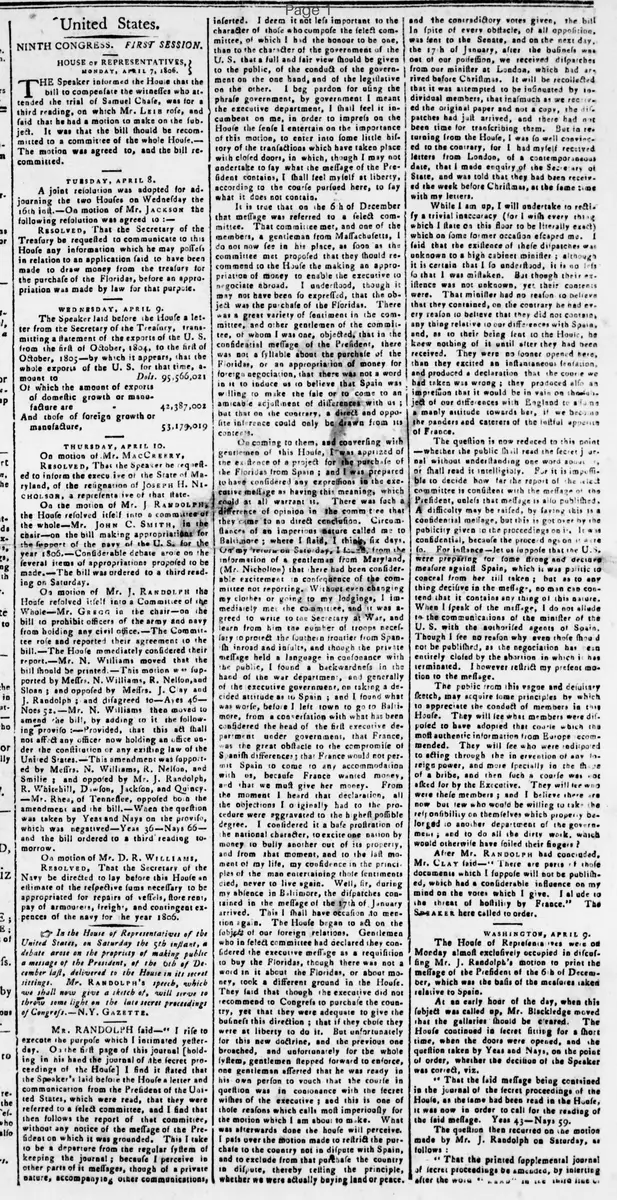
NINTH CONGRESS.
FIRST SESSION.
HOUSE OF REPRESENTATIVES.
MONDAY, APRIL 7, 1806.
A bill to compensate the witnesses who attended the trial of Samuel Chase, was for a third reading, on which Mr. Leib rose, and said that he had a motion to make on the subject. It was that the bill should be recommitted to a committee of the whole House.—The motion was agreed to, and the bill recommitted.
TUESDAY, APRIL 8.
A joint resolution was adopted for adjourning the two Houses on Wednesday the 16th inst.—On motion of Mr. Jackson the following resolution was agreed to:—
Resolved, That the Secretary of the Treasury be requested to communicate to this House any information which he may possess in relation to an application said to have been made to draw money from the treasury for the purchase of the Floridas, before an appropriation was made by law for that purpose.
WEDNESDAY, APRIL 9.
The Speaker laid before the House a letter from the Secretary of the Treasury, transmitting a statement of the exports of the U. S. from the first of October, 1804, to the first of October, 1805—by which it appears, that the whole exports of the U. S. for that time, amount to
Dols. 95,566,021
Of which the amount of exports
of domestic growth or manu-
ufacture are
42,387,002
And those of foreign growth or
manufacture,
53,179,019
THURSDAY, APRIL 10.
On motion of Mr. Macon,
Resolved, That the Speaker be requested to inform the executive of the State of Maryland, of the resignation of Joseph H. Nicholas, a representative of that state.
On the motion of Mr. J. Randolph the House resolved itself into a committee of the whole—Mr. John C. Smith, in the chair—on the bill making appropriations for the support of the army of the U. S. for the year 1806.—Considerable debate arose on the several items of appropriations proposed to be made,—The bill was ordered to a third reading on Saturday.
On motion of Mr. J. Randolph the House resolved itself into a Committee of the Whole—Mr. Gregg in the chair—on the bill to prohibit officers of the army and navy from holding any civil office,—The Committee rose and reported their agreement to the bill.—The House immediately considered their report. Mr. N. Williams moved that the bill should be printed.—This motion was supported by Messrs. N. Williams, R. Nelson, and Sloan; and opposed by Messrs. J. Clay and J. Randolph: and disagreed to—Ayes 46—Noes 52.—Mr. N. Williams then moved to amend the bill, by adding to it the following proviso: Provided, that this act shall not affect any officer now holding an office under the constitution or any existing law of the United States.—This amendment was supported by Messrs. N. Williams, R. Nelson, and Smilie: and opposed by Mr. J. Randolph, R. Whitehill, Dawson, Jackson, and Quincy.—Mr. Rhea, of Tennessee, opposed both the amendment and the bill.—When the question was taken by Yeas and Nays on the proviso, which was negatived—Yeas 36—Nays 66—and the bill ordered to a third reading tomorrow.
On motion of Mr. D. R. Williams,
Resolved, That the Secretary of the Navy be directed to lay before this House an estimate of the respective sums necessary to be appropriated for repairs of vessels, store rent, pay of armourers, freight, and contingent expenses of the navy for the year 1806.
In the House of Representatives of the United States, on Saturday the 5th instant, a debate arose on the propriety of making public a message of the President, of the 6th of December last, delivered to the House in its secret sittings. Mr. Randolph's speech, which we shall not give a sketch of, will serve to throw some light on the late secret proceedings of Congress.—N.Y. Gazette.
Mr. RANDOLPH said—'I rise to execute the purpose which I intimated yesterday. On the first page of this journal (holding in his hand the journal of the secret proceedings of the House) I find it stated that the Speaker laid before the House a letter and communication from the President of the United States, which were read, that they were referred to a select committee, and I find that then follows the report of that committee, without any notice of the message of the President on which it was grounded. This I take to be a departure from the regular system of keeping the journal; because I perceive in other parts of it messages, though of a private nature, accompanying other communications, inserted. I deem it not less important to the character of those who compose the select committee, of which I had the honour to be one, than to the character of the government of the U. S. that a full and fair view should be given to the public, of the conduct of the government on the one hand, and of the legislative on the other. I beg pardon for using the phrase government, by government I mean the executive department, I shall feel it incumbent on me, in order to impress on the House the sense I entertain on the importance of this motion, to enter into some little history of the transactions which have taken place with closed doors, in which, though I may not undertake to say what the message of the President contains, I shall feel myself at liberty, according to the course pursued here, to say what it does not contain.
It is true that on the 6th of December that message was referred to a select committee. That committee met, and one of the members, a gentleman from Massachusetts, I do not now see in his place, as soon as the committee met proposed that they should recommend to the House the making an appropriation of money to enable the executive to negotiate abroad. I understood, though it may not have been so expressed, that the object was the purchase of the Floridas. There was a great variety of sentiments in the committee, and other gentlemen of the committee, of whom I was one, objected, that in the confidential message of the President, there was not a syllable about the purchase of the Floridas, or an appropriation of money for foreign negotiation, that there was not a word in it to induce us to believe that Spain was willing to make the sale or to come to an amicable adjustment of differences with us; but that on the contrary, a direct and opposite inference could only be drawn from its contents.
On coming to them, and conversing with gentlemen of this House, I was apprized of the existence of a project for the purchase of the Floridas from Spain; and I was prepared to have considered any expressions in the executive message as having this meaning, which could at all warrant it. There was such a difference of opinion in the committee that they came to no direct conclusion. Circumstances of an imperious nature called me to Baltimore: where I staid, I think, six days. On my return Saturday, I found, from the information of a gentleman from Maryland, (Mr. Nicholson) that there had been considerable excitement in consequence of the committee not reporting. Without even changing my clothes or going to my lodgings, I immediately met the committee, and it was agreed to write to the Secretary at War, and learn from him the number of troops necessary to protect the southern frontier from Spanish inroad and insults, and though the private message held a language in consonance with the public. I found a backwardness in the hand of the war department, and generally of the executive government, on taking a decided attitude as to Spain; and I found what was worse, before I left town to go to Baltimore, from a conversation with what has been considered the head of the first executive department under government, that France, was the great obstacle to the compromise of Spanish differences; that France would not permit Spain to come to any accommodation with us, because France wanted money, and that we must give her money. From the moment I heard that declaration, all the objections I originally had to the procedure were aggravated to the highest possible degree. I considered it a base prostration of the national character, to excite one nation by money to bully another out of its property, and from that moment, and to the last moment of my life, my confidence in the principles of the man entertaining those sentiments ceased, never to rise again. Well, sir, during my absence in Baltimore, the dispatches contained in the message of the 17th of January arrived. This I shall have occasion to mention again. The House began to act on the subject of our foreign relations. Gentlemen who in select committee had declared they considered the executive message as a requisition to buy the Floridas, though there was not a word in it about the Floridas, or about money, took a different ground in the House, They said that though the executive did not recommend to Congress to purchase the country, yet that they were adequate to give the business this direction: that if they chose they were at liberty to do it. But unfortunately for this new doctrine, and the previous one broached, and unfortunately for the whole system, gentlemen stepped forward to enforce, one gentleman asserted that he was ready in his own person to vouch that the course in question was in consonance with the secret wishes of the executive; and this is one of those reasons which calls most imperiously for the motion which I am about to make. What was afterwards done the house will perceive. I pass over the motion made to restrict the purchase to the country put in dispute with Spain, and to exclude from that purchase the country in dispute, thereby testing the principle, whether we were actually buying land or peace. And the contradictory votes given, the bill in spite of every obstacle, of all opposition, was sent to the Senate, and on the next day. the 17th of January, after the business was out of our possession, we received dispatches from our minister at London, which had arrived before Christmas. It will be recollected that it was attempted to be insinuated by individual members, that inasmuch as we received the original paper and not a copy, the dispatches had just arrived, and there had not been time for transcribing them. But in returning from the House, I was so well convinced of the contrary, for I had myself received letters from London, of a contemporaneous date, that I made enquiry of the Secretary of State, and was told that they had been received the week before Christmas, at the same time with my letters.
While I am up, I will undertake to rectify a trivial inaccuracy (for I wish every thing which I state on this floor to be literally exact) which on some former occasion escaped me. I said that the existence of these dispatches was unknown to a high cabinet minister; although it is certain that I so understood, it is no less so that I was mistaken. But though their existence was not unknown, yet their contents were. That minister had no reason to believe that they contained, on the contrary he had every reason to believe that they did not contain. any thing relative to our differences with Spain, and, as to their being sent to the House, he knew nothing of it until after they had been received. They were no sooner opened here, than they excited an instantaneous sensation, and produced declaration that the course we had taken was wrong; they produced also an impression that it would be in vain on the subject of our differences with England to assume manly attitude towards her, if we become the panders and caterers of the lustful appetites of France.
The question is now reduced to this point —whether the public shall read the secret journal without understanding one word about it, or shall read it intelligibly. For it is impossible to decide how far the report of the select committee is consistent with the message of the President, unless that message is also published. A difficulty may be raised, by saying this is a confidential message, but this is got over by the publicity given to the proceedings on it. It is confidential, because the proceedings on it are so. For instance—let us suppose that the H. were preparing for some strong and decisive measure against Spain, which it was politic to conceal from her till taken: but as to any thing decisive in the message, no man can contend that it contains any thing of this nature. When I speak of the message, I do not allude to the communications of the minister of the U.S. with the authorised agents of Spain. Though I see no reason why even those should not be published, as the negotiation has been entirely closed by the abortion in which it has terminated. I however restrict my present motion to the message.
The public from this vague and delusive sketch, may acquire some principles by which to appreciate the conduct of members in this House. They will see what members were disposed to have adopted that course which the most authentic information from Europe recommended. They will see who were disposed to acting through the intervention of any foreign power, and more especially in the use of a bribe, and then such a course was not asked for by the Executive. They will see who were those members; and I believe there are now but few who would be willing to take the responsibility on themselves which properly belongs to another department of the government; and to do all the dirty work, which would otherwise have soiled their fingers?
After Mr. Randolph had concluded, Mr. Clay said—'There are parts of those documents which I suppose will not be published, which had a considerable influence on my mind on the votes which I gave. I allude to the threat of hostility by France.'
The Speaker here called to order.
WASHINGTON, APRIL 9.
The House of Representatives were on Monday almost exclusively occupied in discussing Mr. J. Randolph's motion to print the message of the President of the 6th of December, which was the basis of the measures taken relative to Spain.
At an early hour of the day, when this object was called up, Mr. Blackledge moved that the galleries should be cleared. The House continued in secret sitting for a short time, when the doors were opened, and the question taken by Yeas and Nays, on the point of order, whether the decision of the Speaker was correct, viz.
That the said message being contained in the journal of the secret proceedings of the House, as the same had been read in the House, it was now in order to call for the reading of the said message. Yeas 43—Nays 59.
The question then recurred on the motion made by Mr. J. Randolph on Saturday, as follows:
'That the printed Supplemental journal of secret proceedings be amended, by inserting after the word "gAU" the first page, the message of the President of the United States, of the 6th December last, and that a new edition of the said journal, thus amended, be printed for the use of the members.'
On this motion a very interesting debate ensued, in which a pretty full view was taken by the different speakers of the arguments urged in Secret debate. Messrs. J. Randolph, Jos. H. Clay, Eppes and Kelly supported, and Messrs. Smoot, Findley, Fisk, G.W. Campbell, Bell and Jackson opposed the motion.
About 5 o'clock the Yeas and Nays were taken on the motion, which was disagreed to-- Yeas 44--Nays 74.
On Tuesday, a motion was made by Mr. J. Randolph, to print the letter addressed to, and the letter received from, the Secretary of War, which is referred to in the report of the committee on Spanish affairs--which was disagreed to.
On Friday the 11th, and Saturday the 12th inst. the House of Representatives was not engaged in any business of moment. The bill to prohibit officers of the army and navy of the United States, from holding or exercising any civil office, was read the third time, and passed. It is to have effect from the 3d of July next. On the passage of this bill, a debate arose principally on the constitutionality of adopting a principle which, it was contended, would have a retrospective effect, by compelling those persons, already appointed to both a civil and military office, to vacate one of them.
The House went into a Committee of the Whole--Mr. Gregg in the chair--on the bill concerning the further safeguard of merchant vessels in the vicinity of the United States.
The first section of the bill was read as follows:
Sec. 1. Be it enacted by the Senate and House of Representatives of the United States of America, in Congress assembled, That it shall be lawful for the President of the U. S. whenever he shall deem it expedient, to prohibit the exercise of hostilities against merchant vessels in any of the roads, or places of anchorage, near the ports and harbours of the U. S. and also in any of the tracts of sea within the principal head-lands on the coasts of the U. S. and to require all foreign armed ships, or vessels, of whatever description, to abstain from seizing, annoying, or molesting, any merchant vessels, within any of the spaces and precincts aforesaid.
Mr. Crowninshield moved to amend the section by extending the contemplated protection to "American citizens or other persons."
Mr. Dana considered the amendment superfluous, as the section provided against molesting merchant vessels; he believed the impressment of seamen would be a molestation.
Mr. Crowninshield held a different opinion as to the construction of the section--which only provided against molesting a merchant vessel.
Mr. Ely expressed himself of the same opinion with Mr. Dana.
After some further conversation Mr. C. withdrew his amendment, and submitted it under a new modification, in which there it was disagreed to, under the idea that it was superfluous.
On motion of Mr. Jackson, the section was so amended, as to apply the provision to all persons whatever.
After some other amendments, the committee rose, and the bill as amended in Committee of the Whole, was ordered to a third reading on Monday.
Mr. Newton gave notice that he should on Monday call up his resolution, proposing an amendment to the constitution of the United States.
The House resolved itself into a Committee of the Whole, Mr. Dawson in the chair, on the bill to suspend the sale of certain lands in the state of Ohio and Indiana territory.
The bill suspends the sale of lands, on which installments are due, until the first of October next.
A motion of Mr. Lyon to extend the time till February 1, was lost.
The committee rose, and reported the bill without amendment, which was read a third time and passed--Ayes 66.
The bill has passed both Houses.
What sub-type of article is it?
What keywords are associated?
What entities or persons were involved?
Where did it happen?
Domestic News Details
Primary Location
Washington
Event Date
April 7 12, 1806
Key Persons
Outcome
various bills passed or recommitted; motions on publishing secret messages and letters disagreed to (e.g., yeas 44-nays 74 on printing presidential message); bill prohibiting military officers from holding civil offices passed; land sale suspension bill passed both houses; export figures reported: total $95,566,021, domestic $42,387,002, foreign $53,179,019.
Event Details
Daily proceedings of the U.S. House of Representatives, Ninth Congress, First Session, including debates and votes on bills for witness compensation in Samuel Chase trial, adjournment resolution, treasury information on Florida purchase and exports, resignation notification, army appropriations, prohibition on military officers holding civil offices, navy expense estimates, safeguards for merchant vessels, land sales suspension in Ohio and Indiana, and extensive debate on publishing the President's secret December 6, 1806 message regarding Spanish affairs and potential Florida purchase, with John Randolph's detailed speech criticizing executive actions and committee proceedings.