Thank you for visiting SNEWPapers!
Sign up free
Kentucky Gazette
Lexington, Fayette County, Kentucky
What is this article about?
In a letter to Lt. Gov. William T. Barry from Mason County, KY, on October 20, 'Marcellus' criticizes Kentucky judges for partisanship in elections and politics, contrasting with historical ideals of impartial justice. He urges judicial independence, highlights impeachment impracticality, and calls for reforms like salary adjustments and scrutiny of nominees.
Clipping
OCR Quality
Full Text
LETTER II
TO WILLIAM T. BARRY,
(Lieutenant Governor)
Mason County, October 20.
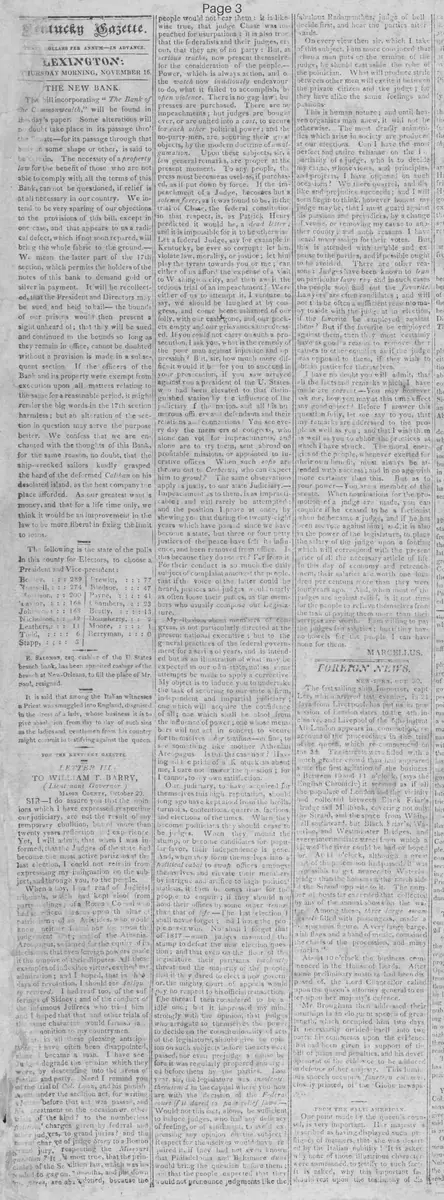
SIR—I do assure you that the opinions which I have expressed respecting our judiciary, are not the result of any temporary ebullition, but of more than twenty years reflection and experience. Yet, I will admit, that when I was informed, that the Judges of the state had become the most active partisans at the last election, I could not refrain from expressing my indignation on the subject, and through you, to the people. When a boy, I had read of Judicial tribunals, which had kept aloof from party strifes; of a Roman Consul who had sacrificed his sons upon the altar of patriotism; of an Aristides, who would know neither friend nor foe upon the judgment seat; and of the Athenian Areopagus, so famed for the equity of its decisions, that even foreign powers made it the umpire of their disputes. All these examples of inflexible virtue excited my admiration; and I hoped, that in his days of revolution, I should see Antiquity revived. I had read too, of the sufferings of Sidney; and of the conduct of the infamous Jeffreys who tried him and I hoped that that and other trials of the same character would furnish a monition to my countrymen. But in all these pleasing anticipations, I have often been disappointed, since I became a man. I have seen Judges degrade the ermine which they wore, by descending into the arena of faction and party. Need I remind you of the trial of Col. Lyon, and his punishment under the sedition act, for writing a letter before that act was passed, and his comment on the occasion or other trials of the kind? to the numberless politicised charges given by federal and other judges, to grand juries? and the recent charge of judge Story to a Boston grand jury, respecting the Missouri question? It's most true, that the principles of the Sedition law, which was intended to gag our mouths, and put down error, are abandoned, because the people would not bear them: it is likewise true, that judge Chase was impeached for usurpations: it is also true that the federalists and their judges, cry out, that they are of no party: But, as serious truths, now present themselves for the consideration of the people.- Power, which is always action, and of the watch now insidiously endeavour to do, what it failed to accomplish, by open violence. There is no gag law; but presses are purchased. There are no impeachments; but judges are bought over, or are united into a cast, to secure for each other political power; and the no-party-men, are securing their great objects, by the modern doctrine of amalgamation. Upon these subjects, sir, a few general remarks, are proper at the present moment. To any people, the press must become as useless, if purchased, as if put down by force. If the impeachment of a Judge, becomes but a solemn farce, as it was found to be, in the trial of Chase, the federal constitution in that respect, is, as Patrick Henry predicted it would be, a dead letter; and it is impossible for it to be otherwise Let a federal Judge, say for example in Kentucky, be ever so corrupt: let him violate law, morality, or justice; let him play the tyrant towards you or me; can either of us afford the expense of a visit to Washington city, and then await the tedious trial of an impeachment? Were either of us to attempt it, I venture to say, we should be laughed at by congress, and come home ashamed of our folly, with our cash gone, and our pockets empty and our grievances unredressed. If you could not carry on such a prosecution, I ask you, what is the remedy of the poor man against injustice and oppression? But, sir, how much more difficult would it be for you to succeed in your prosecution, if you saw arrayed against you a president of the U. States. who had been elevated to that distinguished station by the influence of the judiciary of the nation, and all its numerous officers and defendants and their relations and connections? You see every day the members of congress, who alone can vote for impeachments, and alone are to try them, sent abroad on profitable missions, or appointed to lucrative offices When such sops are thrown out to Cerberus, who can expect him to growl? The same observations apply as justly, to our state Judiciary.- Impeachment as to them, is as impracticable; and will rarely be attempted; and the position I prove at once, by shewing you that during the twenty-eight years which have passed since we have become a state, but three or four petty justices of the peace have felt its influence, and been removed from office. Is this because they do not err? Far from it For their conduct is so much the daily subject of complaint amongst the people, that if the voice of the latter could be heard, justices and judges would nearly as often loose their places, as the members who usually compose our Legislature. My allusions about members of congress, is not particularly directed at the present national executive: but to the general practices of the federal government for a series of years, and is intended but as an illustration of what may be expected in our own state, unless some attempts be made to apply a corrective My object is to induce you to undertake the task of securing to our state a firm, independent and impartial judiciary; one which will acquire the confidence of all; one which shall be aloof from the influence of power; one whose members will not act in concert to secure for themselves her stations—in fine, to see something like another Athenian Areopagus Is that the case now? Having all the pride of a Kentuckian about me, I dare not answer the question; for I cannot, to my own satisfaction. Our judiciary, to have acquired for themselves this high reputation, should long ago have kept aloof from the broils, turmoils, contentions, quarrels factions and elections of the times. When they become politicians they should cease to be judges. When they mount the stump, or become candidates for popular favor, their independence is gone. And, when they form themselves into a political cabal to share offices amongst themselves, and elevate their members by intrigue and artifice to high political stations, it then becomes time for the people to enquire; if they should not hold their offices by some other tenure than that of life—The last election I shall never forget; nor I hope the people ever will. No shall I forget that of 1817—when judges mounted the stump to defeat the new election question; and that even on the floor of the Legislature their partisans insolently threatened the majority of the people. that if they dared to elect a new governor, the mighty court of appeals would pay no respect to his official transaction The threat I then considered to be a idle one: but it impressed my mind, strongly with the opinion, that judges who arrogate to themselves the power to decide on the constitutionality of acts of the legislature, should give no opinion on such subjects before the acts were passed, nor even prejudge a cause before it was regularly prepared and argued before them by the parties. Last year, sir, the legislature was insolently threatened in the capital where you now are with the decision of the Federal court if it dared to pass relief laws.- Would not this fact, alone, be sufficient to induce judges, who had any delicacy of feeling, or of sentiment, to avoid expressing any opinion on the subject? Respect for themselves would have required it, if they had not even known that Philadelphia and Baltimore duns would bring the question before them; and that the people expected that they would not pronounce judgments like the fabulous Radamanthus, judge of hell decide first, and hear the parties after wards. On every view then sir, which I take of this subject, I am more convinced that when a man puts on the ermine of the judge, he should cast aside the robe of the politician. What will produce strife between other men will excite it between the private citizen and the judge; for they have alike the same feelings and passions. This is human nature; and until heaven organises man anew, it will not be otherwise. The most deadly animosities which arise in society are produced at our elections. Can I have the most perfect and entire reliance on the impartiality of a judge, who is to decide my cause, whose views, and principles, and projects, I have opposed on such occasions? We there quarrel, and dislike and prejudice succeeds; and I will soon begin to think, however honest my judge may be, that I must guard against his passions and prejudices, by a change of venue. or removing my cause to another county; and such reasons I have heard many assign for their votes. But this is attended with trouble and expense to the parties, and if possible ought to be avoided. There are other reasons: Judges have been known to lean on particular lawyers: and in such cases the people soon find out the favorite. Lawyers are often candidates; and will not this be often a sufficient reason to make many to side with the judge at an election, if the favorite be employed against them? But if the favorite be employed against them, then they most certainly have as good a reason to remove their causes to other counties as if the judge was opposed to them, if they wish to obtain justice for themselves. I have no doubt you will admit, that all the facts and remarks which I have made are correct.—You may however ask me, how you may at this time effect any good object? Before I answer this question fully, let me say to you, that my remarks are addressed to the people as well as you; and that I wish them as well as you to abhor the practices at which I have struck. The moral energies of the people, whenever exerted for their own benefit, must always be attended with success; and in no age with more certainty than this. But as to your power—You are a member of the senate. When nominations for the promotion of a judge are made, you can enquire if he ceased to be a factionist when he became a judge, and if he has been so, vote against him: and, it is also in the power of the legislature, to place the salary of the judge upon a footing which will correspond with the present price of all the necessary article of life. In this day of economy and retrenchment, their salaries are worth one hundred per centum more than they were four years ago. And, when most of the judges are against relief, is it not time for the people to relieve themselves from the task of paying them more than their services are worth. I am willing to pay the judges fair salaries; but if they have no bowels for the people I can have none for them.
MARCELLUS.
What sub-type of article is it?
What themes does it cover?
What keywords are associated?
What entities or persons were involved?
Letter to Editor Details
Author
Marcellus
Recipient
William T. Barry, (Lieutenant Governor)
Main Argument
judges must remain independent and impartial, free from political partisanship and election involvement; current kentucky judiciary fails this ideal, making impeachment ineffective, and reforms like tenure changes and salary adjustments are needed to restore public confidence.
Notable Details