Thank you for visiting SNEWPapers!
Sign up free
Letter to Editor
October 24, 1792
National Gazette
Philadelphia, Philadelphia County, Pennsylvania
What is this article about?
A satirical letter to the National Gazette mocks the practice of medical lecturers plagiarizing from sources like Dr. Cullen and others, providing a humorous 'recipe' for composing lectures without original effort. Signed by Peter Plagiary, dated October 20, 1792.
Clipping
OCR Quality
95%
Excellent
Full Text
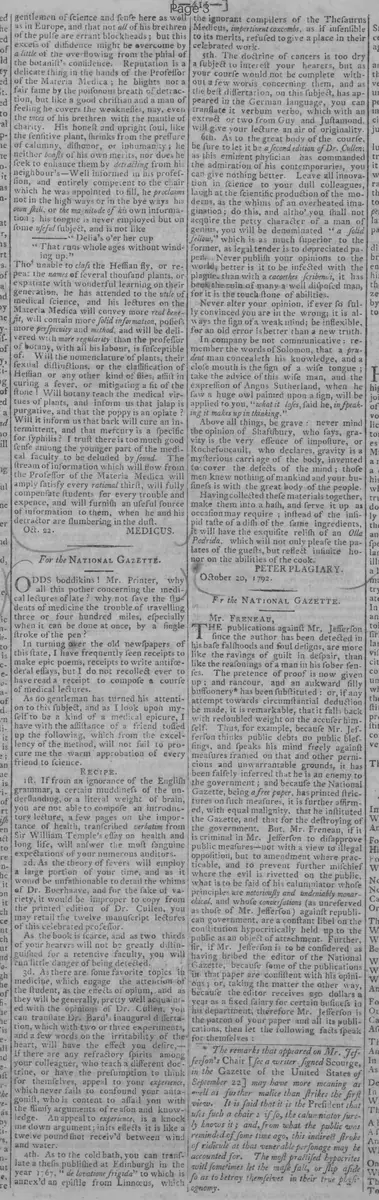
For the National Gazette.
Odds bodikins! Mr. Printer, why all this pother concerning the medical lectures of late? why not save the students of medicine the trouble of travelling three or four hundred miles, especially when it can be done at once, by a single stroke of the pen?
In turning over the old newspapers of this state, I have frequently seen receipts to make epic poems, receipts to write antifederal essays, but I do not recollect ever to have read a receipt to compose a course of medical lectures.
As no gentleman has turned his attention to this subject, and as I look upon myself to be a kind of a medical epicure, I have with the assistance of a friend cooked up the following, which from the excellency of the method, will not fail to procure me the warm approbation of every friend to science.
RECIPE.
1st. If from an ignorance of the English grammar, a certain muddiness of the understanding, or a literal weight of brain, you are not able to compose an introductory lecture, a few pages on the importance of health, transcribed verbatim from Sir William Temple's essay on health and long life, will answer the most sanguine expectations of your numerous auditors.
2d. As the theory of fevers will employ a large portion of your time, and as it would be unfashionable to detail the whims of Dr. Boerhaave, and for the sake of variety, it would be improper to copy from the printed edition of Dr. Cullen, you may retail the twelve manuscript lectures of this celebrated professor.
As the book is scarce, and as two thirds of your hearers will not be greatly distinguished for a retentive faculty, you will run little danger of being detected.
3d. As there are some favorite topics in medicine, which engage the attention of the student, as the effects of opium, and as they will be generally, pretty well acquainted with the opinions of Dr. Cullen, you can translate Dr. Bard's inaugural dissertation, which with two or three experiments, and a few words on the irritability of the heart, will have the effect you desire,
If there are any refractory spirits among your colleagues, who teach a different doctrine, or have the presumption to think for themselves, appeal to your experience, which never fails to confound your antagonist, who is content to assail you with the flimsy arguments of reason and knowledge. An appeal to experience, is a knock down argument; in its effects it is like a twelve pound shot receiv'd between wind and water.
4th. As to the cold bath, you can translate a thesis published at Edinburgh in the year 1767, "de lavatione frigida" to which is annex'd an epistle from Linnaeus, which the ignorant compilers of the Thesaurus Medicus, impertinent coxcombs, as if insensible to its merits, refused to give a place in their celebrated work.
5th. The doctrine of cancers is too dry a subject to interest your hearers, but as your course would not be complete without a few words concerning them, and as the best dissertation, on this subject, has appeared in the German language, you can translate it verbum verbo, which with an extract or two from Guy and Jussieu, will give your lecture an air of originality.
6th. As to the great body of the course, be sure to let it be a Second edition of Dr. Cullen; as this eminent physician has commanded the admiration of his contemporaries, you can give nothing better. Leave all innovation in science to your dull colleagues, laugh at the scientific production of the moderns, as the whims of an overheated imagination; do this, and altho' you shall not acquire the petty character of a man of genius, you will be denominated "a solid fellow," which is as much superior to the former, as legal tender is to depreciated paper. Never publish your opinions to the world, better is it to be infested with the plagite than with a cacoethes scribendi, it has bee the ruin of many a well disposed man, for it is the touch stone of abilities.
Never alter your opinion, if ever so fully convinced you are in the wrong; it is always the sign of a weak mind; be inflexible, for an old error is better than a new truth.
In company be not communicative: remember the words of Solomon, that a prudent man concealeth his knowledge, and a close mouth is the sign of a wise tongue; take the advice of this wise man, and the expression of Angus Sutherland, when he saw a huge owl painted upon a sign, will be applied to you, "what it loses, said he, in speaking it makes up in thinking."
Above all things, be grave: never mind the opinion of Shaftesbury, who says, gravity is the very essence of imposture, or Rochefoucault, who declares, gravity is a mysterious carriage of the body, invented to cover the defects of the mind: those men knew nothing of mankind and your business is with the great body of the people.
Having collected these materials together, make them into a hash, and serve it up as occasion may require; instead of the insipid state of a dish of the same ingredients, it will have the exquisite relish of an Olla Podrida, which will not only please the palates of the guests, but reflect infinite honor on the abilities of the cook.
PETER PLAGIARY.
October 20, 1792.
Odds bodikins! Mr. Printer, why all this pother concerning the medical lectures of late? why not save the students of medicine the trouble of travelling three or four hundred miles, especially when it can be done at once, by a single stroke of the pen?
In turning over the old newspapers of this state, I have frequently seen receipts to make epic poems, receipts to write antifederal essays, but I do not recollect ever to have read a receipt to compose a course of medical lectures.
As no gentleman has turned his attention to this subject, and as I look upon myself to be a kind of a medical epicure, I have with the assistance of a friend cooked up the following, which from the excellency of the method, will not fail to procure me the warm approbation of every friend to science.
RECIPE.
1st. If from an ignorance of the English grammar, a certain muddiness of the understanding, or a literal weight of brain, you are not able to compose an introductory lecture, a few pages on the importance of health, transcribed verbatim from Sir William Temple's essay on health and long life, will answer the most sanguine expectations of your numerous auditors.
2d. As the theory of fevers will employ a large portion of your time, and as it would be unfashionable to detail the whims of Dr. Boerhaave, and for the sake of variety, it would be improper to copy from the printed edition of Dr. Cullen, you may retail the twelve manuscript lectures of this celebrated professor.
As the book is scarce, and as two thirds of your hearers will not be greatly distinguished for a retentive faculty, you will run little danger of being detected.
3d. As there are some favorite topics in medicine, which engage the attention of the student, as the effects of opium, and as they will be generally, pretty well acquainted with the opinions of Dr. Cullen, you can translate Dr. Bard's inaugural dissertation, which with two or three experiments, and a few words on the irritability of the heart, will have the effect you desire,
If there are any refractory spirits among your colleagues, who teach a different doctrine, or have the presumption to think for themselves, appeal to your experience, which never fails to confound your antagonist, who is content to assail you with the flimsy arguments of reason and knowledge. An appeal to experience, is a knock down argument; in its effects it is like a twelve pound shot receiv'd between wind and water.
4th. As to the cold bath, you can translate a thesis published at Edinburgh in the year 1767, "de lavatione frigida" to which is annex'd an epistle from Linnaeus, which the ignorant compilers of the Thesaurus Medicus, impertinent coxcombs, as if insensible to its merits, refused to give a place in their celebrated work.
5th. The doctrine of cancers is too dry a subject to interest your hearers, but as your course would not be complete without a few words concerning them, and as the best dissertation, on this subject, has appeared in the German language, you can translate it verbum verbo, which with an extract or two from Guy and Jussieu, will give your lecture an air of originality.
6th. As to the great body of the course, be sure to let it be a Second edition of Dr. Cullen; as this eminent physician has commanded the admiration of his contemporaries, you can give nothing better. Leave all innovation in science to your dull colleagues, laugh at the scientific production of the moderns, as the whims of an overheated imagination; do this, and altho' you shall not acquire the petty character of a man of genius, you will be denominated "a solid fellow," which is as much superior to the former, as legal tender is to depreciated paper. Never publish your opinions to the world, better is it to be infested with the plagite than with a cacoethes scribendi, it has bee the ruin of many a well disposed man, for it is the touch stone of abilities.
Never alter your opinion, if ever so fully convinced you are in the wrong; it is always the sign of a weak mind; be inflexible, for an old error is better than a new truth.
In company be not communicative: remember the words of Solomon, that a prudent man concealeth his knowledge, and a close mouth is the sign of a wise tongue; take the advice of this wise man, and the expression of Angus Sutherland, when he saw a huge owl painted upon a sign, will be applied to you, "what it loses, said he, in speaking it makes up in thinking."
Above all things, be grave: never mind the opinion of Shaftesbury, who says, gravity is the very essence of imposture, or Rochefoucault, who declares, gravity is a mysterious carriage of the body, invented to cover the defects of the mind: those men knew nothing of mankind and your business is with the great body of the people.
Having collected these materials together, make them into a hash, and serve it up as occasion may require; instead of the insipid state of a dish of the same ingredients, it will have the exquisite relish of an Olla Podrida, which will not only please the palates of the guests, but reflect infinite honor on the abilities of the cook.
PETER PLAGIARY.
October 20, 1792.
What sub-type of article is it?
Satirical
Comedic
Provocative
What themes does it cover?
Health Medicine
Education
Morality
What keywords are associated?
Medical Lectures
Plagiarism
Satire
Dr Cullen
Boerhaave
Education Critique
Health Importance
What entities or persons were involved?
Peter Plagiary
Mr. Printer
Letter to Editor Details
Author
Peter Plagiary
Recipient
Mr. Printer
Main Argument
satirically outlines a 'recipe' for medical lecturers to compose courses by plagiarizing from established sources like dr. cullen and others, mocking the lack of originality and intellectual rigor in medical education.
Notable Details
References Sir William Temple's Essay
Manuscript Lectures Of Dr. Cullen
Dr. Bard's Inaugural Dissertation
Thesis On Cold Bath From Edinburgh 1767 With Linnaeus Epistle
German Dissertation On Cancers
Quotes Solomon, Shaftesbury, Rochefoucault
Appeal To Experience Over Reason