Thank you for visiting SNEWPapers!
Sign up free
Literary
June 14, 1805
Alexandria Daily Advertiser
Alexandria, Virginia
What is this article about?
Historical essay tracing the development of agriculture from ancient Greece, where Pelasgus and Triptolemus introduced acorns and corn, to Athens' perfection of farming, Hesiod's poetic treatise, Roman admiration exemplified by Cato and Virgil's Georgics, and its decline after Constantine due to commerce and barbarian invasions, contrasting with modern views in the U.S.
Clipping
OCR Quality
95%
Excellent
Full Text
ANCIENT AGRICULTURE.
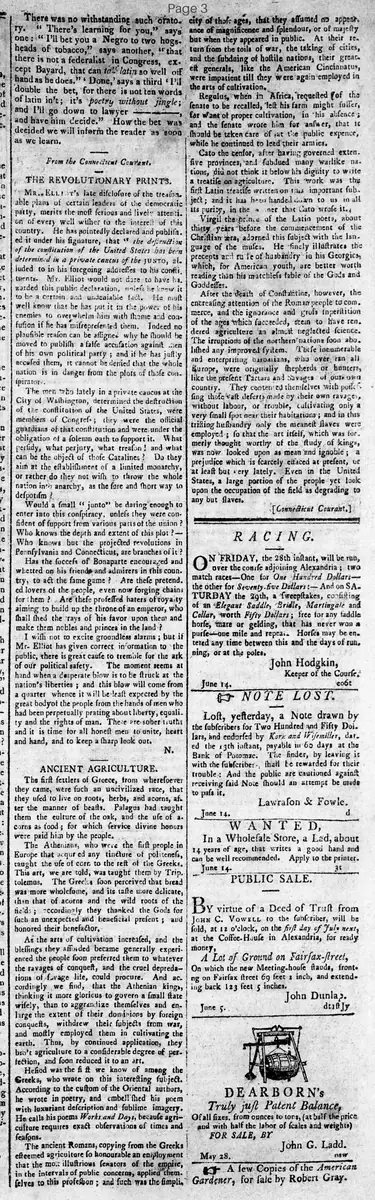
The first settlers of Greece, from wheresoever they came, were such an uncivilized race, that they used to live on roots, herbs, and acorns, after the manner of beasts. Pelasgus had taught them the culture of the oak, and the use of acorns as food; for which service divine honors were paid him by the people. The Athenians, who were the first people in Europe that acquired any tincture of politeness, taught the use of corn to the rest of the Greeks. This art, we are told, was taught them by Triptolemus. The Greeks soon perceived that bread was more wholesome, and its taste more delicate, than that of acorns and the wild roots of the fields : accordingly they thanked the Gods for such an unexpected and beneficial present ; and honored their benefactor. As the arts of cultivation increased. and the blessings they afforded became generally experienced the people soon preferred them to whatever the ravages of conquest, and the cruel depredations of savage life, could procure. And accordingly we find, that the Athenian king, thinking it more glorious to govern a small state wisely, than to aggrandize themselves and enlarge the extent of their dominions by foreign conquests, withdrew their subjects from war, and mostly employed them in cultivating the earth. Thus, by continued application, they brought agriculture to a considerable degree of perfection, and soon reduced it to an art. Hesiod was the first we know of among the Greeks, who wrote on this interesting subject. According to the custom of the Oriental authors, he wrote in poetry, and embellished his poem with luxuriant description and sublime imagery. He calls his poems Works and Days, because agriculture requires exact observations of times and seasons. The ancient Romans, copying from the Greeks esteemed agriculture so honourable an employment that the most illustrious senators of the empire. in the intervals of public concerns, applied themselves to this profession ; and such was the simplicity of those ages, that they assumed no appearance of magnificence and splendour, or of majesty but when they appeared in public. At their return from the toils of war, the taking of cities, and the subduing of hostile nations, their greatest generals, like the American Cincinnatus, were impatient till they were again employed in the arts of cultivation. Regulus, when in Africa, requested of the senate to be recalled, lest his farm might suffer, for want of proper cultivation, in his absence and the senate wrote him for answer, that it should be taken care of at the public expense, while he continued to lead their armies. Cato the censor, after having governed extensive provinces, and subdued many warlike nations, did not think it below his dignity to write a treatise on agriculture. This work was the first Latin treatise written on this important subject; and it has been handed down to us in all its purity, in the very manner that Cato wrote it. Virgil the prince of the Latin poets, about thirty years before the commencement of the Christian era, adorned this subject with the language of the muses. He finely illustrated the precepts and rules of husbandry in his Georgics, which. for American youth, are better worth reading than his matchless fable of the Gods and Goddesses. After the death: of Constantine, however, the increasing attention of the Roman people to commerce, and the ignorance and gross superstition of the ages which succeeded, seem to have rendered agriculture an almost neglected science. The irruptions of the northern nations soon abolished any improved system. These innumerable and enterprising barbarians, who over ran all Europe, were originally shepherds or hunters, like the present Tartars and Savages' of our own country. They contented themselves with possessing those vast deserts made by their own ravages, without labour, or trouble, cultivating only a very small spot near their habitations; and in this trifling husbandry only the meanest slaves were employed ; so that the art itself, which was formerly thought worthy of the study, of kings, was'now looked upon as mean and ignoble; a prejudice which is scarcely effaced at present, or at least but very lately. Even in the United States, a large portion of the people-yet look upon the occupation of the field as degrading to any but slaves.
[Connecticut Courant.]
The first settlers of Greece, from wheresoever they came, were such an uncivilized race, that they used to live on roots, herbs, and acorns, after the manner of beasts. Pelasgus had taught them the culture of the oak, and the use of acorns as food; for which service divine honors were paid him by the people. The Athenians, who were the first people in Europe that acquired any tincture of politeness, taught the use of corn to the rest of the Greeks. This art, we are told, was taught them by Triptolemus. The Greeks soon perceived that bread was more wholesome, and its taste more delicate, than that of acorns and the wild roots of the fields : accordingly they thanked the Gods for such an unexpected and beneficial present ; and honored their benefactor. As the arts of cultivation increased. and the blessings they afforded became generally experienced the people soon preferred them to whatever the ravages of conquest, and the cruel depredations of savage life, could procure. And accordingly we find, that the Athenian king, thinking it more glorious to govern a small state wisely, than to aggrandize themselves and enlarge the extent of their dominions by foreign conquests, withdrew their subjects from war, and mostly employed them in cultivating the earth. Thus, by continued application, they brought agriculture to a considerable degree of perfection, and soon reduced it to an art. Hesiod was the first we know of among the Greeks, who wrote on this interesting subject. According to the custom of the Oriental authors, he wrote in poetry, and embellished his poem with luxuriant description and sublime imagery. He calls his poems Works and Days, because agriculture requires exact observations of times and seasons. The ancient Romans, copying from the Greeks esteemed agriculture so honourable an employment that the most illustrious senators of the empire. in the intervals of public concerns, applied themselves to this profession ; and such was the simplicity of those ages, that they assumed no appearance of magnificence and splendour, or of majesty but when they appeared in public. At their return from the toils of war, the taking of cities, and the subduing of hostile nations, their greatest generals, like the American Cincinnatus, were impatient till they were again employed in the arts of cultivation. Regulus, when in Africa, requested of the senate to be recalled, lest his farm might suffer, for want of proper cultivation, in his absence and the senate wrote him for answer, that it should be taken care of at the public expense, while he continued to lead their armies. Cato the censor, after having governed extensive provinces, and subdued many warlike nations, did not think it below his dignity to write a treatise on agriculture. This work was the first Latin treatise written on this important subject; and it has been handed down to us in all its purity, in the very manner that Cato wrote it. Virgil the prince of the Latin poets, about thirty years before the commencement of the Christian era, adorned this subject with the language of the muses. He finely illustrated the precepts and rules of husbandry in his Georgics, which. for American youth, are better worth reading than his matchless fable of the Gods and Goddesses. After the death: of Constantine, however, the increasing attention of the Roman people to commerce, and the ignorance and gross superstition of the ages which succeeded, seem to have rendered agriculture an almost neglected science. The irruptions of the northern nations soon abolished any improved system. These innumerable and enterprising barbarians, who over ran all Europe, were originally shepherds or hunters, like the present Tartars and Savages' of our own country. They contented themselves with possessing those vast deserts made by their own ravages, without labour, or trouble, cultivating only a very small spot near their habitations; and in this trifling husbandry only the meanest slaves were employed ; so that the art itself, which was formerly thought worthy of the study, of kings, was'now looked upon as mean and ignoble; a prejudice which is scarcely effaced at present, or at least but very lately. Even in the United States, a large portion of the people-yet look upon the occupation of the field as degrading to any but slaves.
[Connecticut Courant.]
What sub-type of article is it?
Essay
What themes does it cover?
Agriculture Rural
What keywords are associated?
Ancient Agriculture
Greek Settlers
Hesiod Works And Days
Roman Farming
Cato Treatise
Virgil Georgics
Barbarian Invasions
What entities or persons were involved?
[Connecticut Courant.]
Literary Details
Title
Ancient Agriculture.
Author
[Connecticut Courant.]
Form / Style
Prose Historical Reflection
Key Lines
Hesiod Was The First We Know Of Among The Greeks, Who Wrote On This Interesting Subject.
Virgil The Prince Of The Latin Poets, About Thirty Years Before The Commencement Of The Christian Era, Adorned This Subject With The Language Of The Muses.
Even In The United States, A Large Portion Of The People Yet Look Upon The Occupation Of The Field As Degrading To Any But Slaves.