Thank you for visiting SNEWPapers!
Sign up free
Literary
August 23, 1872
The Andrew County Republican
Savannah, Andrew County, Missouri
What is this article about?
Article explores Shakespeare's anatomical insight in Hamlet about the ear's musical complexity, detailing the rods of Corti based on Dr. Pritchard's Royal Society paper, explaining sound transmission and perception in the cochlea.
Clipping
OCR Quality
98%
Excellent
Full Text
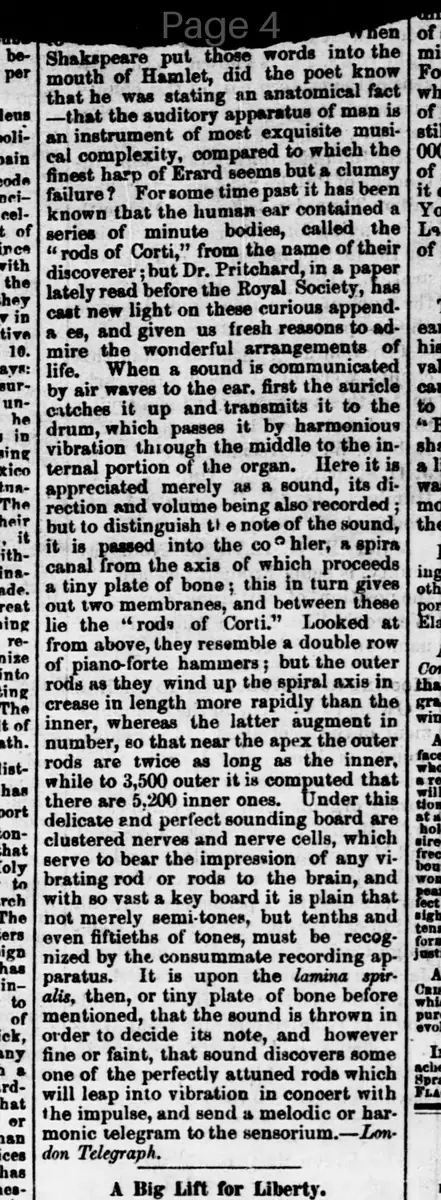
Shakspeare put those words into the mouth of Hamlet, did the poet know that he was stating an anatomical fact—that the auditory apparatus of man is an instrument of most exquisite musical complexity, compared to which the finest harp of Erard seems but a clumsy failure? For some time past it has been known that the human ear contained a series of minute bodies, called the "rods of Corti," from the name of their discoverer; but Dr. Pritchard, in a paper lately read before the Royal Society, has cast new light on these curious appendages, and given us fresh reasons to admire the wonderful arrangements of life. When a sound is communicated by air waves to the ear, first the auricle catches it up and transmits it to the drum, which passes it by harmonious vibration through the middle to the internal portion of the organ. Here it is appreciated merely as a sound, its direction and volume being also recorded; but to distinguish the note of the sound it is passed into the cochlea, a spiral canal from the axis of which proceeds a tiny plate of bone; this in turn gives out two membranes, and between these lie the rods of Corti. Looked at from above, they resemble a double row of piano-forte hammers; but the outer rods as they wind up the spiral axis increase in length more rapidly than the inner, whereas the latter augment in number, so that near the apex the outer rods are twice as long as the inner, while to 3,500 outer it is computed that there are 5,200 inner ones. Under this delicate and perfect sounding board are clustered nerves and nerve cells, which serve to bear the impression of any vibrating rod or rods to the brain, and with so vast a key board it is plain that not merely semi-tones, but tenths and even fiftieths of tones, must be recognized by the consummate recording apparatus. It is upon the lamina spiralis, then, or tiny plate of bone before mentioned, that the sound is thrown in order to decide its note, and however fine or faint, that sound discovers some one of the perfectly attuned rods which will leap into vibration in concert with the impulse, and send a melodic or harmonic telegram to the sensorium.—London Telegraph.
What sub-type of article is it?
Essay
What keywords are associated?
Shakespeare
Hamlet
Human Ear
Rods Of Corti
Dr Pritchard
Royal Society
Anatomy
Sound Perception
What entities or persons were involved?
London Telegraph
Literary Details
Author
London Telegraph
Subject
Anatomical Fact In Hamlet And Rods Of Corti
Form / Style
Prose Reflection On Science Via Literature
Key Lines
Shakspeare Put Those Words Into The Mouth Of Hamlet, Did The Poet Know That He Was Stating An Anatomical Fact—That The Auditory Apparatus Of Man Is An Instrument Of Most Exquisite Musical Complexity, Compared To Which The Finest Harp Of Erard Seems But A Clumsy Failure?
The Human Ear Contained A Series Of Minute Bodies, Called The "Rods Of Corti," From The Name Of Their Discoverer; But Dr. Pritchard, In A Paper Lately Read Before The Royal Society, Has Cast New Light On These Curious Appendages
Under This Delicate And Perfect Sounding Board Are Clustered Nerves And Nerve Cells, Which Serve To Bear The Impression Of Any Vibrating Rod Or Rods To The Brain, And With So Vast A Key Board It Is Plain That Not Merely Semi Tones, But Tenths And Even Fiftieths Of Tones, Must Be Recognized By The Consummate Recording Apparatus.