Thank you for visiting SNEWPapers!
Sign up free
The New Hampshire Gazette
Portsmouth, Rockingham County, New Hampshire
What is this article about?
On April 22, 1796, a large public meeting in New York City, chaired by Francis Van Dyck, unanimously adopted resolutions condemning the Jay Treaty with Britain as impolitic, unconstitutional, and prejudicial. They approved House actions and submitted a memorial urging Congress to protect constitutional rights and refuse funding, pledging support at risk of life and fortune.
Merged-components note: Continuation of the New-York town meeting report and memorial against the British treaty.
Clipping
OCR Quality
Full Text
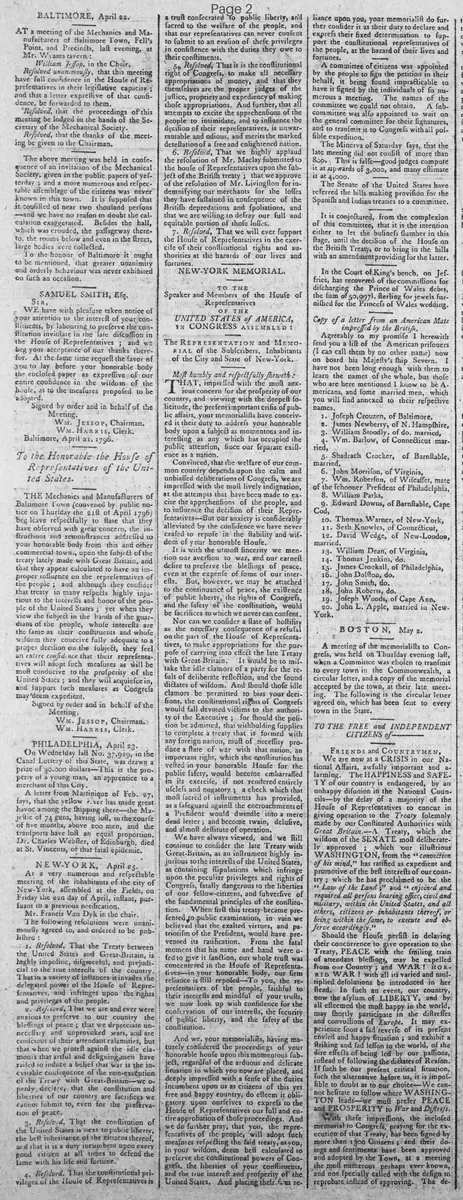
At a very numerous and respectable meeting of the inhabitants of the city of New-York, assembled at the Fields, on Friday the 22d day of April, instant, pursuant to a previous notification.
Mr. Francis Van Dyck in the chair.
The following resolutions were unanimously agreed to, and ordered to be published:
1. Resolved, That the Treaty between the United States and Great-Britain, is highly impolitic, disgraceful, and prejudicial to the true interests of the country. That in a variety of instances it invades the delegated power of the House of Representatives, and infringes upon the rights and privileges of the people.
2. Resolved, That we are and ever were anxious to preserve to our country the blessings of peace; that we deprecate unnecessary and unprovoked wars, and are conscious of their attendant calamities, but that when we protest against the idle clamours that artful and designing men have raised to induce a belief that war is the inevitable consequence of the non-execution of the Treaty with Great-Britain—we openly declare, that the constitution and liberties of our country are sacrifices we cannot submit to, even for the preservation of peace.
3. Resolved, That the constitution of the United States is next to public liberty, the best inheritance of the citizens thereof, and that it is a duty incumbent upon every good citizen at all times to defend the same with his life and fortune.
4. Resolved. That the constitutional privileges of the House of Representatives is a trust consecrated to public liberty. and sacred to the welfare of the people, and that our representatives can never consent to submit to an evasion of these privileges in consistence with the duties they owe to their constituents.
5. Resolved, That it is the constitutional right of Congress, to make all necessary appropriations of money, and that they themselves are the proper judges of the justice, propriety and expediency of making those appropriations. And further, that all attempts to excite the apprehensions of the people to intimidate, and to influence the decision of their representatives, is unwarrantable and odious, and merits the marked detestation of a free and enlightened nation.
6. Resolved. That we highly applaud the resolution of Mr. Maclay submitted to the house of Representatives upon the subject of the British treaty; that we approve of the resolution of Mr. Livingston for indemnifying our merchants for the loss they have sustained in consequence of the British depredations and spoliations, and that we are willing to defray our full and equitable portion of those losses.
7. Resolved, That we will ever support the House of Representatives in the exercise of their constitutional rights and authorities at the hazards of our lives and fortunes.
NEW-YORK MEMORIAL.
TO THE
Speaker and Members of the House of
Representatives
OF THE
UNITED STATES of AMERICA,
IN CONGRESS ASSEMBLED:
The Representation and Memo-
RIAL of the Subscribers, Inhabitants
of the City and State of New-York.
Most humbly and respectfully sheweth:
THAT, impressed with the most anxious concern for the prosperity of our country, and viewing with the deepest solicitude, the present important crisis of public affairs, your memorialists have conceived it their duty to address your honorable body upon a subject as momentous and interesting as any which has occupied the public attention, since our separate existence as a nation.
Convinced, that the welfare of our common country depends upon the calm and unbiased deliberations of Congress, we are impressed with the most lively indignation, at the attempts that have been made to excite the apprehensions of the people, and to influence the decision of their Representatives—But our anxiety is considerably alleviated by the confidence we have never ceased to repose in the stability and wisdom of your honorable House.
It is with the utmost sincerity we mention our aversion to war, and our earnest desire to preserve the blessings of peace, even at the expense of some of our interests. But, however, we may be attached to the continuance of peace, the existence of public liberty, the rights of Congress, and the safety of the constitution, would be sacrifices to which we never can consent.
Nor can we consider a state of hostility as the necessary consequence of a refusal on the part of the House of Representatives, to make appropriations for the purpose of carrying into effect the late Treaty with Great-Britain. It would be to mistake the idle clamors of a party for the result of deliberate reflection, and the sound dictates of wisdom. And should those idle clamors. be permitted to bias your decisions, the constitutional rights of Congress would fall devoted victims to the authority of the Executive; for should the position be admitted, that withholding supplies to complete a treaty that is formed with any foreign nation, must of necessity produce a state of war with that nation, an important right, which the constitution has vested in your honorable House for the public safety, would become embarrassed in its exercise, if not rendered entirely useless and nugatory; a check which that most sacred of instruments has provided, as a safeguard against the encroachments of a President would dwindle into a mere dead letter; and become twain, delusive, and almost destitute of operation.
We have always viewed, and we still continue to consider the late Treaty with Great-Britain, as an instrument highly injurious to the interests of the United States, as containing stipulations which infringe upon the peculiar privileges and rights of Congress, fatally dangerous to the liberties of our fellow-citizens, and subversive of the fundamental principles of the constitution. When first this treaty· became presented to public examination, in vain we believed that the exalted virtues, and patriotism of the President, would have prevented its ratification. From the fatal moment that his name and hand were used to give it sanction, our whole trust was concentered in the House of Representatives—in your honorable body, our firm reliance is still reposed—To you, the representatives of the people, faithful to their interests and mindful of your trusts, we now look up with confidence for the conservation of our interests, the security of public liberty, and the safety of the constitution.
And we, your memorialists, having maturely considered the proceedings of your honorable house upon this momentous subject, regardful of the arduous and delicate situation in which you now are placed, and deeply impressed with a sense of the duties incumbent upon us as citizens of this yet free and happy country, do esteem it obligatory upon ourselves to express to the House of Representatives our full and entire approbation of those proceedings. And we do further pray, that you, the representatives of the people, will adopt such measures respecting the said treaty, as you, in your wisdom, deem best calculated to preserve the constitutional powers of Congress, the liberties of your constituents, and the true interest and prosperity of the United States. And placing their firm reliance upon you, your memorialists do further consider it as their duty to declare and express their fixed determination to support the constitutional representatives of the people, at the hazard of their lives and fortunes.
A committee of citizens was appointed by the people to sign the petition in their behalf, it being found impracticable to have it signed by the individuals of so numerous a meeting. The names of the committee we could not obtain. A sub-committee was also appointed to wait on the general committee for their signatures, and to transmit it to Congress with all possible expedition.
The Minerva of Saturday says, that the late meeting did not consist of more than 800. This is false—good judges compute it at upwards of 3,000, and many estimate it at 4,000.
What sub-type of article is it?
What keywords are associated?
What entities or persons were involved?
Where did it happen?
Domestic News Details
Primary Location
New York
Event Date
Friday The 22d Day Of April, Instant
Key Persons
Outcome
resolutions unanimously adopted and ordered published; memorial prepared and committee appointed to sign and transmit to congress; meeting estimated at 3,000-4,000 attendees.
Event Details
A numerous meeting of New York inhabitants at the Fields adopted seven resolutions criticizing the US-Britain Treaty as impolitic, disgraceful, and infringing on House powers and public rights. They affirmed commitment to peace but prioritized constitution and liberties, applauded resolutions by Maclay and Livingston, and pledged support to the House. A detailed memorial to the House expressed indignation at attempts to intimidate Congress, viewed the treaty as injurious, and prayed for measures to preserve constitutional powers and national interests.