Thank you for visiting SNEWPapers!
Sign up free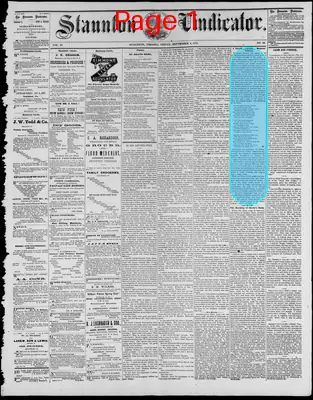
Literary
September 4, 1874
Staunton Vindicator
Staunton, Virginia
What is this article about?
Biographical remembrance of young Lynchburg poet Bransford Vawter, who died prematurely. Includes his poignant 1824 poem of unrequited love for a higher-class woman, misattributed to Thomas Moore, and reflects on his lost potential.
Clipping
OCR Quality
98%
Excellent
Full Text
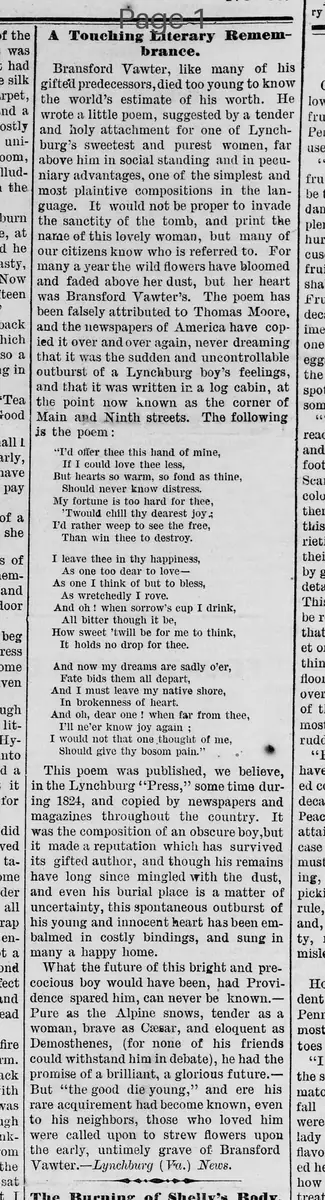
A Touching Literary Remembrance.
Bransford Vawter, like many of his gifted predecessors, died too young to know the world's estimate of his worth. He wrote a little poem, suggested by a tender and holy attachment for one of Lynchburg's sweetest and purest women, far above him in social standing and in pecuniary advantages, one of the simplest and most plaintive compositions in the language. It would not be proper to invade the sanctity of the tomb, and print the name of this lovely woman, but many of our citizens know who is referred to. For many a year the wild flowers have bloomed and faded above her dust, but her heart was Bransford Vawter's. The poem has been falsely attributed to Thomas Moore, and the newspapers of America have copied it over and over again, never dreaming that it was the sudden and uncontrollable outburst of a Lynchburg boy's feelings, and that it was written in a log cabin, at the point now known as the corner of Main and Ninth streets. The following is the poem:
"I'd offer thee this heart of mine,
If I could love thee less,
But hearts so warm, so fond as thine,
Should never know distress.
My fortune is too hard for thee,
'Twould chill thy dearest joy;
I'd rather weep to see thee free,
Than win thee to destroy.
I leave thee in thy happiness.
As one too dear to love—
As one I think of but to bless
As wretchedly I rove.
And oh! when sorrow's cup I drink,
All bitter though it be.
How sweet 'twill be for me to think,
It holds no drop for thee.
And now my dreams are sadly o'er
Fate bids them all depart,
And I must leave my native shore,
In brokenness of heart.
And oh, dear one! when far from thee,
I'll ne'er know joy again;
I would not that one thought of me,
Should give thy bosom pain."
This poem was published, we believe, in the Lynchburg "Press," some time during 1824, and copied by newspapers and magazines throughout the country. It was the composition of an obscure boy, but it made a reputation which has survived its gifted author, and though his remains have long since mingled with the dust, and even his burial place is a matter of uncertainty, this spontaneous outburst of his young and innocent heart has been embalmed in costly bindings, and sung in many a happy home.
What the future of this bright and precocious boy would have been, had Providence spared him, can never be known.— Pure as the Alpine snows, tender as a woman, brave as Caesar, and eloquent as Demosthenes, (for none of his friends could withstand him in debate), he had the promise of a brilliant, a glorious future.— But "the good die young," and ere his rare acquirement had become known, even to his neighbors, those who loved him were called upon to strew flowers upon the early, untimely grave of Bransford Vawter.—Lynchburg (Va.) News.
Bransford Vawter, like many of his gifted predecessors, died too young to know the world's estimate of his worth. He wrote a little poem, suggested by a tender and holy attachment for one of Lynchburg's sweetest and purest women, far above him in social standing and in pecuniary advantages, one of the simplest and most plaintive compositions in the language. It would not be proper to invade the sanctity of the tomb, and print the name of this lovely woman, but many of our citizens know who is referred to. For many a year the wild flowers have bloomed and faded above her dust, but her heart was Bransford Vawter's. The poem has been falsely attributed to Thomas Moore, and the newspapers of America have copied it over and over again, never dreaming that it was the sudden and uncontrollable outburst of a Lynchburg boy's feelings, and that it was written in a log cabin, at the point now known as the corner of Main and Ninth streets. The following is the poem:
"I'd offer thee this heart of mine,
If I could love thee less,
But hearts so warm, so fond as thine,
Should never know distress.
My fortune is too hard for thee,
'Twould chill thy dearest joy;
I'd rather weep to see thee free,
Than win thee to destroy.
I leave thee in thy happiness.
As one too dear to love—
As one I think of but to bless
As wretchedly I rove.
And oh! when sorrow's cup I drink,
All bitter though it be.
How sweet 'twill be for me to think,
It holds no drop for thee.
And now my dreams are sadly o'er
Fate bids them all depart,
And I must leave my native shore,
In brokenness of heart.
And oh, dear one! when far from thee,
I'll ne'er know joy again;
I would not that one thought of me,
Should give thy bosom pain."
This poem was published, we believe, in the Lynchburg "Press," some time during 1824, and copied by newspapers and magazines throughout the country. It was the composition of an obscure boy, but it made a reputation which has survived its gifted author, and though his remains have long since mingled with the dust, and even his burial place is a matter of uncertainty, this spontaneous outburst of his young and innocent heart has been embalmed in costly bindings, and sung in many a happy home.
What the future of this bright and precocious boy would have been, had Providence spared him, can never be known.— Pure as the Alpine snows, tender as a woman, brave as Caesar, and eloquent as Demosthenes, (for none of his friends could withstand him in debate), he had the promise of a brilliant, a glorious future.— But "the good die young," and ere his rare acquirement had become known, even to his neighbors, those who loved him were called upon to strew flowers upon the early, untimely grave of Bransford Vawter.—Lynchburg (Va.) News.
What sub-type of article is it?
Poem
Essay
What themes does it cover?
Love Romance
Death Mortality
Moral Virtue
What keywords are associated?
Unrequited Love
Lyric Poem
Bransford Vawter
Lynchburg
Thomas Moore Attribution
1824 Publication
Literary Details
Title
A Touching Literary Remembrance.
Subject
Remembrance Of Bransford Vawter's Poem Inspired By Unrequited Love For A Lynchburg Woman
Key Lines
I'd Offer Thee This Heart Of Mine,
If I Could Love Thee Less,
But Hearts So Warm, So Fond As Thine,
Should Never Know Distress.
I Leave Thee In Thy Happiness.