Thank you for visiting SNEWPapers!
Sign up free
Arizona Citizen
Tucson, Florence, Pima County, Pinal County, Arizona
What is this article about?
Deputy marshals from Tucson attempted to arrest Es-ke-van-zin, an Indian indicted for murdering Charles McKinney at Camp Grant on October 27, but he evaded capture and continued receiving rations there, highlighting protection issues.
Clipping
OCR Quality
Full Text
Protection.
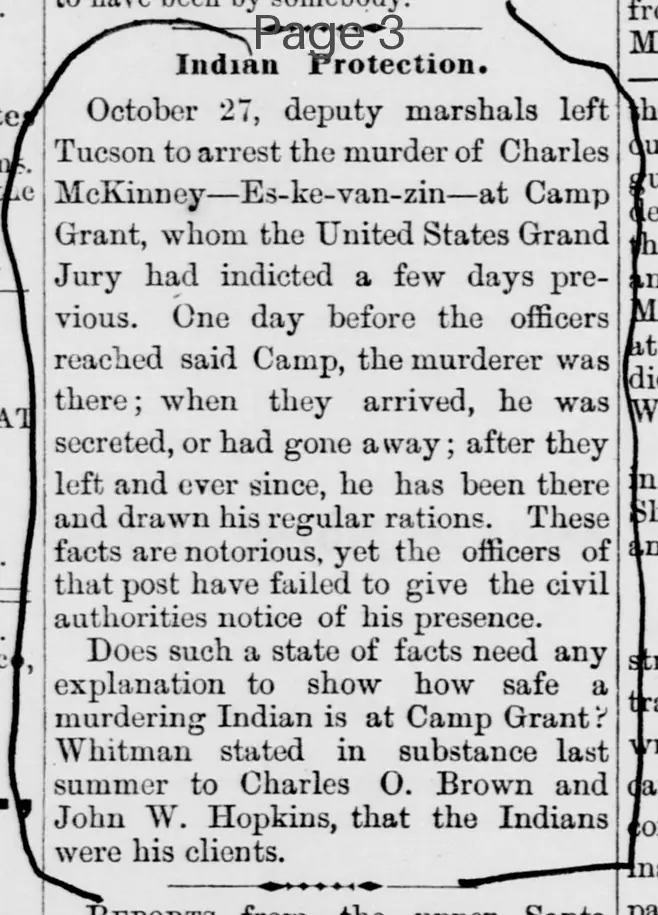
October 27, deputy marshals left Tucson to arrest the murderer of Charles McKinney—Es-ke-van-zin—at Camp Grant, whom the United States Grand Jury had indicted a few days previous. One day before the officers reached said Camp, the murderer was there; when they arrived, he was secreted, or had gone away; after they left and ever since, he has been there and drawn his regular rations. These facts are notorious, yet the officers of that post have failed to give the civil authorities notice of his presence. Does such a state of facts need any explanation to show how safe a murdering Indian is at Camp Grant? Whitman stated in substance last summer to Charles O. Brown and John W. Hopkins, that the Indians were his clients.
What sub-type of article is it?
What keywords are associated?
What entities or persons were involved?
Where did it happen?
Domestic News Details
Primary Location
Camp Grant
Event Date
October 27
Key Persons
Outcome
murderer evaded arrest and continued to receive regular rations at camp grant.
Event Details
Deputy marshals left Tucson on October 27 to arrest Es-ke-van-zin, indicted by the U.S. Grand Jury for murdering Charles McKinney at Camp Grant. The murderer was present just before their arrival but hid or left temporarily; he returned after they departed and has remained, drawing rations, with post officers failing to notify civil authorities. Whitman told Brown and Hopkins last summer that the Indians were his clients.