Thank you for visiting SNEWPapers!
Sign up free
The Daily Evansville Journal
Evansville, Vanderburgh County, Indiana
What is this article about?
Kentucky politician Mr. Wickliffe speaks in Indiana during the Civil War, rallying support for the Union and Constitution, blaming abolitionists and secessionists for the conflict, defending slavery, and criticizing emancipation policies and arming of Black people.
Clipping
OCR Quality
Full Text
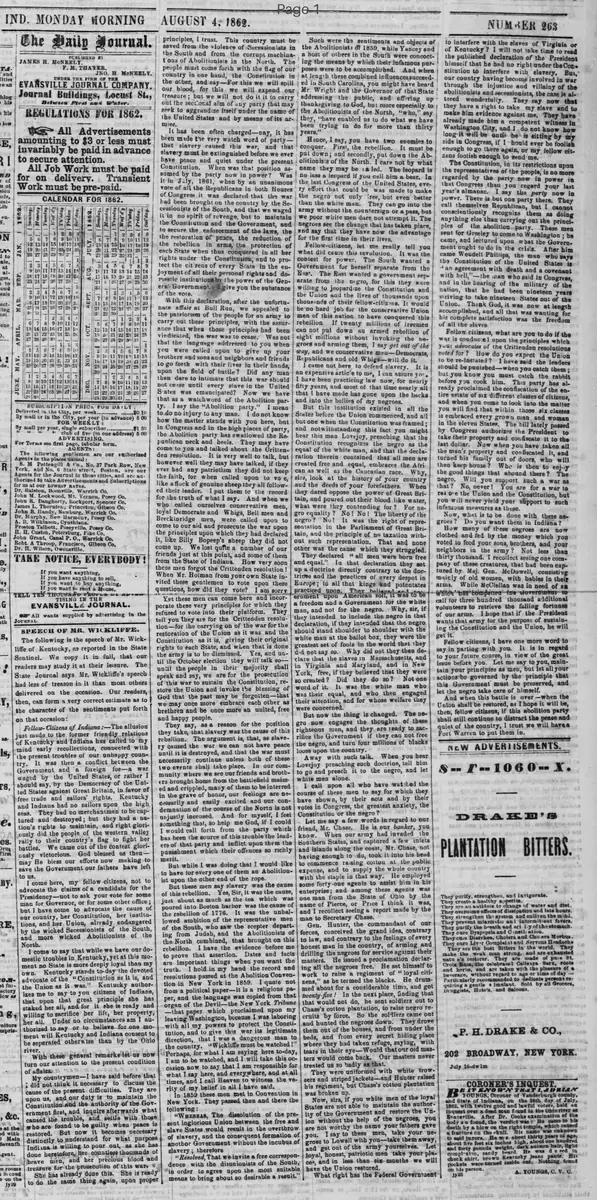
The following is the speech of Mr. Wickliffe of Kentucky, as reported in the State Sentinel. We copy it in full, that our readers may study it at their leisure. The State Journal says Mr. Wickliffe's speech had less of treason in it than most others delivered on the occasion. Our readers, then, can form a very correct estimate as to the character of the sentiments put forth on that occasion:
Fellow-Citizens of Indiana:—The allusion just made to the former friendly relations of Kentucky and Indiana has called to my mind early recollections, connected with the present troubles of our unhappy country. It was then a conflict between the Government and a foreign foe—a war waged by the United States, or rather I should say, by the Democracy of the United States against Great Britain, in favor of free trade and sailors' rights. Kentucky and Indiana had no sailors upon the high seas. They had no merchantmen to be captured and destroyed; but they had a nation's rights to maintain, and right gloriously did the people of the western valley rally to their country's flag to fight her battles. We came out of the contest gloriously victorious. God blessed us then—may He bless our efforts now making to save the Government our fathers have left to us.
I come here, my fellow-citizens, not to advocate the claims of a candidate for the Presidency—not to ask your vote for some man for Governor, or for some other office; but I have come to advocate the cause of our country, her Constitution, her institutions, and her Union, already endangered by the wicked Secessionists of the South, and more wicked Abolitionists of the North.
I come to say that while we have our domestic troubles in Kentucky, yet at this moment no State is more deeply loyal than my own. Kentucky stands to-day the devoted advocate of the "Constitution as it is, and the Union as it was." Kentucky authorizes me to say to you citizens of Indiana, that upon that great principle she has staked her all, and for it she is ready and willing to sacrifice her life, her property, her all. Under no circumstances am I authorized to say or to believe for one moment will Kentucky and Indiana consent to be separated otherwise than by the Ohio river.
With these general remarks let us now turn our attention to the present condition of affairs.
My countrymen—I have said before that I did not think it necessary to discuss the cause of the present difficulties. They are upon us, and our duty is to maintain the Constitution and the authority of the Government first, and inquire afterwards what caused the trouble, and settle with those who are found to be guilty when peace is restored. But now it becomes necessary distinctly to understand for what purpose Indiana is willing to pour out, as she has done heretofore, her countless thousands of brave men, and her precious blood and treasure for the prosecution of this war. She has already done this. She is ready to do the same thing again, upon proper principles, I trust.
This country must be saved from the violence of Secessionists in the South and from the corrupt machinations of Abolitionists in the North. The people must come forth with the flag of our country in one hand, the Constitution in the other, and say—For this we will spill our blood, for this we will expend our treasure; but we will not do it to carry out the sectional aim of any party that may seek to aggrandize itself under the name of the United States and by means of its armies.
It has been often charged—nay, it has been made the very watch word of party—that slavery caused this war, and that slavery must be extinguished before we ever have peace and quiet under the present Constitution. When was that position assumed by the party now in power? Was it in July, 1861, when by an unanimous vote of all the Republicans in both Houses of Congress it was declared that the war had been brought on the country by the Secessionists of the South, and that we waged it in no spirit of revenge, but to maintain the Constitution and the Government, and to secure the enforcement of the laws, the restoration of peace, the reduction of the rebellion in arms, the protection of each State when thus conquered in all her rights under the Constitution, and to protect the citizens of every State in the enjoyment of all their personal rights and domestic institutions by the power of the General Government. I give you the substance of the vote.
With this declaration, after the unfortunate affair at Bull Run, we appealed to the patriotism of the people for an army to carry out these principles, with the assurance that when those principles had been vindicated, the war was to cease. Was not that the language addressed to you when you were called upon to give up your brothers and sons and neighbors and friends to go forth with their lives in their hands, upon the field of battle? Did any man then dare to intimate that this war should not cease until every slave in the United States was emancipated? Now we have that as a watchword of the Abolition party. I say the "Abolition party." I mean to do no injury to any man. I do not know how the matter stands with you here, but in Congress and in the high places of party, the Abolition party has swallowed the Republican neck and heels. They may have come to you and talked about the Crittenden resolution. It is very well to talk, but however well they may have talked, if they ever had any patriotism they did not keep the faith, for when called upon to vote, like a flock of genuine sheep they all followed their leader. I put them to the record for the truth of what I say. And when we who called ourselves conservative men, loyal Democrats and Whigs, Bell men and Breckinridge men, were called upon to come to our aid and prosecute the war upon the principles upon which they had declared it, like Billy Bo-peep's sheep they did not come up. We lost quite a number of our friends just at this point, and some of them from the State of Indiana. How very soon these men forgot the Crittenden resolution! When Mr. Holman from your own State invited these gentlemen to vote upon these questions, how did they vote? I am sorry. Yet these men can come here and incorporate these very principles for which they refused to vote into their platform. They tell you they are for the Crittenden resolution— for the carrying on of the war for the restoration of the Union as it was and the Constitution as it is, giving their original rights to each State, and when that is done the army is to be dismissed. Yes, and until the October election they will talk so—until the people in their majority shall speak and say, we are for the prosecution of this war to sustain the Constitution, restore the Union and invoke the blessing of God that the past may be forgotten—that we may once more embrace each other as brethren and be once more an united, free and happy people.
They say, as a reason for the position they take, that slavery was the cause of this rebellion. The argument is, that, as slavery caused the war we can not have peace until it is destroyed, and that the war must necessarily continue unless both of these two events shall take place. In our community where we see our friends and brothers brought home from the battlefield maimed and crippled, many of them to be interred in the grave of honor, our feelings are necessarily and easily excited and our condemnation of the course of the North is not unjustly incensed. And for myself, I feel something that, so help me God, if I could I would call forth from the party which has been the source of this trouble the leaders of that party and inflict upon them the punishment which their offences so richly merit.
But while I was doing that I would like to have for every one of them an Abolitionist upon the other end of the rope.
But these men say slavery was the cause of this rebellion. Yes, Sir, it was the cause, just about as much as the tea which was poured into Boston harbor was the cause of the rebellion of 1776. It was the unballowed ambition of the representative men of the South, who saw the scepter departing from Judah, and the Abolitionists of the North combined, that brought on this rebellion. I have the evidence before me to prove that assertion. Dates and facts are important things when you want the truth. I hold in my hand the record and resolutions passed at the Abolition Convention in New York in 1859. I quote not from a political paper—it is a religious paper, and the language was copied from that organ of the Devil—the New York Tribune —that paper which proclaimed upon my leaving Washington, because I was laboring with all my powers to protect the Constitution, and to give this war its legitimate direction, that I was a dangerous man to the country. "Wickliffe must be watched!" Perhaps, for what I am saying here to-day, I am to be watched, and I will take this occasion now to say that I am responsible for what I say here, and everywhere, and at all times, and I call Heaven to witness the verity of my belief in all I have said.
In 1859 these men met in Convention in New York. They passed then and there the following:
"Whereas, The dissolution of the present inglorious Union between the free and slave States would result in the overthrow of slavery, and the consequent formation of another Government without the incubus of slavery: therefore
"Resolved, That we invite a free correspondence with the disunionists of the South, in order to agree upon the most suitable means to bring about so desirable a result."
Such were the sentiments and objects of the Abolitionists of 1859, while Yancey and a host of others in the South were concocting the means by which their infamous purposes were to be accomplished. And when at length these combined influences succeeded in South Carolina, you might have heard Mr. Wright and the Governor of that State addressing the public, and offering up thanksgiving to God, but more especially to the Abolitionists of the North, "who," say they, "have enabled us to do what we have been trying to do for more than thirty years."
Hence, I say, you have two enemies to conquer. First, the rebellion. It must be put down; and secondly, put down the Abolitionists of the North. I care not by what name they may be called. The leopard is no less a leopard if you call him a bear. In the last Congress of the United States, every effort that could be was made to make the negro not only free, but even better than the white man. They can go into the army without the countersign or a pass, but we poor white men dare not attempt it. The negroes see the change that has taken place, and say that they have now the advantage for the first time in their lives.
Fellow-citizens, let me really tell you what did cause this revolution. It was the contest for power. The South wanted a Government for herself separate from the East. The East wanted a government separate from the negro, for this they were willing to jeopardize the Constitution and the Union and the lives of thousands upon thousands of their fellow-citizens. It would be no hard job for the conservative Union men of this nation to have conquered this rebellion. If twenty millions of freemen can not put down an armed rebellion of eight millions without invoking the negroes and arming them, I say get out of the way, and we conservative men—Democrats, Republicans and old Whigs—will do it.
I came not here to defend slavery. It is an expensive article to me, I can assure you. I have been practicing law now, for nearly fifty years, and most of that time nearly all that I have made has gone upon the backs and into the bellies of my negroes.
But this institution existed in all the States before the Union commenced, and all but one when the Constitution was framed; and notwithstanding this fact you might hear this man Lovejoy, preaching that the Constitution recognizes the negro as the equal of the white man, and that the declaration therein contained that all men are created free and equal, embraces the African as well as the Caucasian race. Why, sir, look at the history of your country and the deeds of your forefathers. When they dared oppose the power of Great Britain, and poured out their blood like water, what were they contending for? For negro equality? No! No! The liberty of the negro? No! It was the right of representation in the Parliament of Great Britain, and the principle of no taxation without such representation. That and none other was the cause which they struggled. They declared "all men were born free and equal." In that declaration they set up a doctrine directly contrary to the doctrines and the practices of every despot in Europe; to all that kings and potentates practiced upon. They believed no government upon American soil, it was to be a freedom and a Government for the white man, and not for the negro. Why, sir, if they intended to include the negro in that declaration, if they intended that the negro should stand shoulder to shoulder with the white man at the ballot box, they were the greatest set of fools in the world that they did not say so. Why did not they then declare that the slaves in Massachusetts, and in Virginia and Maryland, and in New York, free, if they believed that they were so created? Did they do so? Not one word of it. It was the white man who was their equal, and who then engaged their attention, and for whose welfare they were concerned.
But now the thing is changed. The negro now engages the thoughts of these righteous men, and they are ready to sacrifice the Government if they can not free the negro, and turn four millions of blacks loose upon the country.
Away with such talk. When you hear Lovejoy preaching such doctrine, tell him to go and preach it to the negro, and let white men alone.
I call upon all who have watched the course of these men to say for which they have shown, by their acts and by their votes in Congress, the greatest anxiety, the Constitution or the negro?
Let me say a few words in regard to our friend, Mr. Chase. He is our banker, you know. When our army had invaded the Southern States, and captured a few inlets and islands along the coast, Mr. Chase, not having enough to do, took it into his head to commence raising cotton at the public expense, and to supply the whole country with the staple in that way. He employed some forty-one agents to assist him in his enterprise; and among these agents was one man from the State of Ohio by the name of Pierce, or Price I think it was, and I recollect seeing a report made by the man to Secretary Chase.
Gen. Hunter, the commandant of our forces, conceived the grand idea, contrary to law, and contrary to the feelings of every honest man in the country, of arming and drilling the negroes for service against their masters. He issued a proclamation declaring all the negroes free. He set himself to work to raise a regiment of "loyal citizens," as he termed the blacks. He drummed about for a considerable time, and got twenty-five! In the next place, finding that that would not do, he sent soldiers out to Chase's cotton plantation, to raise negro recruits by force. So the soldiers came out and hunted the negroes down. They drove them out of the houses, and from under the beds, and from every secret hiding place where they had taken refuge, saying, with tears in their eyes—Would that our old masters would come back. Our masters never treated us so badly as that.
They were uniformed with white trousers and striped jackets—and Hunter raised his regiment, but Chase's cotton plantation was broken up.
Now, sirs, if you white men of the loyal States are not able to maintain the authority of the Government and restore the Union without the help of the negroes, you are not worthy the name your fathers gave you. I say to these men, take your negroes to Lowell with you—take them away, and get out of the army yourselves. Let loyal, honest, patriotic men take your places, and in less than six months we will have the Union restored.
What right has the Federal Government to interfere with the slaves of Virginia or of Kentucky? I will not take time to read the published declaration of the President himself that he had no right under the Constitution to interfere with slavery. But, our country having become involved in war through the injustice and villainy of the abolitionists and secessionists, the case altered wonderfully. They say now that they have a right to take my slave and to make him evidence against me. They have already made him a competent witness in Washington City, and I do not know how long it will be until he is sitting by my side in Congress, if I should ever be foolish enough to go there again, or my fellow citizens foolish enough to send me.
The Constitution, in its restrictions upon the representatives of the people, is no more regarded by the party now in power in that Congress than you regard your last year's almanac. I say the party now in power. There is but one party there. They call themselves Republican, but I cannot conscientiously recognize them as doing anything else than carrying out the principles of the abolition party. These men sent for Greeley to come to Washington; he came, and lectured upon what the Government ought to do in the crisis. After him came Wendell Phillips, the man who says the Constitution of the United States is an agreement with death and a covenant with hell,"—the man who said in Congress, and in the hearing of the military of the nation, that he had been nineteen years striving to take nineteen States out of the Union. Thank God, it was now at length accomplished, and all that was wanting for his complete satisfaction was the freedom of all the slaves.
Fellow citizens, what are you to do if the war is conducted upon the principles which your advocates of the Crittenden resolutions voted for? How do you expect the Union to be re-instated? I have said the leaders should be punished—when you catch them; but you know you must catch the rabbit before you cook him. This party has already proclaimed the confiscation of the entire estate of six different classes of citizens, and when you come to look into the matter you will find that within those six classes is embraced every grown man and woman in the eleven States. The bill lately passed by Congress authorizes the President to take their property and confiscate it to the last dollar. Now when you have taken all the man's property and confiscated it, and turned his family out of doors, who will then keep house? Who is then to enjoy the good things that abound there? The negro. Will you support such a war as that? No, never! You are for a war to restore the Union and the Constitution, but you will never yield your support to such infamous measures as these.
Now, what is to be done with these negroes? Do you want them in Indiana? How many of these negroes are now clothed and fed by the money which you voted to feed your sons, brothers, and your neighbors in the army? Not less than thirty thousand. I recollect seeing one company of these creatures, that had been captured by Maj. Gen. McDowell, consisting mainly of old women, with babies in their arms. While McClellan was in need of an army, which has compelled the government to call for three hundred thousand additional volunteers to retrieve the falling fortunes of our arms. I hope that if the President wants that army for the purpose of sustaining the Constitution and the Union, he will get it.
Fellow citizens, I have one more word to say in parting with you. It is in regard to your future course, in view of the great issue before you. Let me say to you, maintain your principles as men, but let all your actions be governed by the principle that this Government must be preserved, and let the negro take care of himself.
And when this battle is over—when the Union shall be restored, as I hope it will be, then, fellow citizens, if this abolition party shall still continue to distract the peace and quiet of the country, I trust we will have a Fort Warren to put them in.
What sub-type of article is it?
What themes does it cover?
What keywords are associated?
What entities or persons were involved?
Where did it happen?
Story Details
Key Persons
Location
Indiana
Event Date
1861 1862
Story Details
Mr. Wickliffe delivers a speech in Indiana advocating for the preservation of the Union and Constitution as they are, criticizing Southern secessionists and Northern abolitionists for causing the Civil War, defending slavery's place in the founding documents, and opposing emancipation and arming of negroes, while invoking past wars and divine blessing.