Thank you for visiting SNEWPapers!
Sign up free
Gazette Of The United States, & Philadelphia Daily Advertiser
Philadelphia, Philadelphia County, Pennsylvania
What is this article about?
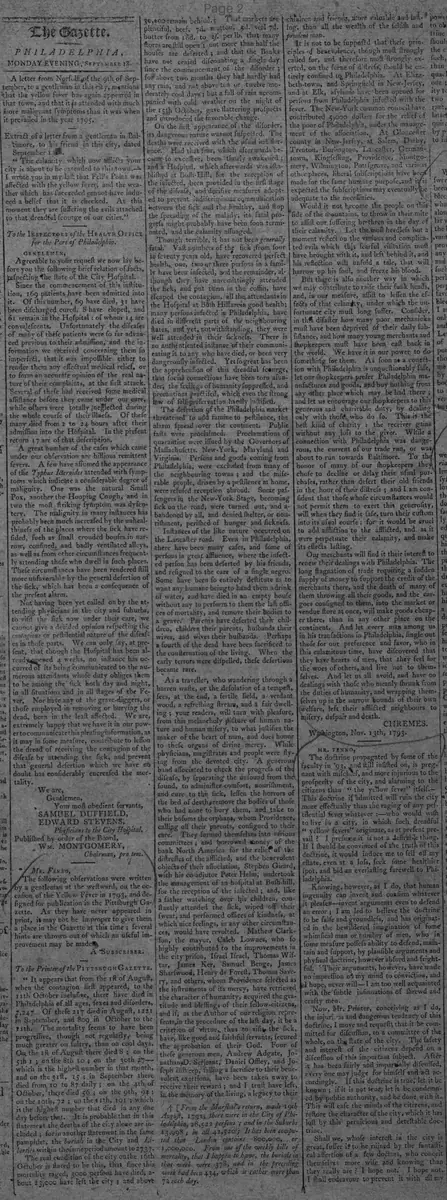
A 1793 account of the Yellow Fever epidemic in Philadelphia, detailing mortality figures, societal panic and desertions, heroic benevolence by individuals like Stephen Girard and Mayor Matthew Clarkson, and a call for westerners to aid through resumed trade and preference for Philadelphia goods.
Clipping
OCR Quality
Full Text
A SUBSCRIBER.
To the Printer of the PITTSBURGH GAZETTE.
It appears that from the 1st of August, when the contagion first appeared, to the 11th October inclusive, there have died in Philadelphia of all ages, sexes and disorders, 2,247. Of these 217 died in August, 1221 in September, and 809 in October to the 11th. The mortality seems to have been progressive, though not regularly, being much greater on sultry, than on cool days. On the 1st of August there died 8; on the 5th 1; on the 8th 10; on the 30th 27—which is the highest number in that month, and on the 31st, 15; in September there died from 10 to 87 daily; on the 4th of October, there died 56; on the 9th, 94; on the 10th, 72; on the 11th, 101; which is the highest number that died in any one day before that. It is probable that in this statement the deaths of the city alone are included; for in another statement in the same pamphlet, the burials in the City and Liberties within the same period amount to 2737.
The real condition of the city on the 16th October is stated to be this, that since this mortality raged, 2000 persons have died, about 23,000 have left the city; and above 30,000 remain behind. That markets are plentiful, beef, 7d. mutton, 8d. veal 7d. butter from 1s.4d. to 2s. per lb. that many stores are still open; not more than half the houses are deserted; and that the Banks have not ceased discounting a single day since the commencement of the disorder; for above two months they had hardly had any rain, and not above ten or twelve moderately cool days; but a fall of rain accompanied with cold weather on the night of the 15th October, gave flattering prospects and introduced the favorable change.
On the first appearance of the disorder, its dangerous nature was not suspected. The deaths were received with the usual indifference. Had that fear, which afterwards became so excessive, been timely awakened; and a Hospital, which afterwards was established at Bush-Hill, for the reception of the infected, been provided in the first stage of the disease, and decisive measures adopted to prevent indiscriminate communication between the sick and the healthy, and stop the spreading of the malady, its fatal progress might probably have been soon terminated, and the calamity assuaged.
Though terrible, it has not been generally fatal. Vast numbers of the sick from our country have recovered perfect health, one, two or three persons in a family have been infected, and the remainder, although they have unremittingly attended the sick, and put them in the coffin, have escaped the contagion, all the attendants in the Hospital at Bush Hill are in good health; many persons infected in Philadelphia, have died in different parts of the neighbouring states, and yet, notwithstanding, they were well attended in their sickness. There is no authenticated instance of their communicating it to any who have died, or been very dangerously infected. Yet so great has been the apprehension of this dreadful scourge, that social connections have been torn asunder, the feelings of humanity suppressed, and precautions practised, which even the strong law of self preservation hardly justified.
The desertion of the Philadelphia market threatened to add famine to pestilence, the alarm spread over the continent. Public fasts were proclaimed: Proclamations of quarantine were issued by the Governors of Massachusetts, New-York, Maryland and Virginia. Persons and goods coming from Philadelphia, were excluded from many of the neighbouring towns; and the miserable people, driven by a pestilence at home, were refused reception abroad. Some passengers in the New-York Stage, becoming sick on the road, were turned out, and abandoned by all, and denied shelter, or nourishment, perished of hunger and sickness. Instances of the like nature occurred on the Lancaster road. Even in Philadelphia, there have been many cases, and some of persons in great affluence, where the infected person has been deserted by his friends, and resigned to the care of a single negro. Some have been so entirely destitute as to want any humane being to hand them a drink of water, and have died in an empty house without any to perform to them the last offices of mortality, and remove their bodies to a grave. Parents have deserted their children, children their parents, husbands their wives, and wives their husbands. Perhaps a fourth of the dead have been sacrificed to the consternation of the living. When the early terrors were dispelled, these desertions became rare.
As a traveller, who wandering through a barren waste, or the desolation of a tempest, sees, at the end, a fertile field, a verdant wood, a refreshing stream, and a fair dwelling; your readers, will turn with pleasure, from this melancholy picture of human nature and human misery, to what justifies the maker of the heart of man, and does honor to these organs of divine mercy. While physicians, magistrates and people were flying from the devoted city. A generous band associated to check the progress of the disease, by separating the sick from the sound, to administer comfort, nourishment, and cure to the sick, lessen the horrors of the bed of death, remove the bodies of those who had none to bury them, and take to their bosoms the orphans, whom Providence, calling off their parents, consigned to their care. They formed themselves into various committees; and borrowed money of the Bank North America for the relief of the distressed of the afflicted, and the benevolent objects of their association, Stephen Girard, with his co-adjutor Peter Helm, undertook the management of an hospital at Bush-hill, for the reception of the infected: and, like a father watching over his children, constantly attended the sick, wiped off their sweat, and performed offices of kindness, at which nice feelings, in any other circumstances, would have revolted. Matthew Clarkson, the mayor, Caleb Lownes, who so highly contributed to the improvements in the city prison, Israel Israel, Thomas Wistar, James Kerr, Samuel Benezet, James Sharwood, Henry de Forest, Thomas Savery, and others, whom Providence elected as the instruments of its mercy, have retrieved the character of humanity, acquired the gratitude and blessings of their fellow-citizens, and if, as the Author of our religion represents, in the procedure of the last day, it be a criterion of virtue, thus to visit the sick, have, like good and faithful servants, secured the approbation of their God. Four of these generous men, Andrew Adgate, Jonathan D. Sergeant, Daniel Offley, and Joseph Inskeep, falling a sacrifice to their benevolent exertions, have been taken away to receive their reward; and I trust have left, in the memory of the living, a legacy to their children and friends, more valuable and lasting, than all the wealth of the selfish and prudent man.
It is not to be supposed that these principles of benevolence, though most strongly called for, and therefore most strongly exerted, on the scene of distress, should be entirely confined to Philadelphia. At Elizabeth-town, and Springfield in New-Jersey, and at Elk, asylums have been opened for persons from Philadelphia infected with the fever. The New York common council have contributed 5,000 dollars for the relief of the poor of Philadelphia, under the management of the association. At Gloucester county in New-Jersey, at Salem, Darby, Trenton, Burlington, Lancaster, Germantown, Kingsessing, Providence, Montgomery, Wilmington, Pottgrove, and various other places, liberal subscriptions have been made for the same humane purpose, and it is expected the subscriptions may eventually be adequate to the necessities.
Would it not become the people on this side of the mountains, to throw in their mite to assist our suffering brethren in the day of their calamity. Let the most heedless but a moment reflect on the various and complicated evils which this fearful visitation must have brought with it, and left behind it, and his reflection will unfold a tale, that will harrow up his soul, and freeze his blood.
But there is also another way in which we may contribute to raise their sunk heads, and, in our measure, assist to lessen the effects of that calamity, under which the unfortunate city must long suffer. Consider, in this disaster how many poor mechanics must have been deprived of their daily subsistence, and how many young merchants and shopkeepers must have been cast back in the world. We have it in our power to do something for them. As soon as a connection with Philadelphia is unquestionably safe, let our shopkeepers prefer Philadelphia manufactures and goods, and buy nothing from any other place which may be had there; and let us encourage our shopkeepers to this generous and charitable duty, by dealing only with those, who do so. This is the best kind of charity: the receiver gains without any loss to the giver. While a connection with Philadelphia was dangerous, the current of our trade run, or was about to run towards Baltimore. To the honor of many of our shopkeepers they chose to decline or delay their usual purchases, rather than desert their old friends in the hour of their distress; and I am confident that those whose circumstances would not permit them to exert this generosity, will when they find it safe, turn their custom into its usual course: for it would be cruel to add affliction to the afflicted, and as it were perpetuate their calamity, and make its effects lasting.
Our merchants will find it their interest to renew their dealings with Philadelphia. The long stagnation of trade requiring a sudden supply of money to support the credit of the merchants there, and the death of many of them throwing all their goods, and the cargoes consigned to them, into the market or vendue store at once, will make goods cheaper there, than in any other place on the continent. And let every man among us in his transactions in Philadelphia, single out those for our preference and favor, who in this calamitous time, have discovered that they have hearts of men, that they feel for the woes of others, and live not to themselves. And let us all avoid, and have no dealings with those who meanly shrunk from the duties of humanity, and wrapping themselves up in the narrow bounds of their own welfare, left their afflicted neighbours to misery, despair and death.
CHREMES.
What sub-type of article is it?
What themes does it cover?
What keywords are associated?
What entities or persons were involved?
Letter to Editor Details
Author
Chremes
Recipient
The Printer Of The Pittsburgh Gazette
Main Argument
the 1793 yellow fever in philadelphia caused significant mortality and societal disruption, but also highlighted acts of benevolence; residents west of the mountains should aid by resuming trade with philadelphia and favoring those who showed humanity during the crisis.
Notable Details