Thank you for visiting SNEWPapers!
Sign up free
Literary
April 24, 1830
Providence Daily Advertiser
Providence, Providence County, Rhode Island
What is this article about?
Satirical tale of Mrs. Elizabeth Hill, a wealthy widow in a Swabian town, who repeatedly changes her habits and appearance to match the town's influential figures—from reading novels, to dancing, to piety, to military fashion—ultimately attributed to her vanity by a sensible observer.
Clipping
OCR Quality
95%
Excellent
Full Text
NANTUCKET.
FROM THE NEW YORK AMERICAN.
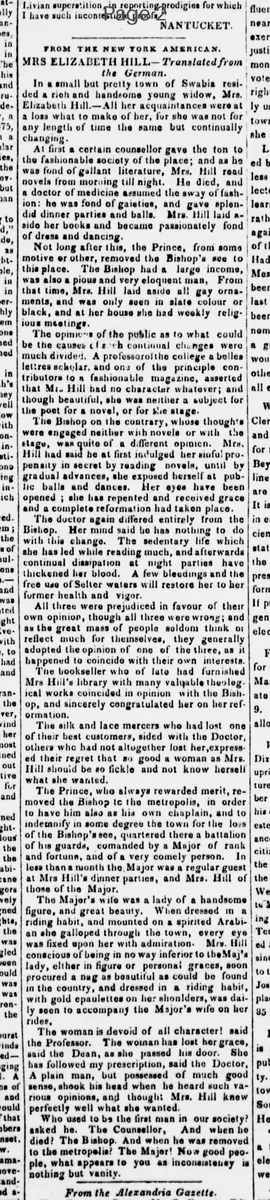
MRS. ELIZABETH HILL—Translated from the German.
In a small but pretty town of Swabia resided a rich and handsome young widow, Mrs. Elizabeth Hill.—All her acquaintances were at a loss what to make of her, for she was not for any length of time the same but continually changing:
At first a certain counsellor gave the ton to the fashionable society of the place; and as he was fond of gallant literature, Mrs. Hill read novels from morning till night. He died, and a doctor of medicine assumed the sway of fashion: he was fond of gaieties, and gave splendid dinner parties and balls. Mrs. Hill laid aside her books and became passionately fond of dress and dancing.
Not long after this, the Prince, from some motive or other, removed the Bishop's see to this place. The Bishop had a large income, was also a pious and very eloquent man. From that time, Mrs. Hill laid aside all gay ornaments, and was only seen in slate colour or black, and at her house she had weekly religious meetings.
The opinions of the public as to what could be the causes of such continual changes were much divided. A professor of the college a belles lettres scholar, and one of the principal contributors to a fashionable magazine, asserted that Mrs. Hill had no character whatever; and though beautiful, she was neither a subject for the poet nor a novel, or for the stage.
The Bishop on the contrary, whose thoughts were engaged neither with novels or with the stage, was quite of a different opinion. Mrs. Hill had said he at first indulged her sinful propensity in secret by reading novels, until by gradual advances, she exposed herself at public balls and dances. Her eyes have been opened; she has repented and received grace and a complete reformation had taken place.
The doctor again differed entirely from the Bishop. Her mind said he has nothing to do with this change. The sedentary life which she has led while reading much, and afterwards continual dissipation at night parties have thickened her blood. A few bleedings and the free use of Seltzer waters will restore her to her former health and vigor.
All three were prejudiced in favour of their own opinion, though all three were wrong; and as the great mass of people seldom think or reflect much for themselves, they generally adopted the opinion of one of the three, as it happened to coincide with their own interests.
The bookseller who of late had furnished Mrs. Hill's library with many valuable theological works coincided in opinion with the Bishop, and sincerely congratulated her on her reformation.
The silk and lace mercers who had lost one of their best customers, sided with the Doctor, others who had not altogether lost her, expressed their regret that so good a woman as Mrs. Hill should be so fickle and not know herself what she wanted.
The Prince, who always rewarded merit, removed the Bishop to the metropolis, in order to have him also as his own chaplain, and to indemnify in some degree the town for the loss of the Bishop's see, quartered there a battalion of his guards, commanded by a Major of rank and fortune, and of a very comely person. In less than a month the Major was a regular guest at Mrs. Hill's dinner parties, and Mrs. Hill of those of the Major.
The Major's wife was a lady of a handsome figure, and great beauty. When dressed in a riding habit, and mounted on a spirited Arabian she galloped through the town, every eye was fixed upon her with admiration. Mrs. Hill conscious of being in no way inferior to the Major's lady, either in figure or personal graces, soon procured a nag as beautiful as could be found in the country, and dressed in a riding habit, with gold epaulettes on her shoulders, was daily seen to accompany the Major's wife on her rides.
"The woman is devoid of all character!" said the Professor. "The woman has lost her grace," said the Dean, as she passed his door. "She has followed my prescription," said the Doctor.
A plain man, but possessed of much good sense, shook his head when he heard such various opinions, and thought Mrs. Hill knew perfectly well what she wanted.
"Who used to be the first man in our society?" asked he. "The Counsellor." "And when he died?" "The Bishop." "And when he was removed to the metropolis?" "The Major!" "Now good people, what appears to you as inconsistency is nothing but vanity."
FROM THE NEW YORK AMERICAN.
MRS. ELIZABETH HILL—Translated from the German.
In a small but pretty town of Swabia resided a rich and handsome young widow, Mrs. Elizabeth Hill.—All her acquaintances were at a loss what to make of her, for she was not for any length of time the same but continually changing:
At first a certain counsellor gave the ton to the fashionable society of the place; and as he was fond of gallant literature, Mrs. Hill read novels from morning till night. He died, and a doctor of medicine assumed the sway of fashion: he was fond of gaieties, and gave splendid dinner parties and balls. Mrs. Hill laid aside her books and became passionately fond of dress and dancing.
Not long after this, the Prince, from some motive or other, removed the Bishop's see to this place. The Bishop had a large income, was also a pious and very eloquent man. From that time, Mrs. Hill laid aside all gay ornaments, and was only seen in slate colour or black, and at her house she had weekly religious meetings.
The opinions of the public as to what could be the causes of such continual changes were much divided. A professor of the college a belles lettres scholar, and one of the principal contributors to a fashionable magazine, asserted that Mrs. Hill had no character whatever; and though beautiful, she was neither a subject for the poet nor a novel, or for the stage.
The Bishop on the contrary, whose thoughts were engaged neither with novels or with the stage, was quite of a different opinion. Mrs. Hill had said he at first indulged her sinful propensity in secret by reading novels, until by gradual advances, she exposed herself at public balls and dances. Her eyes have been opened; she has repented and received grace and a complete reformation had taken place.
The doctor again differed entirely from the Bishop. Her mind said he has nothing to do with this change. The sedentary life which she has led while reading much, and afterwards continual dissipation at night parties have thickened her blood. A few bleedings and the free use of Seltzer waters will restore her to her former health and vigor.
All three were prejudiced in favour of their own opinion, though all three were wrong; and as the great mass of people seldom think or reflect much for themselves, they generally adopted the opinion of one of the three, as it happened to coincide with their own interests.
The bookseller who of late had furnished Mrs. Hill's library with many valuable theological works coincided in opinion with the Bishop, and sincerely congratulated her on her reformation.
The silk and lace mercers who had lost one of their best customers, sided with the Doctor, others who had not altogether lost her, expressed their regret that so good a woman as Mrs. Hill should be so fickle and not know herself what she wanted.
The Prince, who always rewarded merit, removed the Bishop to the metropolis, in order to have him also as his own chaplain, and to indemnify in some degree the town for the loss of the Bishop's see, quartered there a battalion of his guards, commanded by a Major of rank and fortune, and of a very comely person. In less than a month the Major was a regular guest at Mrs. Hill's dinner parties, and Mrs. Hill of those of the Major.
The Major's wife was a lady of a handsome figure, and great beauty. When dressed in a riding habit, and mounted on a spirited Arabian she galloped through the town, every eye was fixed upon her with admiration. Mrs. Hill conscious of being in no way inferior to the Major's lady, either in figure or personal graces, soon procured a nag as beautiful as could be found in the country, and dressed in a riding habit, with gold epaulettes on her shoulders, was daily seen to accompany the Major's wife on her rides.
"The woman is devoid of all character!" said the Professor. "The woman has lost her grace," said the Dean, as she passed his door. "She has followed my prescription," said the Doctor.
A plain man, but possessed of much good sense, shook his head when he heard such various opinions, and thought Mrs. Hill knew perfectly well what she wanted.
"Who used to be the first man in our society?" asked he. "The Counsellor." "And when he died?" "The Bishop." "And when he was removed to the metropolis?" "The Major!" "Now good people, what appears to you as inconsistency is nothing but vanity."
What sub-type of article is it?
Prose Fiction
Satire
What themes does it cover?
Social Manners
Moral Virtue
What keywords are associated?
Widow
Vanity
Society
Swabia
Fashion
Satire
Character
What entities or persons were involved?
Translated From The German
Literary Details
Title
Mrs. Elizabeth Hill
Author
Translated From The German
Key Lines
"The Woman Is Devoid Of All Character!" Said The Professor. "The Woman Has Lost Her Grace," Said The Dean, As She Passed His Door. "She Has Followed My Prescription," Said The Doctor.
"Who Used To Be The First Man In Our Society?" Asked He. "The Counsellor." "And When He Died?" "The Bishop." "And When He Was Removed To The Metropolis?" "The Major!" "Now Good People, What Appears To You As Inconsistency Is Nothing But Vanity."