Thank you for visiting SNEWPapers!
Sign up free
Virginia Free Press & Farmers' Repository
Charles Town, Jefferson County, West Virginia
What is this article about?
Reports on Virginia Legislature proceedings in Richmond from March 26 to April 1, covering bills on elections, judiciary reform, land titles, railroads, turnpikes, and local matters in House of Delegates and Senate.
Clipping
OCR Quality
Full Text
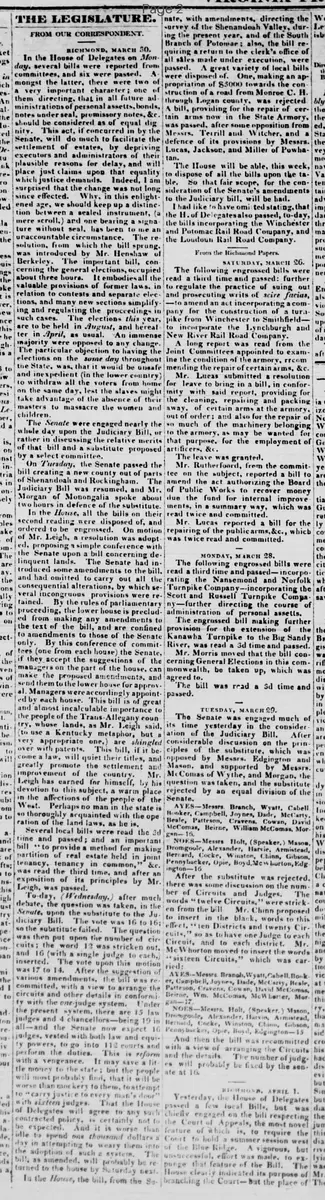
FROM OUR CORRESPONDENT.
RICHMOND, MARCH 30.
In the House of Delegates on Monday, several bills were reported from committees, and six were passed. Amongst the latter, there were two of a very important character; one of them directing, that in all future administrations of personal assets, bonds, notes under seal, promissory notes, &c. should be considered as of equal dignity. This act, if concurred in by the Senate, will do much to facilitate the settlement of estates, by depriving executors and administrators of their plausible reasons for delay, and will place just claims upon that equality which justice demands. Indeed, I am surprised that the change was not long since effected. Why, in this enlightened age, we should keep up a distinction between a sealed instrument, (a mere scroll,) and one bearing a signature without seal, has been to me an unaccountable circumstance. The resolution, from which the bill sprung, was introduced by Mr. Henshaw of Berkeley. The important bill, concerning the general elections, occupied about three hours. It embodies all the valuable provisions of former laws, in relation to contests and separate elections, and many new sections simplifying and regulating the proceedings in such cases. The elections this year, are to be held in August, and hereafter in April, as usual. An immense majority were opposed to any change. The particular objection to having the elections on the same day throughout the State, was, that it would be unsafe and inexpedient (in the lower country) to withdraw all the voters from home on the same day, lest the slaves might take advantage of the absence of their masters to massacre the women and children.
The Senate were engaged nearly the whole day upon the Judiciary Bill, or rather in discussing the relative merits of that bill and a substitute proposed by a select committee.
On Tuesday, the Senate passed the bill creating a new county out of parts of Shenandoah and Rockingham. The Judiciary Bill was resumed, and Mr. Morgan of Monongalia spoke about two hours in defence of the substitute.
In the House, all the bills on their second reading were disposed of, and ordered to be engrossed. On motion of Mr. Leigh, a resolution was adopted, proposing a simple conference with the Senate upon a bill concerning delinquent lands. The Senate had introduced some amendments to the bill, and had omitted to carry out all the consequential alterations, by which several incongruous provisions were retained. By the rules of parliamentary proceeding, the lower house is precluded from making any amendments to the text of the bill, and are confined to amendments to those of the Senate only. By this conference of committees (one from each house) the Senate, if they accept the suggestions of the managers on the part of the house, can make the proposed amendments, and send them to the lower house for approval. Managers were accordingly appointed by each house. This bill is of great and almost incalculable importance to the people of the Trans-Allegany country, whose lands, as Mr. Leigh said, (to use a Kentucky metaphor, but a very appropriate one,) are shingled over with patents. This bill, if it become a law, will quiet their titles, and greatly promote the settlement and improvement of the country. Mr. Leigh has earned for himself, by his devotion to this subject, a warm place in the affections of the people of the West. Perhaps no man in the state is so thoroughly acquainted with the operation of the land laws, as he is.
Several local bills were read the 3d time and passed; and an important bill "to provide a method for making partition of real estate held in joint tenancy, tenancy in common," &c. was read the third time, and after an exposition of its principles by Mr. Leigh, was passed.
To-day, (Wednesday,) after much debate, the question was taken, in the Senate, upon the substitute to the Judiciary Bill. The vote was 16 to 16; so the substitute failed. The question was then put upon the number of circuits: the word 12 was stricken out, and 16 (with a single judge to each,) inserted. The vote upon this motion was 17 to 14. After the suggestion of various amendments, the bill was recommitted, with a view to arrange the circuits and other details in conformity with the one-judge system. Under the present system, there are 15 Law judges and 4 chancellors—being 19 in all—and the Senate now expect 16 Judges, vested with both law and equity powers, to go into 112 courts and perform the duties. This is reform with a vengeance. It may save a little money to the state; but the people will most probably find, that it will be worse than mockery to them, to attempt to "carry justice to every man's door" with sixteen judges. That the House of Delegates will agree to any such contracted policy, is certainly not to be expected. And it is worse than idle to spend one thousand dollars a day in attempting to weary them into the adoption of such a system. The bill, as amended, will probably be returned to the house by Saturday next.
In the House, the bill, from the Senate, with amendments, directing the survey of the Shenandoah Valley, during the present year, and of the South Branch of Potomac: also, the bill requiring a return to the clerk's office of all sales made under execution, were passed. A great variety of local bills were disposed of. One, making an appropriation of $5000 towards the construction of a road from Monroe C. H. through Logan county, was rejected. A bill, providing for the repair of certain arms now in the State Armory, was passed, after some opposition from Messrs. Terrill and Witcher, and a defence of its provisions by Messrs. Lucas, Jackson, and Miller of Powhatan.
The House will be able, this week, to dispose of all the bills upon the table. So that fair scope, for the consideration of the Senate's amendments to the Judiciary bill, will be had.
I had like to have omitted stating, that the H. of Delegates also passed, to-day, the bills incorporating the Winchester and Potomac Rail Road Company, and the Loudoun Rail Road Company.
From the Richmond Papers.
SATURDAY, MARCH 26.
The following engrossed bills were read a third time and passed: further to regulate the practice of suing out and prosecuting writs of scire facias,—to amend an act incorporating a company for the construction of a turnpike from Winchester to Smithfield—to incorporate the Lynchburgh and New River Rail Road Company.
A long report was read from the Joint Committees appointed to examine the condition of the armory, recommending the repair of certain arms, &c.
Mr. Lucas submitted a resolution for leave to bring in a bill, in conformity with said report, providing for the cleaning, repairing and packing away, of certain arms at the armory, out of order: and also for the repair of so much of the machinery belonging to the armory, as may be wanted for that purpose, for the employment of artificers, &c. The leave was granted.
Mr. Rutherfoord, from the committee on the subject, reported a bill to amend the act authorizing the Board of Public Works to recover money due the fund for internal improvements, in a summary way, which was read twice and committed.
Mr. Lucas reported a bill for the repairing of the public arms, &c., which was twice read and committed.
MONDAY, MARCH 28.
The following engrossed bills were read a third time and passed—incorporating the Nansemond and Norfolk Turnpike Company—incorporating the Scott and Russell Turnpike Company—further directing the course of administration of personal assets.
The engrossed bill making further provision for the extension of the Kanawha Turnpike to the Big Sandy River, was read a 3d time and passed.
Mr. Morris moved that the bill concerning General Elections in this commonwealth, be taken up, which was agreed to.
The bill was read a 3d time and passed.
TUESDAY, MARCH 29.
The Senate was engaged much of its time yesterday in the consideration of the Judiciary Bill. After considerable discussion on the principles of the substitute, which was opposed by Messrs. Edgington and Mason, and supported by Messrs. McComas of Wythe, and Morgan, the question was taken, and the substitute rejected by an equal division of the Senate.
AYES—Messrs. Branch, Wyatt, Cabell, Booker, Campbell, Joynes, Dade, McCarty, Beale, Patteson, Cravens, Cowan, David McComas, Beirne, William McComas, Morgan—16.
NOES—Messrs. Holt, (Speaker,) Mason, Dromgoole, Alexander, Harvie, Armistead, Bernard, Cocke, Winston, Chinn, Gibson, Pennybacker, Opie, Boyd, New Bolton, Edgington—16.
After the substitute was rejected, there was some discussion on the number of Circuits and Judges. The words "twelve Circuits," were stricken from the bill. Mr. Chinn proposed to insert in the blank, words to this effect, "ten Districts and twenty Circuits," so as to have one Judge to each Circuit, and to each district. Mr. McWhorter moved to insert the words "sixteen Circuits," which was carried:
AYES.—Messrs. Branch, Wyatt, Cabell, Booker, Campbell, Joynes, Dade, McCarty, Beale, Patteson, Cravens, Cowan, David McComas, Beirne, Wm. McComas, McWhorter, Morgan—17.
NOES.—Messrs. Holt, (Speaker,) Mason, Dromgoole, Alexander, Harvie, Armistead, Bernard, Cocke, Winston, Chinn, Gibson, Pennybacker, Opie, Boyd, Edgington—15.
And then the bill was recommitted with a view of arranging the Circuits and the details. The number of judges will probably be fixed by the senate at 16.
RICHMOND, APRIL 1.
Yesterday, the House of Delegates passed a few local Bills, but was chiefly engaged on the bill respecting the Court of Appeals, the most novel feature of which is, to require the Court to hold a summer session west of the Blue Ridge. A vigorous, but unsuccessful, effort was made, to expunge that feature of the Bill. The House clearly indicated its purpose of branching the Court—but the place of Western location—whether Staunton, Lexington, the Warm Springs, or Lewisburg—is yet undetermined.
What sub-type of article is it?
What keywords are associated?
What entities or persons were involved?
Where did it happen?
Domestic News Details
Primary Location
Richmond
Event Date
March 26 To April 1
Key Persons
Outcome
bills passed include those on personal assets administration, general elections (set for august this year, april hereafter), new county creation, delinquent lands, partition of real estate, survey of shenandoah valley and south branch of potomac, return of execution sales, repair of state arms, incorporation of winchester and potomac rail road company, loudoun rail road company, lynchburgh and new river rail road company, nansemond and norfolk turnpike company, scott and russell turnpike company, kanawha turnpike extension; judiciary bill substitute failed, amended to 16 circuits with one judge each, recommitted; road appropriation from monroe c. h. through logan county rejected; court of appeals bill passed with summer session west of blue ridge.
Event Details
In the House of Delegates and Senate, discussions and votes on various bills including administration of personal assets, general elections, judiciary reform, new county from Shenandoah and Rockingham, delinquent lands in Trans-Allegany, partition of real estate, surveys, arms repair, railroad and turnpike incorporations, and Court of Appeals sessions; concerns raised about election timing due to slave risks and judiciary efficiency with fewer judges.