Thank you for visiting SNEWPapers!
Sign up free
The New Hampshire Gazette
Portsmouth, Rockingham County, New Hampshire
What is this article about?
On June 7, Massachusetts Governor Elbridge Gerry addressed the legislature, defending federal commerce policies against British and French restrictions, criticizing Boston town resolutions opposing U.S. laws, warning against resistance, and discussing state affairs like elections, religion, and the prison system.
Merged-components note: This is a continuation of the Massachusetts governor's speech across pages 1 and 2; the second part was mislabeled as editorial but is part of the legislative domestic news report.
Clippings
1 of 2
OCR Quality
Full Text
FRIDAY JUNE 7.
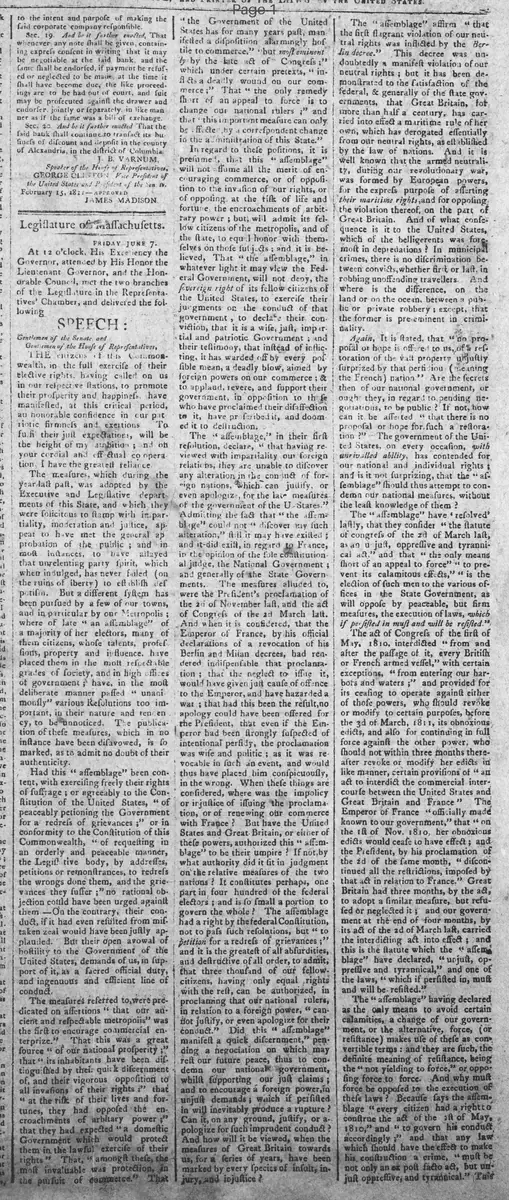
At 12 o'clock, His Excellency the Governor, attended by His Honor the Lieutenant Governor, and the Honorable Council, met the two branches of the Legislature in the Representatives' Chamber, and delivered the following
SPEECH:
Gentlemen of the Senate, and Gentlemen of the House of Representatives,
The citizens of this Commonwealth, in the full exercise of their elective rights, having called on us in our respective stations, to promote their prosperity and happiness, have manifested, at this critical period, an honorable confidence in our patriotic firmness and exertions. To fulfill their just expectations, will be the height of my ambition; and on your cordial and effectual co-operation, I have the greatest reliance.
The measures, which during the year last past, was adopted by the Executive and Legislative departments of this State, and which they were solicitous to stamp with impartiality, moderation and justice, appear to have met the general approbation of the public; and in most instances, to have allayed that unrelenting party spirit, which when indulged, has never failed (on the ruins of liberty) to establish despotism. But a different system has been pursued by a few of our towns, and in particular by our Metropolis; where of late "an assemblage" of a majority of her electors, many of them citizens, whose talents, professions, property and influence, have placed them in the most respectable grades of society, and in high offices of government: have, in the most deliberate manner passed "unanimously" various Resolutions too important, in their nature and tendency, to be unnoticed. The publication of these measures, which in no instance have been disavowed, is so marked, as to admit no doubt of their authenticity.
Had this "assemblage" been content, with exercising freely their rights of suffrage; or agreeably to the Constitution of the United States, "of peaceably petitioning the Government for a redress of grievances;" or in conformity to the Constitution of this Commonwealth, "of requesting in an orderly and peaceable manner, the Legislative body, by address, petitions or remonstrances, to redress the wrongs done them, and the grievances they suffer;" no rational objection could have been urged against them—On the contrary, their conduct, if it had even resulted from mistaken zeal would have been justly applauded. But their open avowal of hostility to the Government of the United States, demands of us, in support of it, as a sacred official duty, an ingenuous and efficient line of conduct.
The measures referred to, were predicated on assertions "that our, ancient and respectable metropolis" was the first to encourage commercial enterprise." That this was a great source "of our national prosperity;" that "its inhabitants have been distinguished by their quick discernment of, and their vigorous opposition to all invasions of their rights " that "at the risk of their lives and fortunes, they had opposed the encroachments of arbitrary power;" that they had expected "a domestic Government which would protect them in the lawful exercise of their rights " That, amongst these, the most invaluable was protection, in the pursuit of commerce. " That "the Government of the United States has for many years past, manifested a disposition alarmingly hostile to commerce," but most eminently by the "late act of Congress;" which under certain pretexts, "inflicts a deadly wound on our commerce;" That "the only remedy short of an appeal to force is to change our national rulers ;" and that "this important measure can only be effected, by a correspondent change in the administration of this State."
In regard to these positions, it is presumed, that this "assemblage" will not assume all the merit of encouraging commerce, or of opposition to the invasion of our rights, or of opposing, at the risk of life and fortune, the encroachments of arbitrary power; but, will admit its fellow citizens of the metropolis, and of the state, to equal honor with themselves on those subjects; and, it is believed, That "the assemblage," in whatever light it may view the Federal Government, will not deny, the sovereign right of its fellow citizens of the United States, to exercise their judgments on the conduct of that government, to declare their conviction, that it is a wise, just, impartial and patriotic Government; and their testimony, that instead of instigating, it has warded off by every possible mean, a deadly blow, aimed by foreign powers on our commerce; & to applaud, revere, and support their government, in opposition to those who have proclaimed their disaffection to it, have or eribed it, and doomed it to destruction.
The "assemblage," in their first resolution, declare, "that having reviewed with impartiality our foreign relations, they are unable to discover any alteration in the conduct of foreign nations, which can justify, or even apologize, for the late measures of the government of the U. States."
Admitting the fact that "the assemblage" could not "discover any such alteration," still it may have existed; and it did exist, in regard to France, in the opinion of the whole constitutional judge, the National Government; and generally of the State Governments. The measures alluded to, were the President's proclamation of the 21 of November last, and the act of Congress of the 2d March last. And when it is considered, that the Emperor of France, by his official declarations of a revocation of his Berlin and Milan decrees, had rendered indispensable that proclamation : that the neglect to issue it, would have given just cause of offence to the Emperor, and have hazarded a war ; that had this been the result, no apology could have been offered for the President, that even if the Emperor had been strongly suspected of intentional perfidy, the proclamation was wise and politic : as it was revocable in such an event, and would thus have placed him conspicuously, in the wrong. When these things are considered, where was the impolicy or injustice of issuing the proclamation, or of renewing our commerce with France ? But have the United States and Great Britain, or either of these powers, authorized this "assemblage" to be their umpire ? If not, by what authority did it sit in judgment on the relative measures of the two nations ? It constitutes perhaps, one part in four hundred of the federal electors ; and is so small a portion to govern the whole? The assemblage had a right by the federal Constitution, not to pass such resolutions, but "to petition for a redress of grievances ;" and it is the greatest of all absurdities, and destructive of all order, to admit, that three thousand of our fellow citizens, having only equal rights with the rest, can be authorized, in proclaiming that our national rulers, in relation to a foreign power, "cannot justify, or even apologize for their conduct." Did this "assemblage" manifest a quick discernment," pending a negociation on which may rest our future peace, thus to condemn our national government, whilst supporting our just claims ; and to encourage a foreign power, in unjust demands; which if persisted in will inevitably produce a rupture? Can it, on any ground, justify, or apologize for such imprudent conduct. And how will it be viewed, when the measures of Great Britain towards us, for a series of years, have been marked by every species of insult, injury, and injustice.
The "assemblage" affirm "that the first flagrant violation of our neutral rights was inflicted by the Berlin decree." This decree was undoubtedly a manifest violation of our neutral rights ; but it has been demonstrated to the satisfaction of the federal, & generally of the state governments, that Great Britain, for more than half a century, has carried into effect a maritime rule of her own, which has derogated essentially from our neutral rights, as established by the law of nations. And it is well known that the armed neutrality, during our revolutionary war, was formed by European powers, for the express purpose of asserting their maritime rights, and for opposing the violation thereof, on the part of Great Britain. And of what consequence is it to the United States, which of the belligerents was foremost in depredations : In municipal crimes, there is no discrimination between convicts, whether first or last, in robbing unoffending travellers. And where is the difference, on the land or on the ocean, between a public or private robbery; except, that the former is pre-eminent in criminality.
Again, It is stated, that "no proposal or hope is offered to us, of a restoration of the vast property unjustly surprised by that perfidious (meaning the French) nation". Are the secrets then of our national government, or ought they, in regard to pending negotiations, to be public ? If not, how can it be asserted "that there is no proposal or hope for such a restoration ?" - The government of the United States, on every occasion, with unrivalled ability, has contended for our national and individual rights and is it not surprising, that the "assemblage" should thus attempt to condemn our national measures, without the least knowledge of them ?
The "assemblage" have 'resolved' lastly, that they consider "the statute of congress of the 2d of March last as an unjust, oppressive and tyrannical act," and that "the only means short of an appeal to force" "to prevent its calamitous effects," "is the election of such men to the various offices in the State Government, as will oppose by peaceable, but firm measures, the execution of laws, which if persisted in must and will be resisted."
The act of Congress of the first of May, 1810, interdicted "from and after the passage of it, every British or French armed vessel," with certain exceptions, "from entering our harbors and waters ;" and provided for its ceasing to operate against either of those powers, who should revoke or modify to certain purposes, before the 2d of March, 1811, its obnoxious edicts, and also for continuing in full force against the other power, who should not within three months thereafter revoke or modify her edicts in like manner, certain provisions of "an act to interdict the commercial intercourse between the United States and Great Britain and France" The Emperor of France "officially made known to our government," that "on the 1st of Nov. 1810, her obnoxious edicts would cease to have effect; and. the President, by his proclamation of the 2d of the same month. "discontinued all the restrictions, imposed by that act in relation to France." Great Britain had three months, by the act, to adopt a similar measure, but refused or neglected it ; and our government at the end of four months, by its act of the 2d of March last, carried the interdicting act, into effect : and this is the statute which the "assemblage" have declared, "unjust, oppressive and tyrannical," and one of the laws, "which if persisted in, must and will be resisted."
The "assemblage" having declared as the only means to avoid certain calamities, a change of our government, or the alternative, force, (or resistance) makes use of these as convertible terms : and they are such, the definite meaning of resistance, being the "not yielding to force," or opposing force to force. And why must force be opposed to the execution of these laws ? Because says the assemblage "every citizen had a right to construe the act of the 1st of May, 1810," and "to govern his conduct accordingly ;" and that any law which should have the effect to make his construction a crime, "must be not only an ex post facto act, but unjust oppressive, and tyrannical."
The doctrine of the right of every citizen thus finally to confine a law, and to govern his conduct accordingly, is novel; such authority being invested only in the judiciary. If a person charged with having violated a law, has by due process been convicted thereof and received his sentence; this will and ought to be carried into effect, his construction of the law notwithstanding. It often happens that a law in some instances operates unjustly, and the effect of it, in such cases, is usually prevented by petitioning the Legislature (whose duty it is) to redress the grievance; or, by a recommendation, (before sentence) of the judicial court, for pardon of the person convicted. If all defective laws, are ex post facto acts, because in a few instances they may have operated as such, our national and state codes abound with them: and every Legislature has been justly chargeable with injustice, oppression and tyranny. Many laws are of great length and intricacy and the construction of them by individuals may be right, or wrong, or partaking of both these qualities; till these constructions, according to the opinion of the "assembly," are to be so many criteria for determining whether the law is an ex post facto act, or unjust, oppressive and tyrannical. If every citizen (according to the declarations recited) has a right thus to put his construction, on any law; to declare other laws, if opposed to that construction, unjust, oppressive and tyrannical; to preclude by it all supplementary or explanatory laws of the Legislature; and to resist them by force: our constitutions are nullities. Our constituted authorities are usurpers, and we are reduced to a state of nature.
Again, If our national rulers are justly charged as it is stated by this "assembly," with having passed a tyrannical act, and laws that must and will be resisted, they have rebelled against the sovereignty of the people, are subject to punishment, and have forfeited forever a claim to public confidence. But if the charge is unfounded, if they have conducted agreeably to our national charter, (which is manifestly the sense of the nation) have not these who have denounced the government of the United States as oppressive, tyrannical and unjust, and who have declared an intention to resist the execution of their laws, unwarrantably, adopted measures, tending to excite a spirit of insurrection and rebellion, and to destroy our internal peace and tranquility? And is it expected, that a correct and well informed people, will rally round the standard of disaffection; hazard their right of self-government, which they hold by the charter of the God of nature, and present to the world the unparalleled phenomenon, of a sovereign people in rebellion against their own sovereignty? It is believed the people in general of the United States are incapable of such political suicide. And here it may be remarked, that the "assembly" have been lavish in their encomiums on Great Britain, and in their satires on France. In respect to the conduct of France, no justification or even apology will be offered; but it may still be enquired, why Great Britain has not availed herself (as France has done) of the benefits proffered to both, by the liberal act of Congress, of 1st of May 1810? She has condemned the French emperor, for not having been definite in revoking his edicts; and at the same time, in every instance, has refused to revoke her own. If he is culpable for not doing every thing, Great Britain is more so for not doing any thing required by justice. Why has she not supported her condemnation of him, and raised her own fame, by superior acts of equity and liberality? Is it, because fearful of the competition of the United States, she is opposed to a general renewal of their commerce? Will she only be satisfied by a monopoly of this? Is She not convinced, that the mutual interests of the two nations demand an amicable adjustment of their differences? Our government has given unequivocal proofs, of an earnest, and ardent desire to obtain that object. But, because of that, does Great Britain expect to draw, or drive us into measures, which, contrary to our essential interest, must involve us in unnecessary War? If so, if she will not listen to her wise statesmen, but will support an administration inimical to this country in a system of evasions, pretensions, procrastinations and prevarications, she will too late discover her error; and by enlisting these states in the interest of her adversary, to which all her measures tend, will hasten her national overthrow; and by such a deplorable event, will extend far and wide calamitous consequences.
To diminish, and exterminate, if possible, a party spirit, the Executive of this Commonwealth, during the past year, has confirmed in his place, or re-appointed when requisite, every state officer, under its controul, who has been correct in his conduct, and faithful to his trust; disregarding his politics, and requiring only his support of the federal and state constitutions, governments and laws, with a due regard to the rights of officers and individuals, subject to his official discretion. But it cannot be expected of any Executive, so far to disregard the sacred obligations of duty and honor, as to preserve in official stations, such individuals as would abuse the influence of their public characters, by sanctioning resistance to law, or by such other conduct, as will beguile peaceable and happy citizens, into a state of civil warfare.
For our metropolis, I have ever entertained an affectionate esteem and respect; and regret exceedingly, that she has not supported the salutary measures of this government, of the last year. Had this been done, we might have silenced the demon of party discord; have manifested such an invincible determination to preserve our Union, as would have animated our sister states to similar measures; and might have destroyed the germ of every hope to sever the U. States. Of late years, "the dismemberment of our Union" has been an avowed object in the ministerial papers of Great Britain: and to effect it, a war has been urged against these states. How mortifying would it be, for any of our fellow citizens, to find that their proceedings, unintentionally, had promoted such nefarious designs; and had thus entailed on them and on their posterity, an indelible stain? It is seldom admitted as an apology, that individuals, in the adoption of such dangerous means, had laudable and honest views; or that they possess fair reputations; for these circumstances, serving, to increase and extend the evil, excite a proportionate degree of public resentment.
Numerous instances, of this kind, existed at the commencement of our revolutionary war, and compelled our fellow citizens to exile themselves, and to spend the residue of their mournful days in foreign climes. - It is remarkable likewise, that such of late years have been the politics of almost every commercial metropolis of our sister states, as to have driven from it, the state legislature. The reasons assigned have been, the influx of foreigners, and a collectr in those great seaports, of the declared malcontents of the national and state governments; individuals, who, with the uniform of Washington, have combatted the fundamental principles of our revolution, as delineated by that revered patriot.--May our Metropolis, by regaining the high ground which she once held, when Americans throughout Europe were denominated Bostonians, and Boston was considered as "the Cradle of liberty," sanctify these walls as the permanent seat of the Legislature; and firmly support our National and State Governments, our Union and Independence.
But although the great body of the people, will always be careful to preserve internal peace, they must be prepared to meet incessant plots to divide and conquer them. And let me, gentlemen, address your reason, not your feelings, on this important subject. Who can contemplate, without chills of horror, the dismemberment of our Union, and a civil war? What is to be expected from these concomitant evils? We are now blessed by Divine Providence above any other nation. We have national and state constitutions, which, by securing the freedom and frequency of elections; by the short tenure of legislative and executive offices; by the requisite qualifications of those in office; by the numerous checks required in free governments; and above all, by the entire dependence of those systems, on the sovereignty of the people, are rendered incapable of a sudden change to an arbitrary system of government. We are blessed with the free exercise of our civil and religious rights, with the prompt and due administration of justice -with a country capable of supplying all our wants and wishes-- with a flourishing state of universities, and other seminaries of literature and of science in general-with a local situation, distant from the terrific scenes of unprecedented carnage-- with an efficient national defence, by a patriotic and powerful militia; rendering unnecessary those expensive military establishments, which are oppressive and dangerous to liberty-- with the extension, over the globe, of a lucrative commerce; subject indeed at present, to great and inevitable embarrassments-and with innumerable other benefits. And is it possible for us, by ingratitude of the deepest dye, to that Omnipotent Being who has so favored us, to violate every moral, religious and political obligation? by destroying the greatest of social enjoyments, our internal peace and tranquility; by placing in military array, relatives, friends and fellow citizens, against each other: by exciting them to ungovernable fury; by urging them to profane our temples, to sack and burn our towns, to ravage our country, to lay waste our cultivated and beautiful fields, to strew them with the bodies of our most valuable citizens, to embrue their hands in the blood of our innocent women and children, and to pursue a ferocious warfare, which would extend through the land, plague, pestilence, and famine. This is but a faint picture of a civil war. Ten foreign wars are a luxury, when compared-with one civil conflict. At all events, let us preserve peace at home, and wage war, if indispensable, with any nation, however powerful.
My objects, on this occasion, are to bring conviction to the minds of my fellow citizens, who may be in an error, not to wound or ruffle their feelings.-To recommend, gentlemen, by every mean in your power, the security of the blessings we enjoy-To urge the necessity of a revision of our laws regulating elections; as well to prevent turbulent proceedings in our primary assemblies, as to ensure the right of ballot; which is a mode essentially secret in its nature, for restraining an undue influence. To invite you to represent truly to our fellow citizens the nature and tendency of our national and state proceedings, and to exhort them to support as the Temple of our Liberty and Independence, the Government of the United States.
Let us attend for a moment, to the two Great Pillars of our prosperity, Agriculture, and Commerce. These are such near relations, as that, the loss of one, will be death to the other. Nothing can be more unwise, than the establishment at home, of a, market for the surplus of our produce and manufactures. The choice of foreign marts, for the sale of these, generally enhances, and often doubles their value. If any foreign power should inhibit our commerce with them, let us spurn at theirs, and exert ourselves to be independent of it, by a skilful management of the means we possess. And whilst our towering forests, fertile soils, and rich mines furnish us with ample materials for a navy-and our population, with intrepid officers and seamen to man it, let us proclaim from pole to pole, by our naval thunders, that we will defend to the last moment of our existence, our neutral maritime rights, and a commercial intercourse with every friendly nation.
Pursuant to an order of the Legislature of the 27th of Feb. last, I appointed the Hon. Perez Morton, Jonathan Smith, jun. and Thomas B. Adams, Esquires, Commissioners, to repair to the county of Lincoln for certain purposes; and their report will shew, that they have discharged the important trust, with great ability, impartiality and promptitude: and will also present the pleasing prospect, of a speedy and equitable termination of the unhappy disputes, which have arisen, from interfering territorial claims in that county.
It is a happy circumstance, and does great honor to our clergy, that there exists amongst them, a general spirit of religious liberality and tolerance. They advance in the straight road of christianity; which is always strewed with flowers.-Should any, perchance, wander into the devious paths of party politics, the injury will not extend beyond themselves; and they will soon retreat from the lacerations of briars and thorns which will meet them at every step.
A late solemn decision, of our supreme judicial court, has limited the right of protestant teachers of piety, religion and morality, to demand the taxes paid by their respective hearers, for the support of public worship, to those of incorporated societies; and has produced a great excitement. This may render indispensable, an attention to the subject; and further provisions, to encourage, by every possible mean, the liberty of conscience in relation to religious opinion & worship.
The affairs of the State prison, by the judicious management of the board of visitors, have presented of late a pleasing aspect. The unhappy subjects of that useful institution, have been advantageously employed; the expenses of it have been greatly reduced; and the humane attention of the visitors, with the faithful services of the physician, have been instrumental, in maintaining in the prison, a remarkable state of health.
But the Legislature having taken measures to enquire into and remedy the defects of its original establishment, suggested on a former occasion, have rendered unnecessary further remarks on this subject.
The existing state of our public concerns, I flatter myself, will present an apology for the time occupied on this occasion: and I shall communicate by message, the documents referred to in this address, with other matters which may require your consideration. And now gentlemen, I shall take my leave of you for the present; with an ardent prayer to Almighty God, that an inviolable attachment to the peace, happiness and welfare of our country, may banish forever from our breasts, a party spirit; and induce us all, in the full exercise of every christian, moral and social virtue, to embrace each other, as fellow citizens as friends, and as brethren.
E. GERRY
What sub-type of article is it?
What keywords are associated?
What entities or persons were involved?
Where did it happen?
Domestic News Details
Primary Location
Massachusetts
Event Date
Friday June 7
Key Persons
Event Details
Governor E. Gerry delivered a speech to the Massachusetts Legislature criticizing resolutions from a Boston town meeting that opposed federal commerce laws, defending U.S. policies on trade with France and Britain, warning against resistance to laws, urging support for the national government, and addressing state issues including elections, religious liberty, and the state prison.