Thank you for visiting SNEWPapers!
Sign up free
Editorial
December 28, 1857
The Daily Manchester American
Manchester, Hillsboro County, New Hampshire
What is this article about?
Editorial correspondence from Hancock, NH, on Christmas Day, describing the preserved old-fashioned Hancock Hotel as a hub of rural social life, with nostalgic reflections on pre-railroad taverns. It profiles Hancock's agricultural resources and unchanging customs, then discusses neighboring Greenfield's farming economy and failed industrial ventures.
Clipping
OCR Quality
98%
Excellent
Full Text
Editorial Correspondence.
Inns of olden time--One of them left A village medley—Hancock-Greenfield.
Hancock, Friday, Dec. 25th.
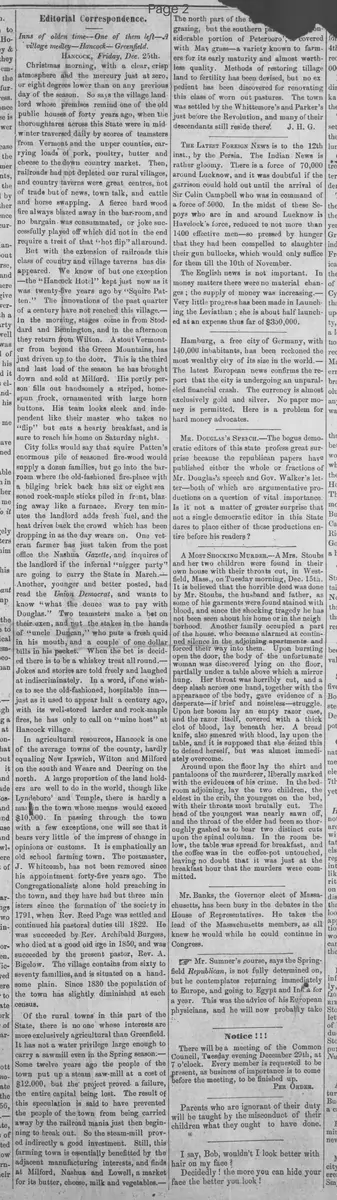
Christmas morning, with a clear, crisp atmosphere and the mercury just at zero, or eight degrees lower than on any previous day of the season. So says the village landlord whose premises remind one of the old public houses of forty years ago, when the thoroughfares across this State were in mid-winter traversed daily by scores of teamsters from Vermont and the upper counties, carrying loads of pork, poultry, butter and cheese to the down country market. Then, railroads had not depleted our rural villages, and country taverns were great centres, not of trade but of news, town talk, and cattle and horse swapping. A fierce hard wood fire always blazed away in the bar-room, and no bargain was consummated, or joke successfully played off which did not in the end require a treat of that "hot flip" all around.
But with the extension of railroads this class of country and village taverns has disappeared. We know of but one exception —the "Hancock Hotel" kept just now as it was twenty-five years ago by 'Squire Patten." The innovations of the past quarter of a century have not reached this village.—In the morning, stages come in from Stoddard and Bennington, and in the afternoon they return from Wilton. A stout Vermonter from beyond the Green Mountains, has just driven up to the door. This is the third and last load of the season he has brought down and sold at Milford. His portly person fills out handsomely a striped, home-spun frock, ornamented with large horn buttons. His team looks sleek and independent like their master who takes no "flip" but eats a hearty breakfast, and is sure to reach his home on Saturday night.
City folks would say that squire Patten's enormous pile of seasoned fire-wood would supply a dozen families, but go into the bar-room where the old-fashioned fire-place with a bulging brick back has six or eight seasoned rock-maple sticks piled in front, blazing away like a furnace. Every ten minutes the landlord adds fresh fuel, and the heat drives back the crowd which has been dropping in as the day wears on. One veteran farmer has just taken from the post office the Nashua Gazette, and inquires of the landlord if the infernal "nigger party" are going to carry the State in March. Another, younger and better posted, had read the Union Democrat, and wants to know "what the deuce was to pay with Douglas." Two teamsters make a bet on their oxen, and put the stakes in the hands of "uncle Duncan," who puts a fresh quid in his mouth, and a couple of one dollar bills in his pocket. When the bet is decided there is to be a whiskey treat all round.—Jokes and stories are told freely and laughed at indiscriminately. In a word, if one wishes to see the old-fashioned, hospitable inn— just as it used to appear half a century ago, with its well-stored larder and rock-maple fires, he has only to call on "mine host" at Hancock village.
In agricultural resources, Hancock is one of the average towns of the county, hardly equaling New Ipswich, Wilton and Milford on the south and Weare and Deering on the north. A large proportion of the land holders are well to do in the world, though like Lyndeboro' and Temple, there is hardly a man in the town whose means would exceed $10,000.' In passing through the town with a few exceptions, one will see that it bears very little of the impress of change in opinions or customs. It is emphatically an old school farming town. The postmaster, J. Whitcomb, has not been removed since his appointment forty-five years ago. The Congregationalists alone hold preaching in the town, and they have had but three ministers since the formation of the society in 1791, when Rev. Reed Page was settled and continued his pastoral duties till 1822. He was succeeded by Rev. Archibald Burgess, who died at a good old age in 1850, and was succeeded by the present pastor, Rev. A. Bigelow. The village contains from sixty to seventy families, and is situated on a handsome plain. Since 1830 the population of the town has slightly diminished at each census.
Of the rural towns in this part of the State, there is no one whose interests are more exclusively agricultural than Greenfield. It has not a water privilege large enough to carry a sawmill even in the Spring season.—Some twelve years ago the people of the town put up a steam saw-mill at a cost of $12,000, but the project proved a failure, the entire capital being lost. The result of this speculation is said to have prevented the people of the town from being carried away by the railroad mania just then beginning to break out. So the steam-mill proved indirectly a good investment. Still, this farming town is essentially benefitted by the adjacent manufacturing interests, and finds at Milford, Nashua and Lowell, a market for its butter, cheese, milk and vegetables.—
The north part of the town is suited to grazing, but the southern part, and a considerable portion of Peterboro', covered with May grass—a variety known to farmers for its early maturity and almost worthless quality. Methods of restoring tillage land to fertility has been devised, but no expedient has been discovered for renovating this class of worn out pastures. The town was settled by the Whittemore's and Parker's just before the Revolution, and many of their descendants still reside there.
J. H. G.
Inns of olden time--One of them left A village medley—Hancock-Greenfield.
Hancock, Friday, Dec. 25th.
Christmas morning, with a clear, crisp atmosphere and the mercury just at zero, or eight degrees lower than on any previous day of the season. So says the village landlord whose premises remind one of the old public houses of forty years ago, when the thoroughfares across this State were in mid-winter traversed daily by scores of teamsters from Vermont and the upper counties, carrying loads of pork, poultry, butter and cheese to the down country market. Then, railroads had not depleted our rural villages, and country taverns were great centres, not of trade but of news, town talk, and cattle and horse swapping. A fierce hard wood fire always blazed away in the bar-room, and no bargain was consummated, or joke successfully played off which did not in the end require a treat of that "hot flip" all around.
But with the extension of railroads this class of country and village taverns has disappeared. We know of but one exception —the "Hancock Hotel" kept just now as it was twenty-five years ago by 'Squire Patten." The innovations of the past quarter of a century have not reached this village.—In the morning, stages come in from Stoddard and Bennington, and in the afternoon they return from Wilton. A stout Vermonter from beyond the Green Mountains, has just driven up to the door. This is the third and last load of the season he has brought down and sold at Milford. His portly person fills out handsomely a striped, home-spun frock, ornamented with large horn buttons. His team looks sleek and independent like their master who takes no "flip" but eats a hearty breakfast, and is sure to reach his home on Saturday night.
City folks would say that squire Patten's enormous pile of seasoned fire-wood would supply a dozen families, but go into the bar-room where the old-fashioned fire-place with a bulging brick back has six or eight seasoned rock-maple sticks piled in front, blazing away like a furnace. Every ten minutes the landlord adds fresh fuel, and the heat drives back the crowd which has been dropping in as the day wears on. One veteran farmer has just taken from the post office the Nashua Gazette, and inquires of the landlord if the infernal "nigger party" are going to carry the State in March. Another, younger and better posted, had read the Union Democrat, and wants to know "what the deuce was to pay with Douglas." Two teamsters make a bet on their oxen, and put the stakes in the hands of "uncle Duncan," who puts a fresh quid in his mouth, and a couple of one dollar bills in his pocket. When the bet is decided there is to be a whiskey treat all round.—Jokes and stories are told freely and laughed at indiscriminately. In a word, if one wishes to see the old-fashioned, hospitable inn— just as it used to appear half a century ago, with its well-stored larder and rock-maple fires, he has only to call on "mine host" at Hancock village.
In agricultural resources, Hancock is one of the average towns of the county, hardly equaling New Ipswich, Wilton and Milford on the south and Weare and Deering on the north. A large proportion of the land holders are well to do in the world, though like Lyndeboro' and Temple, there is hardly a man in the town whose means would exceed $10,000.' In passing through the town with a few exceptions, one will see that it bears very little of the impress of change in opinions or customs. It is emphatically an old school farming town. The postmaster, J. Whitcomb, has not been removed since his appointment forty-five years ago. The Congregationalists alone hold preaching in the town, and they have had but three ministers since the formation of the society in 1791, when Rev. Reed Page was settled and continued his pastoral duties till 1822. He was succeeded by Rev. Archibald Burgess, who died at a good old age in 1850, and was succeeded by the present pastor, Rev. A. Bigelow. The village contains from sixty to seventy families, and is situated on a handsome plain. Since 1830 the population of the town has slightly diminished at each census.
Of the rural towns in this part of the State, there is no one whose interests are more exclusively agricultural than Greenfield. It has not a water privilege large enough to carry a sawmill even in the Spring season.—Some twelve years ago the people of the town put up a steam saw-mill at a cost of $12,000, but the project proved a failure, the entire capital being lost. The result of this speculation is said to have prevented the people of the town from being carried away by the railroad mania just then beginning to break out. So the steam-mill proved indirectly a good investment. Still, this farming town is essentially benefitted by the adjacent manufacturing interests, and finds at Milford, Nashua and Lowell, a market for its butter, cheese, milk and vegetables.—
The north part of the town is suited to grazing, but the southern part, and a considerable portion of Peterboro', covered with May grass—a variety known to farmers for its early maturity and almost worthless quality. Methods of restoring tillage land to fertility has been devised, but no expedient has been discovered for renovating this class of worn out pastures. The town was settled by the Whittemore's and Parker's just before the Revolution, and many of their descendants still reside there.
J. H. G.
What sub-type of article is it?
Agriculture
What keywords are associated?
Hancock Hotel
Rural Taverns
Agricultural Resources
Greenfield Farming
Old School Customs
Steam Saw Mill Failure
What entities or persons were involved?
Squire Patten
J. Whitcomb
Rev. Reed Page
Rev. Archibald Burgess
Rev. A. Bigelow
Whittemore
Parker
Editorial Details
Primary Topic
Rural Inns And Farming Towns Of Hancock And Greenfield, Nh
Stance / Tone
Nostalgic Appreciation Of Traditional Rural Life
Key Figures
Squire Patten
J. Whitcomb
Rev. Reed Page
Rev. Archibald Burgess
Rev. A. Bigelow
Whittemore
Parker