Thank you for visiting SNEWPapers!
Sign up free
Daily National Intelligencer
Washington, District Of Columbia
What is this article about?
Committee report to Maine Convention finds majority vote for separation from Massachusetts despite irregularities; recommends seeking ratification, drafting constitution, and applying for statehood admission to Congress.
Clipping
OCR Quality
Full Text
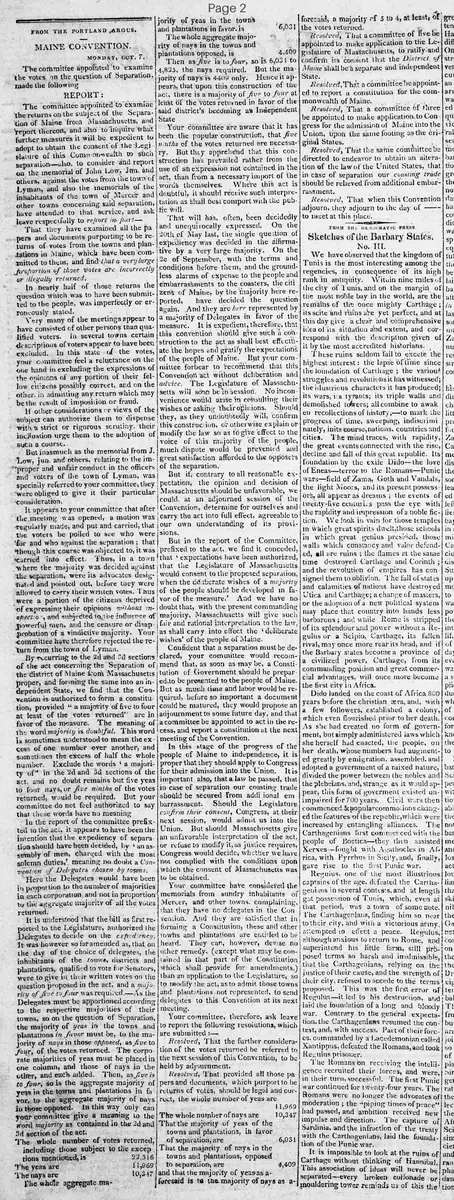
MAINE CONVENTION
The committee appointed to examine the votes on the question of Separation, made the following REPORT:
The committee appointed to examine the returns on the subject of the Separation of Maine from Massachusetts, and report thereon, and also to inquire what further measures it will be expedient to adopt to obtain the consent of the Legislature of this Commonwealth to such separation—also, to consider and report on the memorial of John Low, Jun. and others, against the votes from the town of Lyman, and also the memorials of the inhabitants of the town of Mercer and other towns concerning said separation,
have attended to that service, and ask leave respectfully to report in part—
That they have examined all the papers and documents purporting to be returns of votes from the towns and plantations in Maine, which have been committed to them, and find that a very large proportion of those votes are incorrectly or illegally returned.
In nearly half of those returns the question which was to have been submitted to the people, was imperfectly or erroneously stated.
Very many of the meetings appear to have consisted of other persons than qualified voters. In several towns certain descriptions of voters appear to have been excluded. In this state of the votes,
your committee feel a reluctance on the one hand in excluding the expressions of the opinions of any portion of their fellow citizens possibly correct, and on the other, in admitting any return which may be the result of imposition or fraud.
If other considerations or views of the subject can authorize them to dispense with a strict or rigorous scrutiny, their inclination urge them to the adoption of such a course.
But inasmuch as the memorial from J. Low, jun. and others, relating to the improper and unfair conduct in the officers and voters of the town of Lyman, was specially referred to your committee, they were obliged to give it their particular consideration.
It appears to your committee that after the meeting was opened, a motion was regularly made, and put and carried, that the voters be poled to see who were for and who against the separation; that though this course was objected to, it was carried into effect. Thus, in a town where the majority was decided against the separation, were its advocates designated and pointed out, before they were allowed to carry their written votes. Thus were a portion of the citizens deprived of expressing their opinions without inspection, and subjected to the influence of powerful men, and the censure or disapprobation of a vindictive majority. Your committee have therefore rejected the return from the town of Lyman.
By recurring to the 2d and 3d sections of the act concerning the Separation of the district of Maine from Massachusetts proper, and forming the same into an independent State, we find that the Convention is authorized to form a constitution, provided "a majority of five to four at least of the votes returned" are in favor of the measure. The meaning of the word majority is doubtful. This word is sometimes understood to mean the excess of one number over another, and sometimes the excess of half the whole number. Exclude the words "a majority of" in the 2d and 3d sections of the act, and no doubt remains but five yeas to four nays, or five ninths of the votes returned, would be required. But your committee do not feel authorized to say that these words have no meaning.
In the report of the committee prefixed to the act, it appears to have been the intention that the expediency of separation should have been decided, by "an assembly of men, charged with the most solemn duties," meaning no doubt a Convention of Delegates chosen by towns.
Here the Delegates would have been in proportion to the number of majorities in each corporation, and not in proportion to the aggregate majority of all the votes returned.
It is understood that the bill as first reported to the Legislature, authorized the Delegates to decide on the expediency.
It was however so far amended as, that on the day of the choice of delegates, the inhabitants of the towns, districts and plantations, qualified to vote for Senators, were to give in their written votes on the question proposed in the act, and a majority of five to four was required.—As the Delegates must be apportioned according to the respective majorities of their towns, so on the question of Separation, the majority of yeas in the towns and plantations in favor must be, to the majority of nays in those opposed, as five to four, of the votes returned. The corporate majorities of yeas must be placed in one column, and those of nays in the other, and each added. Then, as five is to four, so is the aggregate majority of yeas in the towns and plantations in favor, to the aggregate majority of nays in those opposed. In this way only can your committee give a meaning to the word majority as contained in the 2d and 3d section of the act.
The whole number of votes returned, including those subject to the exceptions mentioned, is 22,316
The yeas are 11,969
The nays are 10,347
The whole aggregate majority of yeas in the towns and plantations in favor, is 6,031
The whole aggregate majority of nays in the towns and plantations opposed, is 4,409
Then as five is to four, so is 6,031 to 4,825, the nays required. But the majority of nays is 4,409 only. Hence it appears, that upon this construction of the act, there is a majority of five to four at least of the votes returned in favor of the said district's becoming an Independent State.
Your committee are aware that it has been the popular construction, that five ninths of the votes returned are necessary. But they apprehend that this construction has prevailed rather from the use of an expression not contained in the act, than from a necessary import of the words themselves. Where this act is doubtful, it should receive such interpretation as shall best comport with the public will.
That will has, often, been decidedly and unequivocally expressed. On the 20th of May last, the single question of expediency was decided in the affirmative by a very large majority. On the 2d of September, with the terms and conditions before them, and the groundless alarms of expense to the people and embarrassments to the coasters, the citizens of Maine, by the majority here reported, have decided the question again. And they are here represented by a majority of Delegates in favor of the measure. It is expedient, therefore, that this convention should give such a construction to the act as shall best effectuate the hopes and gratify the expectations of the people of Maine. But your committee forbear to recommend that this Convention act without deliberation and advice. The Legislature of Massachusetts will soon be in session. No inconvenience would arise in consulting their wishes or asking their opinions. Should they, as they undoubtedly will, confirm this construction, or otherwise explain or modify the law so as to give effect to the voice of this majority of the people,
much dispute would be prevented and great satisfaction afforded to the opposers of the separation.
But if, contrary to all reasonable expectation, the opinion and decision of Massachusetts should be unfavorable, we could, at an adjourned session of the Convention, determine for ourselves and carry the act into full effect, agreeable to our own understanding of its provisions.
But in the report of the Committee, prefixed to the act, we find it conceded, that "expectations have been authorized, that the Legislature of Massachusetts would consent to the proposed separation, when the deliberate wishes of a majority of the people should be developed in favor of the measure." And we have no doubt that, with the present commanding majority, Massachusetts will give such fair and rational interpretation to the law, as shall carry into effect the "deliberate wishes" of the people of Maine.
Confident that a separation must be declared, your committee would recommend that, as soon as may be, a Constitution of Government should be prepared, to be presented to the people of Maine.
But as much time and labor would be required, before so important a document could be matured, they would propose an adjournment to some future day, and that a committee be appointed to act in the recess, and report a constitution at the next meeting of the Convention.
In this stage of the progress of the people of Maine to independence, it is proper that they should apply to Congress for their admission into the Union. It is important also, that a law be passed, that in case of separation our coasting trade should be secured from additional embarrassment. Should the Legislature confirm their consent, Congress, at their next session, would admit us into the Union. But should Massachusetts give an unfavorable interpretation of the act, or refuse to modify it, as justice requires, Congress would decide, whether we have not complied with the conditions upon which the consent of Massachusetts was to be obtained.
Your committee have considered the memorials from sundry inhabitants of Mercer, and other towns, complaining that they have no delegates in the Convention. And they are satisfied that in forming a Constitution, these and other towns and plantations are entitled to be heard. They can, however, devise no other remedy, (except what may be contained in that part of the Constitution which shall provide for amendments,)
than an application to the Legislature, so to modify the act, as to admit those towns and plantations not represented, to send delegates to this Convention at its next meeting.
Your committee, therefore, ask leave to report the following resolutions, which are submitted:-
Resolved, That the further consideration of the votes returned be referred to the next session of this Convention, to be held by adjournment.
Resolved, That provided all those papers and documents, which purport to be returns of votes, should be legal and correct, the whole number of yeas are 11,969
The whole number of nays are 10,347
That the majority of yeas of the towns and plantations, in favor of separation, are 6,031
That the majority of nays in the towns and plantations, opposed to separation, are 4,409
and that the majority of yeas aforesaid is to the majority of nays as aforesaid, a majority of 5 to 4, at least, of the votes returned.
Resolved, That a committee of five be appointed to make application to the Legislature of Massachusetts, to ratify and confirm its consent That the District of Maine shall be a separate and independent State.
Resolved, That a committee be appointed to report a constitution for the commonwealth of Maine.
Resolved, That a committee of three be appointed to make application to Congress for the admission of Maine into the Union, upon the same footing as the original States.
Resolved, That the same committee be directed to endeavor to obtain an alteration of the law of the United States, that in case of separation our coasting trade should be relieved from additional embarrassment.
Resolved, That when this Convention adjourn, they adjourn to the day of ---- to meet at this place.
What sub-type of article is it?
What keywords are associated?
What entities or persons were involved?
Where did it happen?
Domestic News Details
Primary Location
Maine
Key Persons
Outcome
the committee found a majority of five to four in favor of separation based on aggregate majorities: yeas 11,969, nays 10,347; aggregate yea majority 6,031, nay majority 4,409. rejected return from lyman. recommended proceeding with constitution and applications to massachusetts and congress.
Event Details
Committee report to the Maine Convention on examining vote returns for separation from Massachusetts. Noted irregularities in many returns, rejected Lyman's due to unfair polling. Interpreted the act's majority requirement as aggregate town majorities of five to four, finding it met. Proposed resolutions for adjournment, committee to seek ratification from Massachusetts, draft constitution, apply to Congress for admission, and address coasting trade.