Thank you for visiting SNEWPapers!
Sign up free
Alexandria Daily Advertiser
Alexandria, Virginia
What is this article about?
In Aaron Burr's trial, Gen. Wilkinson testifies about receiving ciphered letters from Burr via Swartwout and Bollman in 1806 at Natchitoches, revealing a plot to assemble 7,000 men for an expedition against Mexican provinces, involving associates like Dayton and Truxtun, prompting Wilkinson to alert authorities.
Merged-components note: Continuation of the same article 'TRIAL OF COLONEL A. BURR' across pages 2 and 3, with sequential reading order and matching topic.
Clippings
1 of 2
OCR Quality
Full Text
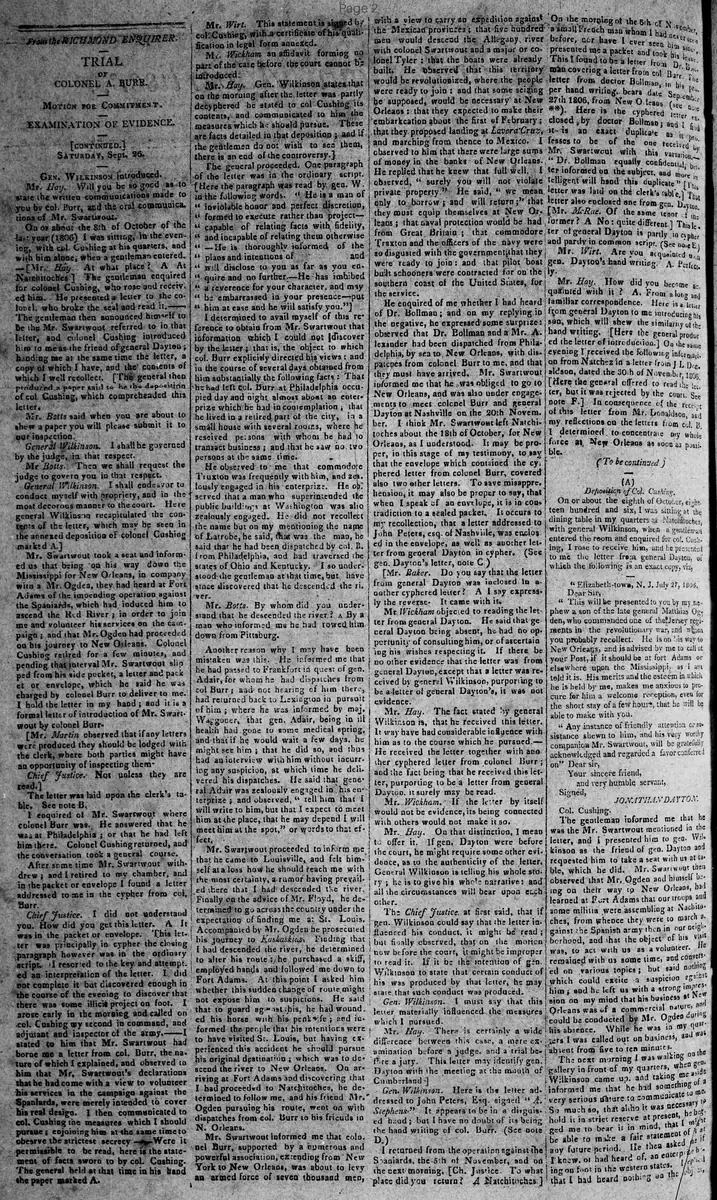
TRIAL OF COLONEL A. BURR.
Motion for Commitment.
EXAMINATION OF EVIDENCE CONTINUED.
SATURDAY, SEPT. 26.
GEN. WILKINSON introduced
Mr. Hay. Will you be so good as to state the written communications made to you by Col. Burr and the oral communications of Mr. Swartwout.
On or about the 5th of October of the last year (1806) I was sitting, in the evening, with Col. Cushing at his quarters, and with him alone; when a gentleman entered.
Mr. Hay. At what place? A. At Natchitoches. The gentleman enquired for Colonel Cushing, who rose and received him. He presented a letter to the Colonel, who broke the seal and read it. The gentleman then announced himself to be the Mr. Swartwout referred to in that letter and Colonel Cushing introduced him to me as the friend of General Dayton; handing me at the same time the letter, a copy of which I have, and the contents of which I well recollect. The general then produced a paper said to be the deposition of Col. Cushing, which comprehended this letter.
Mr. Betts said when you are about to shew a paper you will please submit it to our inspection.
General Wilkinson! I shall be governed by the judge in that respect.
Mr. Botts. Then we shall request the judge to govern you in that respect.
General Wilkinson. I shall endeavor to conduct myself with propriety, and in the most decorous manner to the court. Here general Wilkinson recapitulated the contents of the letter, which may be seen in the annexed deposition of Colonel Cushing marked A.
Mr. Swartwout took a seat and informed us that being on his way down the Mississippi for New Orleans, in company with a Mr. Ogden, they had heard at Fort Adams of the impending operation against the Spaniards, which had induced him to ascend the Red River; in order to join me and volunteer his services on the campaign; and that Mr. Ogden had proceeded on his journey to New Orleans. Colonel Cushing retired for a few minutes, and pending that interval Mr. Swartwout slipped from his side pocket a letter and packet or envelope, which he said he was charged by Colonel Burr to deliver to me.
I hold the letter in my hand; and it is a formal letter of introduction of Mr. Swartwout by Colonel Burr.
[Mr. Martin observed that if any letters were produced they should be lodged with the clerk, where both parties might have an opportunity of inspecting them.]
Chief Justice. Not unless they are read.
The letter was laid upon the clerk's table. See note B.
I enquired of Mr. Swartwout where Colonel Burr was. He answered that he was at Philadelphia: or that he had left him there. Colonel Cushing returned, and the conversation took a general course. After some time Mr. Swartwout withdrew; and I retired to my chamber, and in the packet or envelope I found a letter addressed to me in the cypher from Col. Burr.
Chief Justice. I did not understand you. How did you get this letter. A. It was in the packet or envelope. This letter was principally in cypher the closing paragraph however was in the ordinary script. I resorted to the key and attempted an interpretation of the letter. I did not complete it but discovered enough in the course of the evening to discover that there was some illicit project on foot. I arose early in the morning and called on Col. Cushing my second in command, and adjutant and inspector of the army. I stated to him that Mr. Swartwout had borne me a letter from Col. Burr. the nature of which I explained, and observed to him that Mr. Swartwout's declarations that he had come with a view to volunteer his services in the campaign against the Spaniards, were merely intended to cover his real design. I then communicated to Col. Cushing the measures which I should pursue; enjoining him at the same time to observe the strictest secrecy. Were it permissible to be read, here is the statement of facts sworn to by Col. Cushing.
The general held at that time in his hand the paper marked A.
Mr. Wirt. This statement is signed by Col. Cushing, with a certificate of his station in legal form annexed.
Mr. Wickham an affidavit forming no part of the case before the court cannot be introduced.
Mr. Hay. Gen. Wilkinson states that on the morning after the letter was partly decyphered he stated to Col. Cushing its contents, and communicated to him the measures which he should pursue. These are facts detailed in that deposition: and if the gentlemen do not wish to see them, there is an end of the controversy.
The general proceeded, One paragraph of the letter was in the ordinary script.
[Here the paragraph was read by Gen. W. in the following words. "He is a man of inviolable honor and perfect discretion, formed to execute rather than project it capable of relating facts with fidelity, and incapable of relating them otherwise. He is thoroughly informed of the plans and intentions of [and] will disclose to you as far as you enquire and no further.--He has imbibed a reverence for your character, and may be embarrassed in your presence--put him at ease and he will satisfy you."]
I determined to avail myself of this reference to obtain from Mr. Swartwout that information which I could not discover by the letter: that is, the object to which Col. Burr explicitly directed his views: and in the course of several days obtained from him substantially the following facts: That he had left Col. Burr at Philadelphia occupied day and night almost about an enterprize which he had in contemplation; that he lived in a retired part of the city, in a small house with several rooms, where he received persons with whom he had to transact business; and that he saw no two persons at the same time.
He observed to me that Commodore Truxton was frequently with him, and zealously engaged in his enterprize. He observed that a man who superintended the public buildings at Washington was also zealously engaged. He did not recollect the name but on my mentioning the name of L'Enfant, he said, that was the man, he said that he had been dispatched by Col. B. from Philadelphia, and had traversed the states of Ohio and Kentucky. I so understood the gentleman at that time, but, have since discovered that he descended the river.
Mr. Botts. By whom did you understand that he descended the river? A. By a man who informed me he had rowed him down from Pittsburgh.
Another reason why I may have been mistaken was this... He informed me that he had passed to Frankfort in quest of Gen. Adair, for whom he had dispatches from Col. Burr; and not hearing of him there, had returned back to Lexington in pursuit of him; where he was informed by Maj. Warrington, that Gen. Adair, being in ill health had gone to some medical spring, and that if he would wait a few days, he might see him: that he did so, and thus had an interview with him without incurring any suspicion, at which time he delivered his dispatches. He said that General Adair was zealously engaged in his enterprize; and observed, "tell him that I will write to him, but that I expect to meet him at the place, that he may depend I will meet him at the spot," or words to that effect.
Mr. Swartwout proceeded to inform me that he came to Louisville, and felt himself at a loss how he should reach me with the most certainty, a rumor having prevailed there that I had descended the river. Finally on the advice of Mr. Floyd, he determined to go across the country under the expectation of finding me at St. Louis. Accompanied by Mr. Ogden he prosecuted his journey to Kaskaskias. Finding that I had descended the river, he determined to alter his route: he purchased a skiff, employed hands and followed me down to Fort Adams. At this point I asked him whether this sudden change of route might not expose him to suspicion. He said that to guard against this, he had wounded his horse with his penknife; and informed the people that his intentions were to have visited St. Louis, but having experienced this accident he should pursue his original destination; which was to descend the river to New Orleans. On arriving at Fort Adams and discovering that I had proceeded to Natchitoches, he determined to follow me, and his friend Mr. Ogden pursuing his route, went on with dispatches from Col. Burr to his friends in N. Orleans.
Mr. Swartwout informed me that Colonel Burr supported by a numerous and powerful association extending from New York to New Orleans, was about to levy an armed force of seven thousand men, with a view to carry an expedition against the Mexican provinces; that five hundred men would descend the Alleghany river with Colonel Swartwout and a major or Colonel Tyler: that the boats were already built. He observed that this territory would be revolutionized, where the people were ready to join: and that some seizing he supposed, would be necessary at New Orleans: that they expected to make their embarkation about the first of February; that they proposed landing at Vera Cruz, and marching from thence to Mexico. I observed to him that there were large sums of money in the banks of New Orleans. He replied that he knew that full well. I observed, "surely you will not violate private property." He said, "we mean only to borrow; and will return;" that they must equip themselves at New Orleans; that naval protection would be had from Great Britain: that Commodore Truxton and the officers of the navy were so disgusted with the government that they were ready to join: and that pilot boat built schooners were contracted for on the southern coast of the United States, for the service.
He enquired of me whether I had heard of Dr. Bollman; and on my replying in the negative, he expressed some surprise: observed that Dr. Bollman and a Mr. Alexander had been dispatched from Philadelphia, by sea to New Orleans, with dispatches from Colonel Burr to me, and that they must have arrived. Mr. Swartwout informed me that he was obliged to go to New Orleans, and was also under engagements to meet Colonel Burr and General Dayton at Nashville on the 20th November. I think Mr. Swartwout left Natchitoches about the 18th of October, for New Orleans, as I understood. It may be proper, in this stage of my testimony, to say that the envelope which contained the cyphered letter from Colonel Burr, covered also two other letters. To save misapprehension, it may also be proper to say, that when I speak of an envelope, it is in contradiction to a sealed packet. It occurs to my recollection, that a letter addressed to John Peters, esq. of Nashville, was enclosed in the envelope, as well as another letter from General Dayton in cypher. (See Gen. Dayton's letter, note C.)
Mr. Baker. Do you say that the letter from General Dayton was enclosed in another cyphered letter? A. I say expressly the reverse--It came with it.
Mr. Wickham objected to reading the letter from General Dayton. He said that General Dayton being absent, he had no opportunity of consulting him, or of ascertaining his wishes respecting it. If there be no other evidence that the letter was from General Dayton, except that a letter was received by General Wilkinson, purporting to be a letter of General Dayton's, it was not evidence.
Mr. Hay. The fact stated by General Wilkinson is, that he received this letter. It may have had considerable influence with him as to the course which he pursued. He received the letter together with another cyphered letter from Colonel Burr; and the fact being that he received this letter, purporting to be a letter from General Dayton, it surely may be read.
Mr. Wickham. If the letter by itself would not be evidence, its being connected with others would not make it so.
Mr. Hay. On that distinction, I mean to offer it. If Gen. Dayton were before the court, he might require some other evidence, as to the authenticity of the letter. General Wilkinson is telling his whole story; he is to give his whole narrative: and all the circumstances will bear upon each other.
The Chief Justice, at first said, that if Gen. Wilkinson could say that the letter influenced his conduct, it might be read; but finally observed, that on the motion now before the court, it might be improper to read it in. If it be the intention of Gen. Wilkinson to state that certain conduct of his was produced by that letter, he may state that such conduct was produced.
Gen. Wilkinson. I must say that this letter materially influenced the measures which I pursued.
Mr. Hay. There is certainly a wide difference between this case, a mere examination before a judge, and a trial before a jury. This letter may identify Gen. Dayton with the meeting at the mouth of Cumberland.
Gen. Wilkinson. Here is the letter addressed to John Peters, Esq. signed "A. Stephens." It appears to be in a disguised hand; but I have no doubt of its being the hand writing of Col. Burr. (See note D.)
I returned from the operation against the Spaniards, the 5th of November, and on the next morning.
Ch. Justice. To what place did you return? A. Natchitoches.
On the morning of the 5th of November, a small French man whom I had never seen before, nor have I ever seen him since, presented me a packet and took his leave. This I found to be a letter from Dr. Bollman covering a letter from Col. Burr. The letter from Doctor Bollman, in his proper hand writing, bears date September 27th 1806, from New Orleans (see note **). Here is the cyphered letter enclosed by Doctor Bollman; and I find it is an exact duplicate as it professes to be of the one received by Mr. Swartwout with this variation.-- "Dr. Bollman equally confidential; better informed on the subject, and more intelligent will hand this duplicate." [This letter was laid on the clerk's table.] That letter also enclosed one from Gen. Dayton.
[Mr. McRae. Of the same tenor as the former? A. No: quite different.] This letter of General Dayton is partly in cypher and partly in common script. (See note E.)
Mr. Wirt. Are you acquainted with Gen. Dayton's hand writing. A. Perfectly.
Mr. Hay. How did you become acquainted with it? A. From a long and familiar correspondence. Here is a letter from General Dayton to me introducing his son, which will shew the similarity of the hand writing. [Here the general produced the letter of introduction.] On the same evening I received the following information from Natchez in a letter from J.L. Donaldson, dated the 30th of November, 1806. Here the general offered to read the letter, but it was rejected by the court. See note F.] In consequence of the receipt of this letter from Mr. Donaldson, and my reflections on the letters from Col. B. I determined to concentrate my whole force at New Orleans as soon as possible.
(To be continued)
(A)
Deposition of Col. Cushing.
On or about the eighth of October, eighteen hundred and six, I was sitting at the dining table in my quarters at Natchitoches, with General Wilkinson, when a gentleman entered the room and enquired for Col. Cushing, I rose to receive him, and he presented to me the letter from General Dayton, of which the following is an exact copy, viz,
"Elizabeth-town, N. J. July 27, 1806.
Dear Sir,
This will be presented to you by my nephew a son of the late general Matthias Ogden, who commanded one of the Jersey regiments in the revolutionary war, and whom you probably recollect. He is on his way to New Orleans, and is advised by me to call at your Post, if it should be at Fort Adams or elsewhere upon the Mississippi, as I am told it is. His merits and the esteem in which he is held by me, makes me anxious to procure for him a welcome reception, even for the short stay of a few hours, that he will be able to make with you.
Any instance of friendly attention or assistance shewn to him, and his very worthy companion Mr. Swartwout, will be gratefully acknowledged and regarded a favor conferred on
Dear sir,
Your sincere friend, and very humble servant,
Signed,
JONATHAN DAYTON."
Col. Cushing:
The gentleman informed me that he was the Mr. Swartwout mentioned in the letter, and I presented him to Gen. Wilkinson as the friend of Gen. Dayton and requested him to take a seat with us at table, which he did. Mr. Swartwout then observed that Mr. Ogden and himself being on their way to New Orleans, had learned at Fort Adams that our troops and some militia were assembling at Natchitoches, from whence they were to march against the Spanish army then in our neighborhood, and that the object of his visit was to act with us as a volunteer. He remained with us some time, and conversed on various topics; but said nothing which could excite a suspicion against him; and he left us with a strong impression on my mind that his business at New Orleans was of a commercial nature.
While he was in my quarters I was called out on business, and was absent from five to ten minutes. The next morning I was walking on the gallery in front of my quarters, when Gen. Wilkinson came up, and taking me aside informed me that he had something of a very serious nature to communicate to me. So much so, that although it was necessary to hold it in strict reserve at present, he begged me to bear it in mind, that I might be able to make a fair statement of it at any future period. He then asked me if I knew of or had heard of, an enterprize being on foot in the western states. I replied that I had heard nothing on the subject.
I liked him that the enterprise was to carry a greater number of individuals than this moment associated for purposes ideal to the government of the U. S. health, popularity and talents who delivered you the letter their head and The story of serving as a volunteer is only a unique He has brought me a letter from t been able fully to make out, but being cypher capable, and that it is my duty to oppose that his object trea wres me that he has founds-ys the napy dim by every means in my power. He as. with his-ofcrs to make me se- pnd in command. and to give the officers the army anything I may ask for them inl need to confer with him at Nash. and he requests me to send a confident. Ville jo, Tennessee. : In fact Se seems to jo him I then asked the general when alulae on me and the army as ready to ber he had received any information from government, to which he replied that he had not, and that be must therefore adopt such measures as in his judgment were best calculated to defend the country do de Sabine and endeavor to make such erms with the Spanish commander, as would justify him in removing the greater pit of his forces to- the Mississippi, and the moment this should be effected he could send me to New Orleans in a light brig, with orders to secure the French train of artillery at that post, and to put the place in the best possible situation for defense, and that he would follow with every man that could be spared from Natchitoches with all possible expedition: He pd none would give the information he had received to the president of the United States and solicit particular instructions in his government, but as delay might prove ruinous, he would pursue the course Alore suggested, as the only means in his power to save the country, until the pleasure of the president should be known.- On our march to the Sabine the general informed me that he thought his presence at New Orleans at as early a period as possible was absolutely necessary, and that the moment he could make terms with the Spanish commander, he would set out for the Mississippi and leave me to bring on the troops. Natchitoches, 15th Nov. 1806. Signed, T. H. CUSHING Col. of the 2d Reg. of Infantry and Adj't ecd Inspector of the army Sworn to before me at the city of New Orleans, this twentieth day of May, 1807. Signed, GEORGE POLLOCK. Justice of the peace of the parish of Orleans. B Philadelphia, 25th July, 1806. Dear Sir, Mr. Swartwout, the brother of Colonel S. of New York, being on his way from the Mississippi and presuming that he may pass you at some point on the river, has requested of me a letter of introduction, which I give with pleasure as he is a most able young man, and highly respectable in his character and connections. I pray you to afford him any friendly offers, which his situation may require and beg you to pardon the trouble which this may give you. With entire respect, Your friend and obedient servant. BURR. His excellency, gen. Wilkinson M. Swartwout. (C) Copy of letter from general Dayton to general Wilkinson, written in cypher, except those parts printed in Italics. This cipher was designed by general Dayton, founded on the Hieroglyphics known to gen. Wilkinson and col. Burr. July 9th, 1806. It is well ascertained that you are to be placed in next session Jefferson will to af to yield reluctantly to the public sentiment but yield he will + prepare yourself therefore for it you know the rest You are not a man to despair or even to pad, especially when such prospects offer in another quarter. Are you ready, are your generous associates ready? Wealth and glory receive Louisiana O a H letter and from address Mexico you one before to shall me I set here have out for a- o me in Cincinnati, receive and treat my nephew affectionately as you would receive your friend DAYTON. (D) SIR, I have concluded to undertake the land purchase which we talked of last winter and determined to go on the lands this fall any number of settlers could be had on this side the mountains, but I should prefer to have the greater part from the western country you promised to write about the horses but have heard nothing from you & suppose there will be no difficulty on that head The money for the first payment is now ready..I shall be at Frankfort about the 15th August and hope then to meet you and col. Lynch there It is quite necessary that I should see Lynch as I shall be provided with cash to go on vigorously with our speculation Some of the concerned are now on their way to see you and will be with you nearly as soon as this letter. Please to encourage them and give them good account of things. Your humble servant (Signed) A. STEPHENS John Peters Esq. Nashville Letter from Doctor Bollman to Gen. Wilkinson, of the 27th September, 1806. New-Orleans, Septa 27th, 1806. SIR, I have the honor to forward to your excellency, the enclosed letters, which I was charged to deliver to you by our mutual friend. I shall remain for some time at this place, and should be glad to learn when and where I may have the pleasure of an interview with you. Have the goodness to inform me of it, and please to direct your letter to me to the care of Messrs. Chew and Relf, or enclose under cover to them. I have the honor to be, with great respect, sir, your excellency's most ob't servant, (Signed) ERICK BOLLMAN. Genl. WILKINSON. (E) July 16th, 1807. My dear Friend, As you are said to have removed your Head Quarters down the river, and there is a report that the Spaniards intercept our mails which pass necessarily through the territory occupied by them, in order to reach you : I think proper to address you in cypher that the contents may be concealed from the Dons, if they should make so free as to open the letter Take the following for the Catch -word, or Check word (and you may very readily decy. pher the figures). Viz. in your own Hieroglyphic [.]. but in your own alphabet thus, Hieroglyphics VTOA Every thing and even heaven itself appears to have conspired to prepare this Train for a grand explosion; are you also ready? For I know your unflinching spirit when a great object is in view Your present is more favorable than your late position, and as you can retain it without suspicion or alarm, you ought by no means to retire from it until your friends join you in December some where on the river Mississippi--Under the auspices of Burr and Wilkinson, I shall be happy to engage, and when the time arrives you will find me near you. Write and inform me by first mail what may be expected from you and your associates. In an enterprize of such moment, considerations even stronger than those of affection im- pel me to desire your cordial co-operation and active support. DAYTON. Wealth & Honor Adieu Burr & Wilkinson Courage & Union. Let me hear from you by mail, as well as by the first good private conveyance, and be- lieve me, with the best wishes for your pros- perity and happiness most truly, Your friend and servant JONA: DAYTON. If you write in Cypher? [Hieroglyphics use the same words, viz. V --O-l A (F) Extract of a letter from James L. Donaldson, esq. to General. James Wilkinson, dated. Natchez Oct. 30. 1806. " Michael Myers, arrived here to day in three days from S. Louis, -on his way to New Orleans. He made a communi. cation to me with permission to transmit to you, which might stagger even creduli. ty ; of his information he says he is cer. tain and most firmly believes in the intel. gence he communicates. This is neither more nor less than a plan to revolutionize the Western country has been formed ma- tured, and is ready to explode, that Ken- tucky, Ohio, Tennessee, Orleans and In. diana are combined to declare themselves indepen dent on the 15th of November That proposals have been made to some of the most influential characters at Saint Louis, by accredited agents of the conspi- racy to join the plan. That this person whose name Myers refuses to reveal, is in a most respectable line of life, and has the most unquestionable vouchers of his mis- sion in French and English. That he de- clared if Money was necessary. that it might be commanded to any extent It is proper to add that the persons thus ap- plied to at St. Louis altogether refused to concur in any plan of the kind, saying that it should be only superior force that should dispense with their oath of fidelity to the United States. This may all appear to a person as well acquainted as you are with -the western country as a second spanish conspiracy and as such be ridiculed, and such is my impression of the wonderful plan. But Myers so firmly believed it that having set forth on his journey by land to the U. S He was induced by his fears hastily. to re- turn to arrange his business at all events & prepare. for an Explosion He most so- lemnly protests the truth of the communi- cation, and declares there are only four persons in St. Louis who are privy to the disclosure made by the secret agent It is not improbable that this may be a " Ruse de guerre' a stratagem set on foot by the patrons of the Western. World, to foster and keep alive the dissention, which excited by the pretended exposition of ancient conspiracies may be fanned into a flame by spreading an alarm of an immediately and pressing treasonable combination This I am apt to believe is the case, and in order more fully to succeed they may study and affect mystery, as better calcu- lated to excite suspicion, and that they may have the honor of a new discovery,. How- ever, be the matter as it may, I commu- nicate it to you, as I received it, and have only to regret, that you had it not in person from Myers information, of which, what- ever your judgment might pronounce, the solemnity of his assertion and his certainty of the plan (altho' he was not at liberty to divulge the means) must have staggered the mind capable of believing it."
What sub-type of article is it?
What themes does it cover?
What keywords are associated?
What entities or persons were involved?
Where did it happen?
Story Details
Key Persons
Location
Natchitoches, Philadelphia, New Orleans, Mississippi River
Event Date
1806
Story Details
Gen. Wilkinson testifies receiving ciphered letters from Burr via Swartwout and Bollman detailing a conspiracy to raise 7,000 men for invading Mexico, involving associates and plans for revolutionizing western territories; Wilkinson deciphers parts, consults Cushing, and decides to concentrate forces at New Orleans upon learning of the plot.