Thank you for visiting SNEWPapers!
Sign up free
Alexandria Daily Gazette, Commercial & Political
Alexandria, Virginia
What is this article about?
On Dec. 20, 1810, the U.S. House of Representatives debated a resolution to amend the Constitution, barring members from holding executive offices during the presidential term they served in. Key speakers included Macon, Rhea, Boyd, and Burwell; the matter was referred to a select committee, with passage likely.
Merged-components note: Merging continuation of the congressional debate on constitutional amendment across page break, maintaining sequential reading order.
Clippings
1 of 2
OCR Quality
Full Text
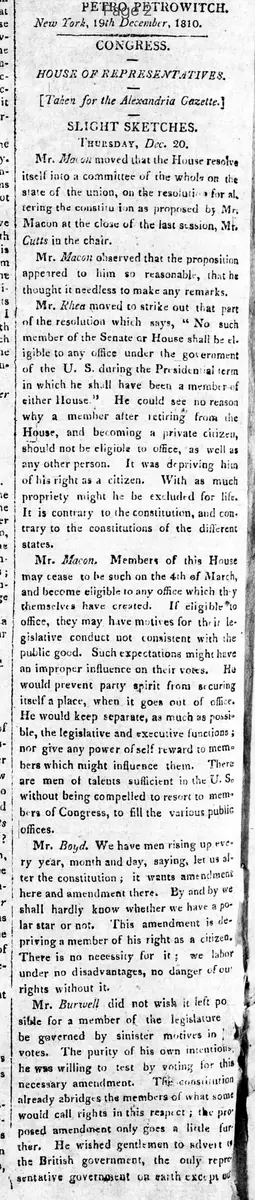
CONGRESS.
HOUSE OF REPRESENTATIVES.
[Taken for the Alexandria Gazette.]
SLIGHT SKETCHES.
Thursday, Dec. 20.
Mr. Munroe moved that the House resolve itself into a committee of the whole on the state of the union, on the resolution for altering the constitution as proposed by Mr. Macon at the close of the last session, Mr. Cutts in the chair.
Mr. Macon observed that the proposition appeared to him so reasonable, that he thought it needless to make any remarks.
Mr. Rhea moved to strike out that part of the resolution which says, "No such member of the Senate or House shall be eligible to any office under the government of the U. S. during the Presidential term in which he shall have been a member of either House." He could see no reason why a member after retiring from the House, and becoming a private citizen, should not be eligible to office, as well as any other person. It was depriving him of his right as a citizen. With as much propriety might he be excluded for life. It is contrary to the constitution, and contrary to the constitutions of the different states.
Mr. Macon, Members of this House may cease to be such on the 4th of March, and become eligible to any office which they themselves have created. If eligible to office, they may have motives for their legislative conduct not consistent with the public good. Such expectations might have an improper influence on their votes. He would prevent party spirit from securing itself a place, when it goes out of office. He would keep separate, as much as possible, the legislative and executive functions; nor give any power of self reward to members which might influence them. There are men of talents sufficient in the U. S. without being compelled to resort to members of Congress, to fill the various public offices.
Mr. Boyd. We have men rising up every year, month and day, saying, let us alter the constitution; it wants amendment here and amendment there. By and by we shall hardly know whether we have a polar star or not. This amendment is depriving a member of his right as a citizen. There is no necessity for it: we labor under no disadvantages, no danger of our rights without it.
Mr. Burwell did not wish it left possible or a member of the legislature be governed by sinister motives in his votes. The purity of his own intentions, he was willing to test by voting for this necessary amendment. The constitution already abridges the members of what some would call rights in this respect; the proposed amendment only goes a little further. He wished gentlemen to advert to the British government, the only representative government on earth except our own.
How do men there in the minority become exalted to office? How often in future, the President may in some instances, to secure support in office, to come over to the ministry? He better acquainted with candidates who are members of either House business; yet how often, for the sake may such members hide their sentiments and views from the President correct, made from the recommendation at. His choice will generally be as those on whom he can rely.
On the question of striking out, twelve only rose in the affirmative.
Some debate arising on the force of the words office and appointment, and some verbal amendments being deemed necessary, the committee of the whole rose, and referred the subject to a select committee.
It is highly probable that the resolution will pass, so that no member of either House shall be eligible to any office under the government of the U.S. during the Presidential term, in any part of which he shall have been a member.
What sub-type of article is it?
What keywords are associated?
What entities or persons were involved?
Where did it happen?
Domestic News Details
Primary Location
Washington, D.C.
Event Date
Thursday, Dec. 20, 1810
Key Persons
Outcome
the motion to strike out failed with twelve in the affirmative; the committee rose and referred the resolution to a select committee; passage is highly probable.
Event Details
The House resolved into committee of the whole to debate Mr. Macon's resolution amending the Constitution to bar Senators and Representatives from U.S. government offices during the presidential term of their service. Mr. Rhea moved to strike the eligibility clause, arguing it violated citizens' rights; opponents like Macon and Burwell argued it prevented improper influences and separated legislative and executive functions. Debate referenced British practices and constitutional principles.