Thank you for visiting SNEWPapers!
Sign up free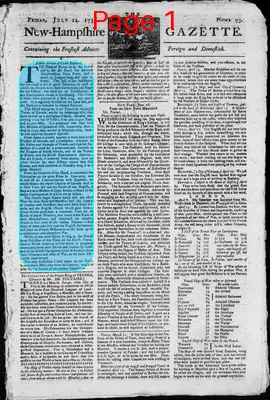
The New Hampshire Gazette
Portsmouth, Rockingham County, New Hampshire
What is this article about?
A historical account of Cape Breton (Isle Royale), its geography, French fishing settlements and fortifications at Louisbourg, economic importance via Treaty of Utrecht, strategic control over St. Lawrence River, and potential British gains from its capture, including fishery dominance, trade advantages, and reduced threats to North American colonies.
Clipping
OCR Quality
Full Text
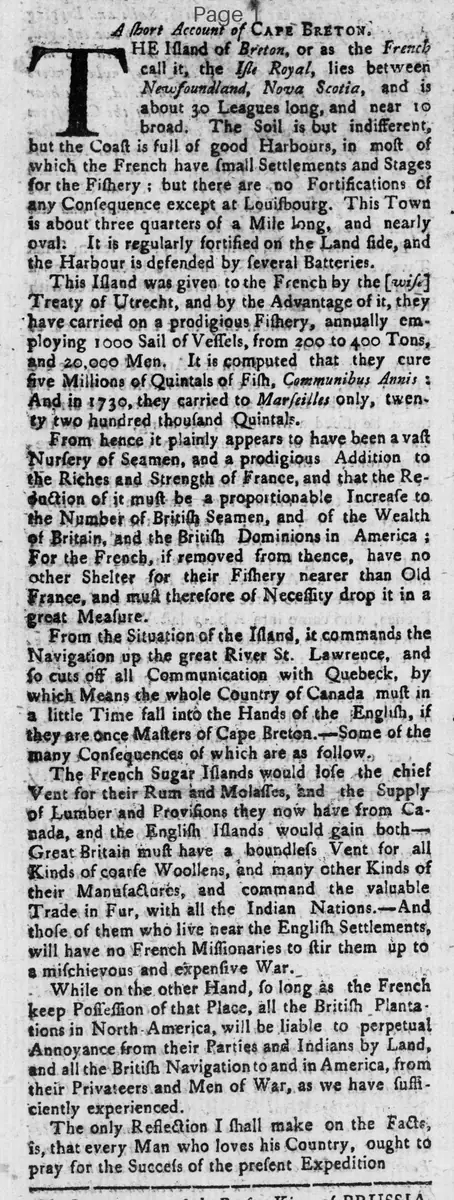
The Island of Breton, or as the French call it, the Isle Royale, lies between Newfoundland, Nova Scotia, and is about 30 Leagues long, and near 10 broad. The Soil is but indifferent, but the Coast is full of good Harbours, in most of which the French have small Settlements and Stages for the Fishery; but there are no Fortifications of any Consequence except at Louisbourg. This Town is about three quarters of a Mile long, and nearly oval: It is regularly fortified on the Land side, and the Harbour is defended by several Batteries.
This Island was given to the French by the Treaty of Utrecht, and by the Advantage of it, they have carried on a prodigious Fishery, annually employing 100 Sail of Vessels, from 20 to 40 Tons, and 20,000 Men. It is computed that they cure five Millions of Quintals of Fish, Communibus Annis: And in 1739, they carried to Marseilles only, twenty two hundred thousand Quintals.
From hence it plainly appears to have been a vast Nursery of Seamen, and a prodigious Addition to the Riches and Strength of France, and that the Reduction of it must be a proportionable Increase to the Number of British Seamen, and of the Wealth of Britain, and the British Dominions in America; For the French, if removed from thence, have no other Shelter for their Fishery nearer than Old France, and must therefore of Necessity drop it in a great Measure.
From the Situation of the Island, it commands the Navigation up the great River St. Lawrence, and so cuts off all Communication with Quebec, by which Means the whole Country of Canada must in a little Time fall into the Hands of the English, if they are once Masters of Cape Breton. Some of the many Consequences of which are as follow.
The French Sugar Islands would lose the chief Vent for their Rum and Molasses, and the Supply of Lumber and Provisions they now have from Canada, and the English Islands would gain both.
Great Britain must have a boundless Vent for all Kinds of coarse Woollens, and many other Kinds of their Manufactures, and command the valuable Trade in Fur, with all the Indian Nations. And those of them who live near the English Settlements, will have no French Missionaries to stir them up to a mischievous and expensive War.
While on the other Hand, so long as the French keep Possession of that Place, all the British Plantations in North America, will be liable to perpetual Annoyance from their Parties and Indians by Land, and all the British Navigation to and in America, from their Privateers and Men of War, as we have sufficiently experienced.
The only Reflection I shall make on the Facts, is, that every Man who loves his Country, ought to pray for the Success of the present Expedition.
What sub-type of article is it?
What themes does it cover?
What keywords are associated?
Where did it happen?
Story Details
Location
Cape Breton (Isle Royale), Louisbourg, St. Lawrence River, Quebec, Canada, North America
Event Date
Treaty Of Utrecht; 1739
Story Details
Description of Cape Breton's geography and French fishing operations; strategic importance for controlling Canada; economic benefits to Britain from its capture, including fishery, trade, and reduced threats.