Thank you for visiting SNEWPapers!
Sign up free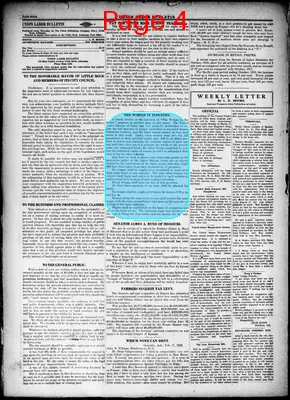
Story
February 28, 1919
Union Labor Bulletin
Little Rock, Pulaski County, Arkansas
What is this article about?
Editorial advocating for protective labor policies for women in industry, supported by the U.S. Bureau of Labor and unions. Outlines rules on working hours, rest, meals, night work ban, equal wages, and minimum wage based on occupation, not sex.
Clipping
OCR Quality
98%
Excellent
Full Text
THE WOMAN IN INDUSTRY.
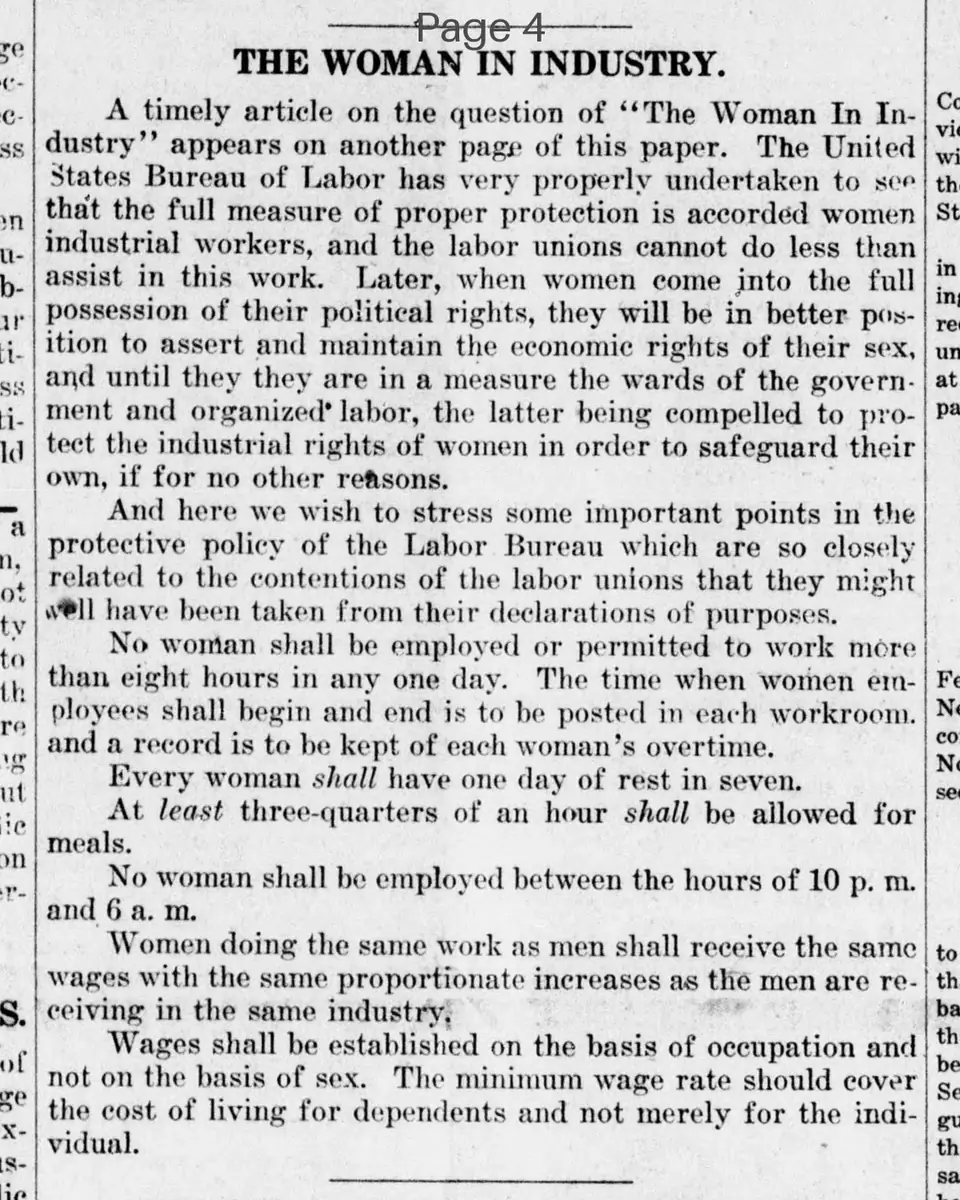
A timely article on the question of "The Woman In Industry" appears on another page of this paper. The United States Bureau of Labor has very properly undertaken to see that the full measure of proper protection is accorded women industrial workers, and the labor unions cannot do less than assist in this work. Later, when women come into the full possession of their political rights, they will be in better position to assert and maintain the economic rights of their sex, and until they are in a measure the wards of the government and organized labor, the latter being compelled to protect the industrial rights of women in order to safeguard their own, if for no other reasons.
And here we wish to stress some important points in the protective policy of the Labor Bureau which are so closely related to the contentions of the labor unions that they might well have been taken from their declarations of purposes.
No woman shall be employed or permitted to work more than eight hours in any one day. The time when women employees shall begin and end is to be posted in each workroom, and a record is to be kept of each woman's overtime.
Every woman shall have one day of rest in seven.
At least three-quarters of an hour shall be allowed for meals.
No woman shall be employed between the hours of 10 p. m. and 6 a. m.
Women doing the same work as men shall receive the same wages with the same proportionate increases as the men are receiving in the same industry.
Wages shall be established on the basis of occupation and not on the basis of sex. The minimum wage rate should cover the cost of living for dependents and not merely for the individual.
A timely article on the question of "The Woman In Industry" appears on another page of this paper. The United States Bureau of Labor has very properly undertaken to see that the full measure of proper protection is accorded women industrial workers, and the labor unions cannot do less than assist in this work. Later, when women come into the full possession of their political rights, they will be in better position to assert and maintain the economic rights of their sex, and until they are in a measure the wards of the government and organized labor, the latter being compelled to protect the industrial rights of women in order to safeguard their own, if for no other reasons.
And here we wish to stress some important points in the protective policy of the Labor Bureau which are so closely related to the contentions of the labor unions that they might well have been taken from their declarations of purposes.
No woman shall be employed or permitted to work more than eight hours in any one day. The time when women employees shall begin and end is to be posted in each workroom, and a record is to be kept of each woman's overtime.
Every woman shall have one day of rest in seven.
At least three-quarters of an hour shall be allowed for meals.
No woman shall be employed between the hours of 10 p. m. and 6 a. m.
Women doing the same work as men shall receive the same wages with the same proportionate increases as the men are receiving in the same industry.
Wages shall be established on the basis of occupation and not on the basis of sex. The minimum wage rate should cover the cost of living for dependents and not merely for the individual.
What sub-type of article is it?
Labor Advocacy
Social Reform
What themes does it cover?
Justice
Moral Virtue
Social Manners
What keywords are associated?
Women In Industry
Labor Protection
Equal Wages
Working Hours
Bureau Of Labor
Labor Unions
Where did it happen?
United States
Story Details
Location
United States
Story Details
Advocacy for women's industrial protections including 8-hour day, weekly rest, meal breaks, no night work, equal pay for equal work, and occupation-based minimum wage covering dependents.