Thank you for visiting SNEWPapers!
Sign up free
Letter to Editor
April 10, 1862
The Alleghanian
Ebensburg, Cambria County, Pennsylvania
What is this article about?
Letter from Camp Curtin reports on routine recruit depot operations, improvements to quarters under Capt. Dodge, arrival of new officers, and eulogizes Col. William G. Murray's heroic death at the Battle of Winchester against Jackson's forces.
Clipping
OCR Quality
98%
Excellent
Full Text
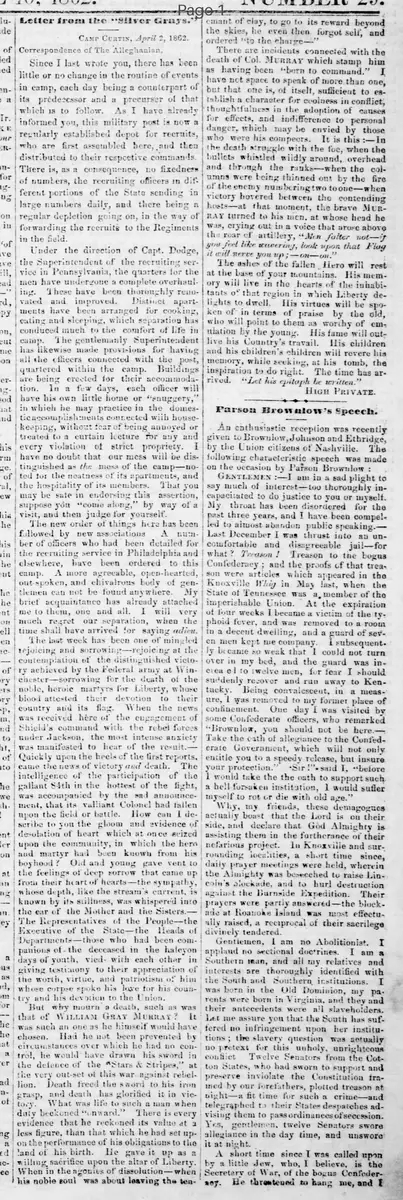
Letter from the "Silver Grays."
Camp Curtin, April 2, 1862.
Correspondence of The Alleghanian.
Since I last wrote you, there has been
little or no change in the routine of events
in camp, each day being a counterpart of
its predecessor and a precursor of that
which is to follow. As I have already
informed you, this military post is now a
regularly established depot for recruits,
who are first assembled here, and then
distributed to their respective commands.
There is, as a consequence, no fixedness
of numbers, the recruiting officers in different portions of the State sending in
large numbers daily, and there being a
regular depletion going on, in the way of
forwarding the recruits to the Regiments
in the field.
Under the direction of Capt. Dodge,
the Superintendent of the recruiting service in Pennsylvania, the quarters for the
men have undergone a complete overhauling. These have been thoroughly renovated and improved. Distinct apartments have been arranged for cooking,
eating and sleeping, which separating has
conduced much to the comfort of life in
camp. The gentlemanly Superintendent
has likewise made provisions for having
all the officers connected with the post,
quartered within the camp. Buildings
are being erected for their accommodation. In a few days, each officer will
have his own little home or "snuggery,"
in which he may practice in the domestic accomplishments connected with housekeeping, without fear of being annoyed or
treated to a curtain lecture for any and
every violation of strict propriety. I
have no doubt that our mess will be distinguished as the mess of the camp-noted for the neatness of its apartments, and
the hospitality of its members. That you
may be safe in endorsing this assertion,
suppose you "come along," by way of a
visit, and then judge for yourself.
The new order of things here has been
followed by new associations. A number of officers who had been detailed for
the recruiting service in Philadelphia and
elsewhere, have been ordered to this
camp. A more agreeable, open-hearted,
out-spoken, and chivalrous body of gentlemen can not be found anywhere. My
brief acquaintance has already attached
me to them, one and all. I will very
much regret our separation, when the
time shall have arrived for saying adieu.
The last week has been one of mingled
rejoicing and sorrowing-rejoicing at the
contemplation of the distinguished victory achieved by the Federal army at Winchester-Sorrowing for the death of the
noble, heroic martyrs for Liberty, whose
blood attested their devotion to their
country and its flag. When the news
was received here of the engagement of
Shields's command with the rebel forces
under Jackson, the most intense anxiety
was manifested to hear of the result.-
Quickly upon the heels of the first reports,
came the news of victory and death. The
intelligence of the participation of the
gallant 84th in the hottest of the fight,
was accompanied by the sad announcement, that its valiant Colonel had fallen upon the field of battle. How can I describe to you the gloom and evidence of
desolation of heart which at once seized
upon the community, in which the hero
and martyr had been known from his
boyhood? Old and young gave vent to
the feelings of deep sorrow that came up
from their heart of hearts--the sympathy,
whose depth, like the stream's current, is
known by its stillness, was whispered into
the ear of the Mother and the Sisters.-
The Representatives of the People--the
Executive of the State-the Heads of
Departments-those who had been companions of the deceased in the halcyon
days of youth, vied with each other in
giving testimony to their appreciation of
the worth, virtue, and patriotism of him
whose corpse spoke his love for his country and his devotion to the Union.
But why mourn a death, such as was
that of WILLIAM GRAY MURRAY? It
was such an one as he himself would have chosen. Had he not been prevented by circumstances over which he had no control, he would have drawn his sword in
the defence of the "Stars & Stripes," at
the very out-set of this war against rebellion. Death freed the sword to his iron
grasp, and death has glorified it in victory. What was life to such a man when
duty beckoned "onward." There is every
evidence that he reckoned its value at a
less figure, than that which he had set upon the performance of his obligations to the land of his birth. He gave it up as a
willing sacrifice upon the altar of Liberty.
When in the agonies of dissolution-when
his noble soul was about leaving the tenement of clay, to go to its reward beyond
the skies, he even then forgot self, and
ordered "to the charge"
There are incidents connected with the
death of Col. Murray which stamp him
as having been "born to command." I
have not space to speak of more than one,
but that one is, of itself, sufficient to establish a character for coolness in conflict,
thoughtfulness in the adoption of causes
for effects, and indifference to personal
danger, which may be envied by those
who were his compeers. It is this :-In
the death struggle with the foe, when the
bullets whistled wildly around, overhead
and through the ranks--when the columns were being thinned out by the fire
of the enemy numbering two to one-when
victory hovered between the contending
hosts--at that moment, the brave Murray turned to his men, at whose head he
was, crying out in a voice that arose above the roar of artillery, "Men falter not-if
you feel like wavering, look upon that Flag it will nerve you up;-on-on."
The ashes of the fallen hero will rest
at the base of your mountains. His memory will live in the hearts of the inhabitants of that region in which Liberty delights to dwell. His virtues will be spoken of in terms of praise by the old,
who will point to them as worthy of emulation by the young. His fame will outlive his Country's travail. His children and his children's children will revere his
memory, while seeking, at his tomb, the
inspiration to do right. The time has arrived. "Let his epitaph be written."
HIGH PRIVATE.
Camp Curtin, April 2, 1862.
Correspondence of The Alleghanian.
Since I last wrote you, there has been
little or no change in the routine of events
in camp, each day being a counterpart of
its predecessor and a precursor of that
which is to follow. As I have already
informed you, this military post is now a
regularly established depot for recruits,
who are first assembled here, and then
distributed to their respective commands.
There is, as a consequence, no fixedness
of numbers, the recruiting officers in different portions of the State sending in
large numbers daily, and there being a
regular depletion going on, in the way of
forwarding the recruits to the Regiments
in the field.
Under the direction of Capt. Dodge,
the Superintendent of the recruiting service in Pennsylvania, the quarters for the
men have undergone a complete overhauling. These have been thoroughly renovated and improved. Distinct apartments have been arranged for cooking,
eating and sleeping, which separating has
conduced much to the comfort of life in
camp. The gentlemanly Superintendent
has likewise made provisions for having
all the officers connected with the post,
quartered within the camp. Buildings
are being erected for their accommodation. In a few days, each officer will
have his own little home or "snuggery,"
in which he may practice in the domestic accomplishments connected with housekeeping, without fear of being annoyed or
treated to a curtain lecture for any and
every violation of strict propriety. I
have no doubt that our mess will be distinguished as the mess of the camp-noted for the neatness of its apartments, and
the hospitality of its members. That you
may be safe in endorsing this assertion,
suppose you "come along," by way of a
visit, and then judge for yourself.
The new order of things here has been
followed by new associations. A number of officers who had been detailed for
the recruiting service in Philadelphia and
elsewhere, have been ordered to this
camp. A more agreeable, open-hearted,
out-spoken, and chivalrous body of gentlemen can not be found anywhere. My
brief acquaintance has already attached
me to them, one and all. I will very
much regret our separation, when the
time shall have arrived for saying adieu.
The last week has been one of mingled
rejoicing and sorrowing-rejoicing at the
contemplation of the distinguished victory achieved by the Federal army at Winchester-Sorrowing for the death of the
noble, heroic martyrs for Liberty, whose
blood attested their devotion to their
country and its flag. When the news
was received here of the engagement of
Shields's command with the rebel forces
under Jackson, the most intense anxiety
was manifested to hear of the result.-
Quickly upon the heels of the first reports,
came the news of victory and death. The
intelligence of the participation of the
gallant 84th in the hottest of the fight,
was accompanied by the sad announcement, that its valiant Colonel had fallen upon the field of battle. How can I describe to you the gloom and evidence of
desolation of heart which at once seized
upon the community, in which the hero
and martyr had been known from his
boyhood? Old and young gave vent to
the feelings of deep sorrow that came up
from their heart of hearts--the sympathy,
whose depth, like the stream's current, is
known by its stillness, was whispered into
the ear of the Mother and the Sisters.-
The Representatives of the People--the
Executive of the State-the Heads of
Departments-those who had been companions of the deceased in the halcyon
days of youth, vied with each other in
giving testimony to their appreciation of
the worth, virtue, and patriotism of him
whose corpse spoke his love for his country and his devotion to the Union.
But why mourn a death, such as was
that of WILLIAM GRAY MURRAY? It
was such an one as he himself would have chosen. Had he not been prevented by circumstances over which he had no control, he would have drawn his sword in
the defence of the "Stars & Stripes," at
the very out-set of this war against rebellion. Death freed the sword to his iron
grasp, and death has glorified it in victory. What was life to such a man when
duty beckoned "onward." There is every
evidence that he reckoned its value at a
less figure, than that which he had set upon the performance of his obligations to the land of his birth. He gave it up as a
willing sacrifice upon the altar of Liberty.
When in the agonies of dissolution-when
his noble soul was about leaving the tenement of clay, to go to its reward beyond
the skies, he even then forgot self, and
ordered "to the charge"
There are incidents connected with the
death of Col. Murray which stamp him
as having been "born to command." I
have not space to speak of more than one,
but that one is, of itself, sufficient to establish a character for coolness in conflict,
thoughtfulness in the adoption of causes
for effects, and indifference to personal
danger, which may be envied by those
who were his compeers. It is this :-In
the death struggle with the foe, when the
bullets whistled wildly around, overhead
and through the ranks--when the columns were being thinned out by the fire
of the enemy numbering two to one-when
victory hovered between the contending
hosts--at that moment, the brave Murray turned to his men, at whose head he
was, crying out in a voice that arose above the roar of artillery, "Men falter not-if
you feel like wavering, look upon that Flag it will nerve you up;-on-on."
The ashes of the fallen hero will rest
at the base of your mountains. His memory will live in the hearts of the inhabitants of that region in which Liberty delights to dwell. His virtues will be spoken of in terms of praise by the old,
who will point to them as worthy of emulation by the young. His fame will outlive his Country's travail. His children and his children's children will revere his
memory, while seeking, at his tomb, the
inspiration to do right. The time has arrived. "Let his epitaph be written."
HIGH PRIVATE.
What sub-type of article is it?
Reflective
Emotional
Historical
What themes does it cover?
Military War
Morality
What keywords are associated?
Camp Curtin
Recruit Depot
Battle Of Winchester
Col William G Murray
Shields Division
Jackson Rebels
84th Regiment
Civil War Heroism
Pennsylvania Recruits
What entities or persons were involved?
High Private.
The Alleghanian
Letter to Editor Details
Author
High Private.
Recipient
The Alleghanian
Main Argument
reports on stable routine and improvements at camp curtin recruit depot; eulogizes col. william g. murray's heroic sacrifice and leadership in the victorious battle of winchester against jackson's rebels.
Notable Details
Victory At Winchester By Shields's Command
Death Of Col. Murray Of The 84th Regiment
Last Words Urging Men To Charge And Look To The Flag
Burial At Base Of Mountains
Praised For Patriotism And Coolness In Battle