Thank you for visiting SNEWPapers!
Sign up free
The Cairo Daily Bulletin
Cairo, Alexander County, Illinois
What is this article about?
Newspaper article explaining the Jewish New Year observance, its timing based on the lunar calendar and harvest, biblical references in Leviticus, rituals including morning services, trumpet blowing with a ram's horn as memorial of creation and resurrection, afternoon psalms by water, and lead-up to the Day of Atonement with penitence days.
Clipping
OCR Quality
Full Text
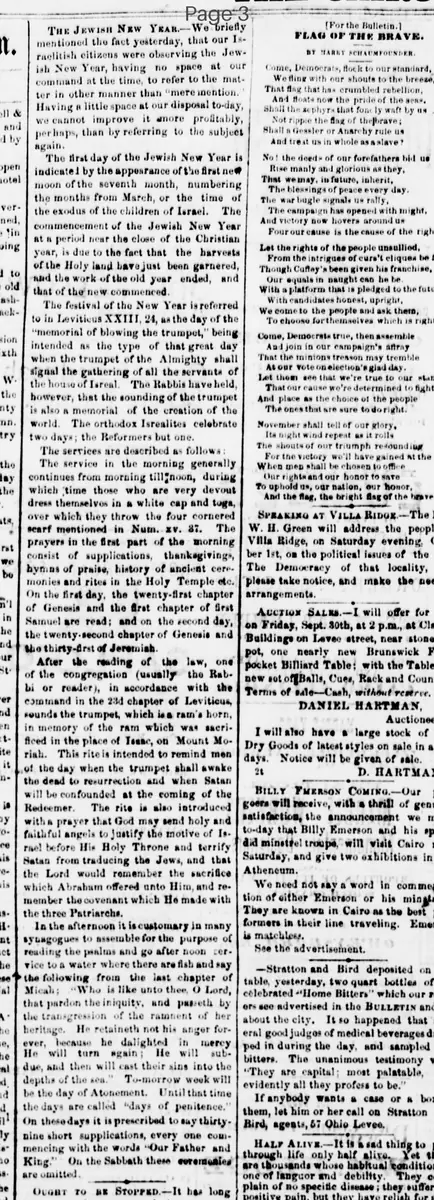
The first day of the Jewish year is indicated by the appearance of the first new moon of the seventh month, numbering the months from March, or the time of the exodus of the children of Israel. The commencement of the Jewish New Year at a period near the close of the Christian year, is due to the fact that the harvests of the Holy land have just been garnered, and the work of the old year ended, and that of the new commenced.
The festival of the New Year is referred to in Leviticus XXIII: 24, as the day of the "memorial of blowing the trumpet," being intended as the type of that great day when the trumpet of the Almighty shall signal the gathering of all the servants of the house of Israel. The Rabbis have held, however, that the sounding of the trumpet is also a memorial of the creation of the World. The orthodox Israelites celebrate two days: the Reformers but one.
The services are described as follows: The service in the morning generally continues from morning till noon, during which time those who are very devout dress themselves in a white cap and toga, over which they throw the four cornered scarf mentioned in Num. xv. 38. The prayers in the first part of the morning consist of supplications, thanksgivings, hymns of praise, history of ancient ceremonies and rites in the Holy Temple, etc. On the first day, the twenty-first chapter of Genesis and the first chapter of Samuel are read; and on the second day, the twenty-second chapter of Genesis and the thirty-first of Jeremiah.
After the reading of the law, one of the congregation (usually the Rabbi or reader), in accordance with the command in the 23d chapter of Leviticus, sounds the trumpet, which is a ram's horn, in memory of the ram which was sacrificed in the place of Isaac, on Mount Moriah. This rite is intended to remind men of the day when the trumpet shall awake the dead to resurrection and when Satan will be confounded at the coming of the Redeemer.
The rite is also introduced with a prayer that God may send holy and faithful angels to justify the motive of Israel before His Holy Throne and terrify Satan from traducing the Jews, and that the Lord would remember the sacrifice which Abraham offered unto Him, and remember the covenant which He made with the three Patriarchs.
In the afternoon it is customary in many synagogues to assemble for the purpose of reading the psalms and go after noon service to a water where there are fish and say the following from the last chapter of Micah: "Who is like unto thee, O Lord, that pardon the iniquity, and passeth by the transgression of the remnant of her heritage. He retaineth not his anger forever, because he delighted in mercy. He will turn again: He will sub. due, and then will cast their sins into the depths of the sea." To-morrow week will be the day of Atonement. Until that time the days are called "days of penitence." On those days it is prescribed to say thirty-nine short supplications, every one commencing with the words "Our Father and King." On the Sabbath these ceremonies are omitted.
What sub-type of article is it?
What themes does it cover?
What keywords are associated?
What entities or persons were involved?
Where did it happen?
Story Details
Key Persons
Location
Holy Land
Event Date
First New Moon Of The Seventh Month
Story Details
Explanation of Jewish New Year as memorial of trumpet blowing, creation, and future resurrection; rituals include services, ram's horn sounding, prayers for justification, psalm reading by water, leading to Days of Penitence and Day of Atonement.