Thank you for visiting SNEWPapers!
Sign up free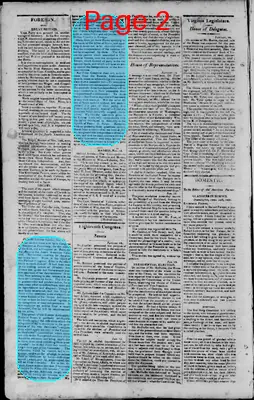
Fincastle Mirror
Fincastle, Botetourt County, Virginia
What is this article about?
Report on an upcoming Parisian Congress addressing South American colonies' independence, with France assuring no military aid to Spain, Russia opposing recognition via ambassador Pozzo di Borgo, and Britain supporting independence. (178 chars)
Clipping
OCR Quality
Full Text
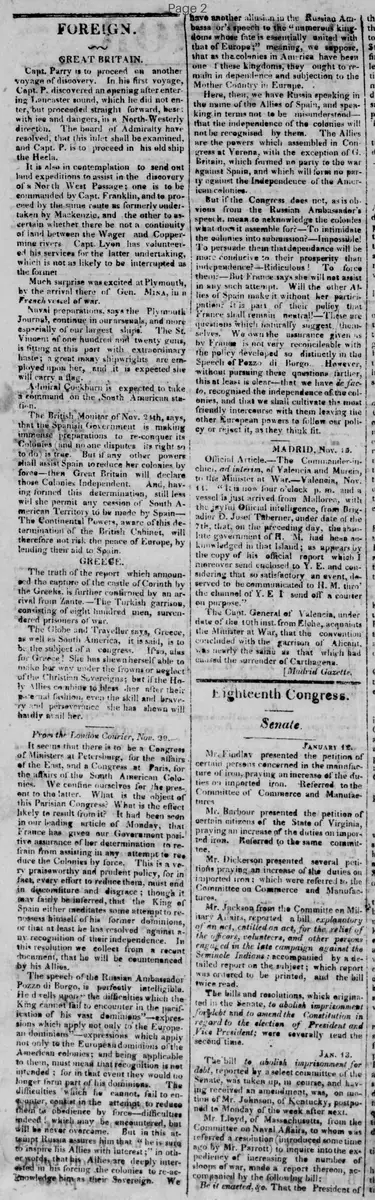
It seems that there is to be a Congress of Ministers at Petersburg, for the affairs of the East, and a Congress at Paris, for the affairs of the South American Colonies. We confine ourselves for the present to the latter. What is the object of this Parisian Congress? What is the effect likely to result from it? It had been seen in our leading article of Monday, that France has given our Government positive assurance of her determination to refrain from assisting in any attempt to reduce the Colonies by force. This is a very praiseworthy and prudent policy, or in fact, every effort to reduce them must end in discomfiture and disgrace; though it may fairly be inferred, that the King of Spain either meditates some attempt to repossess himself of his former dominions, or that at least he has resolved against any recognition of their independence. In this resolution we collect from a recent document, that he will be countenanced by his Allies.
The speech of the Russian Ambassador Pozzo di Borgo, is perfectly intelligible. He dwells upon "the difficulties which the King cannot fail to encounter in the pacification of his vast dominions"—expressions which apply not only to the European dominions or the American colonies; and being applicable to them, must mean that recognition is not intended; for in that event they would no longer form part of his dominions. The difficulties which he cannot fail to encounter, consist in the attempt, to reduce them to obedience by force—difficulties indeed! which may be encountered, but will be never overcome. But in this attempt Russia assures him that "he is sure to inspire his Allies with interest;" in other words, that his Allies are deeply interested in his forcing the colonies to re-acknowledge him as their Sovereign. We have another allusion in the Russian Ambassador's speech to the "numerous kingdoms whose fate is essentially united with that of Europe," meaning, we suppose, that as the colonies in America have been one of these kingdoms, they ought to remain in dependence and subjection to the Mother Country in Europe.
Here, then, we have Russia speaking in the name of the Allies of Spain, and speaking in terms not to be misunderstood—that the independence of the colonies will not be recognised by them. The Allies are the powers which assembled in Congress at Verona, with the exception of Great Britain, which formed no party to the war against Spain, and which will form no party against the Independence of the American colonies.
But if the Congress does not, as is obvious from the Russian Ambassador's speech, mean to acknowledge the colonies what does it assemble for?—To intimidate the colonies into submission?—Impossible! To persuade them that dependence will be more conducive to their prosperity than independence? Ridiculous! To force them?—But France says she will not assist in any such attempt. Will the other Allies of Spain make it without her participation? it is part of their policy that France shall remain neutral!—These are questions which naturally suggest themselves. We own the assurance given by France is not very reconcileable with the policy developed so distinctly in the Speech of Pozzo di Borgo. However, without pursuing these questions further, this at least is clear—that we have de facto recognised the independence of the colonies, and that we shall cultivate the most friendly intercourse with them leaving the other European powers to follow our policy or reject it, as they think fit.
What sub-type of article is it?
What keywords are associated?
What entities or persons were involved?
Where did it happen?
Foreign News Details
Primary Location
Paris
Event Date
Nov. 29
Key Persons
Outcome
britain has de facto recognised the independence of the south american colonies and will cultivate friendly intercourse; russia and allies oppose recognition and support spanish efforts to reassert control without french military aid.
Event Details
A Congress of Ministers is planned at Paris for the affairs of the South American Colonies. France assures Britain it will not assist in any force to reduce the colonies. The King of Spain resists recognising independence, supported by allies including Russia, as per Ambassador Pozzo di Borgo's speech indicating no recognition and interest in Spanish pacification efforts. Britain supports independence, unlike other European powers from the Verona Congress.