Thank you for visiting SNEWPapers!
Sign up free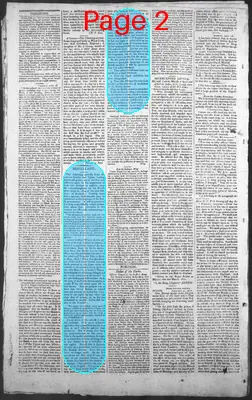
Editorial
November 27, 1810
The New Hampshire Gazette
Portsmouth, Rockingham County, New Hampshire
What is this article about?
Editorial from Petersburg Intelligencer critiques British blockade policies, citing London Courier and Times admissions that legal blockades require actual investment, which Britain violated in retaliation to now-rescinded French Berlin Decree, arguing this justifies ending infringements on American neutral rights.
Clipping
OCR Quality
98%
Excellent
Full Text
Peterburg Intel.
MISCELLANY.
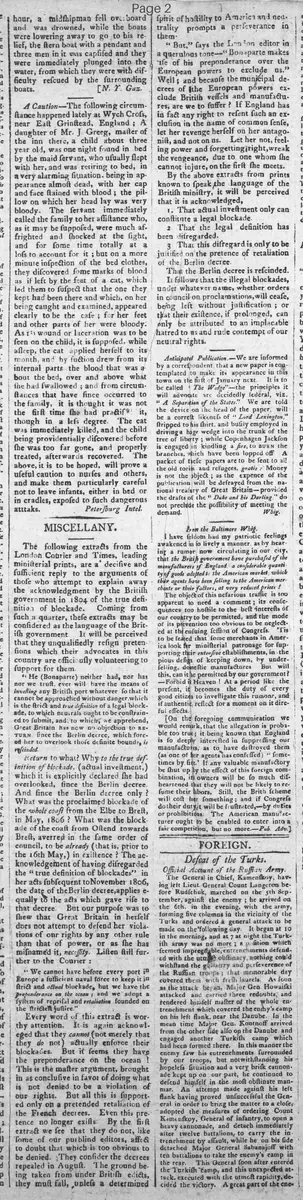
The following extracts from the London Courier and Times, leading ministerial prints, are a decisive and sufficient reply to the arguments of those who attempt to explain away the acknowledgment by the British government in 1804 of the true definition of blockade. Coming from such a quarter, these extracts may be considered as the language of the British government. It will be perceived that they unqualifiedly resign pretensions which their advocates in this country are officiously volunteering to support for them.
"He (Bonaparte) neither had, nor has, nor we trust, ever will have the means of investing any British port whatever so that it cannot be approached without danger, which is the strict and true definition of a legal blockade, to which neutrals ought to be constrained to submit, and, to which, we apprehend, Great Britain has now no objection to return, since the Berlin decree, which forced her to overlook those definite bounds, is rescinded."
Return to what? Why to the true definition of blockade, (actual investment,) which it is explicitly declared she had overlooked, since the Berlin decree.
And since the Berlin decree only? What was the proclaimed blockade of the whole coast from the Elbe to Brest, in May, 1806? What was the blockade of the coast from Ostend towards Brest, averred in the same order of council, to be already (that is, prior to the 16th May,) in existence? The acknowledgement of having disregarded the "true definition of blockades" in her acts subsequent to November 1806, the date of the Berlin decree, applies equally to the acts which gave rise to that decree. But our purpose was to show that Great Britain herself does not attempt to defend her violations of our rights by any other rule than that of power, or as he has misnamed it, necessity. Listen till further to the Courier:
"We cannot have before every port in Europe a sufficient naval force to keep it in strict and actual blockade, but we have the preponderance on the ocean; and we adopt a system of reprisal and retaliation founded on the strictest justice."
Every word of this extract is worthy attention. It is again acknowledged that they cannot (not merely that they do not) actually enforce their blockades. But it seems they have the preponderance on the ocean! This is the master argument, brought in as conclusive in favor of doing what is not denied to be a violation of our rights. But all this is supported only on a pretended retaliation of the French decrees. Even this pretence no longer exists. By the first extract we see that they do not, like some of our purblind editors, affect to doubt that which is too obvious to be denied. They consider the decrees repealed in August. The ground being taken from under British edicts, they must fall, unless a determined spirit of hostility to America and neutrality prompts a perseverance in them.
"But," says the London editor in a querulous tone--"Bonaparte makes use of his preponderance over the European powers to exclude us." Well: and because the municipal decrees of the European powers exclude British vessels and manufactures, are we to suffer? If England has in fact any right to resent such an exclusion in the name of common sense, let her revenge herself on her antagonist, and not on us. Let her not, feeling power and forgetting right, wreak the vengeance, due to one whom she cannot injure, on the first she meets.
By the above extracts from prints known to speak the language of the British ministry, it will be perceived that it is acknowledged,
1. That actual investment only can constitute a legal blockade.
2. That the legal definition has been disregarded.
3. That this disregard is only to be justified on the pretence of retaliation of the Berlin decree.
4. That the Berlin decree is rescinded.
It follows that the illegal blockades, under whatever name, whether orders in council or proclamations, will cease, being left without justification; or that their existence, if prolonged, can only be attributed to an implacable hatred to us and rude contempt of our neutral rights.
MISCELLANY.
The following extracts from the London Courier and Times, leading ministerial prints, are a decisive and sufficient reply to the arguments of those who attempt to explain away the acknowledgment by the British government in 1804 of the true definition of blockade. Coming from such a quarter, these extracts may be considered as the language of the British government. It will be perceived that they unqualifiedly resign pretensions which their advocates in this country are officiously volunteering to support for them.
"He (Bonaparte) neither had, nor has, nor we trust, ever will have the means of investing any British port whatever so that it cannot be approached without danger, which is the strict and true definition of a legal blockade, to which neutrals ought to be constrained to submit, and, to which, we apprehend, Great Britain has now no objection to return, since the Berlin decree, which forced her to overlook those definite bounds, is rescinded."
Return to what? Why to the true definition of blockade, (actual investment,) which it is explicitly declared she had overlooked, since the Berlin decree.
And since the Berlin decree only? What was the proclaimed blockade of the whole coast from the Elbe to Brest, in May, 1806? What was the blockade of the coast from Ostend towards Brest, averred in the same order of council, to be already (that is, prior to the 16th May,) in existence? The acknowledgement of having disregarded the "true definition of blockades" in her acts subsequent to November 1806, the date of the Berlin decree, applies equally to the acts which gave rise to that decree. But our purpose was to show that Great Britain herself does not attempt to defend her violations of our rights by any other rule than that of power, or as he has misnamed it, necessity. Listen till further to the Courier:
"We cannot have before every port in Europe a sufficient naval force to keep it in strict and actual blockade, but we have the preponderance on the ocean; and we adopt a system of reprisal and retaliation founded on the strictest justice."
Every word of this extract is worthy attention. It is again acknowledged that they cannot (not merely that they do not) actually enforce their blockades. But it seems they have the preponderance on the ocean! This is the master argument, brought in as conclusive in favor of doing what is not denied to be a violation of our rights. But all this is supported only on a pretended retaliation of the French decrees. Even this pretence no longer exists. By the first extract we see that they do not, like some of our purblind editors, affect to doubt that which is too obvious to be denied. They consider the decrees repealed in August. The ground being taken from under British edicts, they must fall, unless a determined spirit of hostility to America and neutrality prompts a perseverance in them.
"But," says the London editor in a querulous tone--"Bonaparte makes use of his preponderance over the European powers to exclude us." Well: and because the municipal decrees of the European powers exclude British vessels and manufactures, are we to suffer? If England has in fact any right to resent such an exclusion in the name of common sense, let her revenge herself on her antagonist, and not on us. Let her not, feeling power and forgetting right, wreak the vengeance, due to one whom she cannot injure, on the first she meets.
By the above extracts from prints known to speak the language of the British ministry, it will be perceived that it is acknowledged,
1. That actual investment only can constitute a legal blockade.
2. That the legal definition has been disregarded.
3. That this disregard is only to be justified on the pretence of retaliation of the Berlin decree.
4. That the Berlin decree is rescinded.
It follows that the illegal blockades, under whatever name, whether orders in council or proclamations, will cease, being left without justification; or that their existence, if prolonged, can only be attributed to an implacable hatred to us and rude contempt of our neutral rights.
What sub-type of article is it?
Foreign Affairs
War Or Peace
Trade Or Commerce
What keywords are associated?
Blockade Definition
Neutral Rights
British Policy
Berlin Decree
Orders In Council
American Neutrality
Napoleonic Wars
What entities or persons were involved?
British Government
Bonaparte
London Courier
London Times
Berlin Decree
Editorial Details
Primary Topic
British Blockade Policies And American Neutral Rights
Stance / Tone
Critical Of British Violations, Supportive Of Neutral Rights
Key Figures
British Government
Bonaparte
London Courier
London Times
Berlin Decree
Key Arguments
Actual Investment Is Required For Legal Blockade
Britain Disregarded True Blockade Definition Post Berlin Decree
British Blockades Justified Only By Retaliation Against French Decrees
Berlin Decree Has Been Rescinded, Removing Justification
Britain Admits Inability To Enforce Strict Blockades But Relies On Naval Preponderance
Continued Blockades Stem From Hostility To American Neutrality
Britain Should Target France, Not Neutrals Like America