Thank you for visiting SNEWPapers!
Sign up free
Story
November 10, 1831
Winchester Virginia Republican
Winchester, Virginia
What is this article about?
Charlotte Corday, a young woman opposed to the Reign of Terror, meets Deputy Duperret and resolves to assassinate Jean-Paul Marat. On July 13, 1793, in Paris, she stabs him in his bath, leading to her arrest and execution, hailed as a heroic act.
Clipping
OCR Quality
95%
Excellent
Full Text
Romance of Real Life.
From unpublished Memoirs.
CHARLOTTE CORDAY,
Who so heroically destroyed the monster Marat.
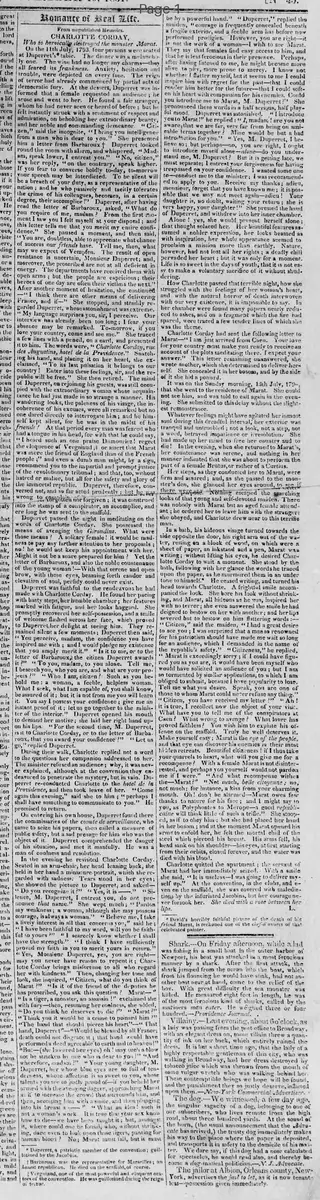
On the 13th July, 1793, four persons were seated at Duperret's table. The dinner was a melancholy one. The wine had no longer any charms—they all feared its frankness. Anxiety, hesitation and trouble, were depicted on every face. The reign of terror had already commenced by partial acts of democratic fury. At the dessert, Duperret was informed that a female requested an audience; he arose and went to her. He found a fair stranger whom he had never seen or heard of before; but he felt instantly struck with a sentiment of respect and admiration, on beholding her extraordinary beauty, and her noble and commanding demeanor. "Citizen," said the incognita, "I bring you intelligence from a man who is dear to you." She presented him a letter from Barbaroux. Duperret looked round the room with alarm, and whispered, "Madam, speak lower, I entreat you." "No, citizen," was her reply, "on the contrary, speak higher. If you fear to converse boldly to-day, to-morrow your speech may be interdicted. To be silent will be a breach of your duty, as a representative of the nation; and he who passively and tacitly tolerates the crime of his colleagues, becomes, in a certain degree, their accomplice!" Duperret, after having read the letter of Barbaroux, asked, "What do you require of me, madam? From the first moment I saw you I felt myself at your disposal; and this letter tells me that you merit my entire confidence." She paused a moment, and then said, "You are, doubtless, able to appreciate what chance of success our friends have. Tell me, then, what may we expect of Vergniaud. The result of open resistance is uncertain, Monsieur Duperret; and, moreover, the proscribed are not at all deficient in energy. The departments have received them with open arms; but the people are capricious; their heroes of one day are often their victims the next." After another moment of hesitation, she continued—“I think there are other means of delivering France, and if—” She stopped, and steadily regarded Duperret, whose astonishment was extreme. "My language surprises you, sir, I perceive. Our interview has already been too long: I fear your absence may be remarked. To-morrow, if you love your country, come and see me." She traced a few lines with a pencil, on a card, and presented it to him. The words were, "Charlotte Corday, rue des Augustins, hotel de la Providence." Snatching his hand, and placing it on her heart, she exclaimed, "To its last pulsation it belongs to our country! Enter into these feelings, sir, and the republic will be free." She then retired. The mind of Duperret, on rejoining his guests, was still occupied with the extraordinary woman whose acquaintance he had just made in so strange a manner. His wandering looks, the paleness of his visage, the incoherence of his excuses, were all remarked but no one dared directly to interrogate him; and he himself kept silent, for he was in the midst of his friends! At that period every man was feared who had a tongue in his head, for with that he could say, "I heard such an one praise Dumouriez! regret the eloquence of Vergniaud; or assert that Marat was more the friend of England than of the French people;" and even a dumb man might, by a sign, recommend you to the impartial and prompt justice of the revolutionary tribunal; and that, too, without hatred or malice, but all for the safety and glory of the immortal republic. Duperret, therefore, conversed not, and so far acted prudently; but he was not forgotten nor forgiven; it was construed into the stamp of a conspirator, an accomplice, and ere long he was sent to the scaffold.
Duperret passed the night in meditating on the words of Charlotte Corday. She possessed the means of avenging the Girondins. What were those means? A solitary female! it would be madness to pay any farther attention to her proposals; no! he would not keep his appointment with her. Might it not be a snare prepared for him? Yet the letter of Barbaroux, and also the noble countenance of the young woman!—With that serene and open brow, with those eyes, beaming forth candor and elevation of soul, perfidy could never exist.
Duperret was faithful to the rendezvous he had made with Charlotte Corday. He found her pacing with hasty steps, her humble chamber; her features marked with fatigue, and her looks haggard. She promptly recovered her self-possession, and a smile of welcome flashed across her face, which proved to Duperret her delight at seeing him. They remained silent a few moments; Duperret then said, "You perceive, madam, the confidence you have inspired me with; and I would pledge my existence that you amply merit it." "Is it to me, or to the letter of Barbaroux, the citizen Duperret awards it?" "To you, madam, to you alone. Tell me, I beseech you, who you are, and what are your projects?" "Who I am, citizen? Such as you behold me: a woman, a feeble, helpless woman. What I seek, what I am capable of, you shall know, be assured of it; but it is not from me you will learn it. You say I possess your confidence; give me an instant proof of it; let us go together to the minister of the interior." Duperret opened his mouth to demand her motive; she laid her right hand upon his lips. "For the second time, M. Duperret, is it to Charlotte Corday, or to the letter of Barbaroux, that you award your confidence?" "Let us go," replied Duperret.
During their walk, Charlotte replied not a word to the questions her companion addressed to her. The minister refused an audience; why, it was never explained, although at the convention they endeavored to penetrate the mystery, but in vain. Duperret re-conducted Charlotte to the hotel de la Providence, and then took leave of her. "Come again this evening," said she to him; "perhaps I shall have something to communicate to you." He promised to return.
On entering his own house, Duperret found there the commissaries of the comite de surveillance, who came to seize his papers, then called a measure of public safety, but a sad presage for him who was the object of it. Duperret comprehended the danger of his situation, and met it manfully. He was a man of coolness and resolution.
In the evening he revisited Charlotte Corday. Seated in an arm-chair, her head leaning back, she held in her hand a miniature-portrait, which she regarded with sadness; Tears stood in her eyes; she showed the picture to Duperret, and asked—“Do you recognize it?” "Yes, it is—” "Silence, M. Duperret, I entreat you, do not pronounce that name." She wept much; "Pardon my weakness; a woman, although she may possess courage, is always a woman." "Believe me, I take a lively interest in all that concerns you," said he; "I have been faithful to my word, will you be faithful to yours?" "I scarcely know whether I shall have the strength." "I think I have sufficiently proved my faith in you to merit yours in return." "Yes, Monsieur Duperret, yes, you are right—may you never have reason to repent it; Charlotte Corday brings misfortune to all who regard her with kindness." Then, changing her tone and look, she inquired, "Citizen, what do you think of Marat?" "Is it of the friend of the deputies he has proscribed, you ask this question? Marat—” "Is a tiger, a monster, an assassin!" exclaimed she with fury—then, resuming her coolness, she added, "Do you think he deserves to die?" "Marat?" "Think you it would be a crime to poniard him?" "The hand that should pierce his heart—” "That hand, Duperret—” "Would be blessed by all France; death could not disgrace it; that hand would have performed a deed agreeable to earth and to heaven?" "But—(she lowered her eyes) oh! may such a blow not be stricken by one who is dear to you?" "And wherefore, madam?" "Your young daughter, M. Duperret, her whose blue eyes are so full of tenderness, whose affection is so sweet to you, whose talents you are so justly proud of—if you beheld her armed with the avenging dagger, approaching Marat as if to increase the crowd that surrounds him, and then, accosting him with a smile, and then plunging into his breast a—” "What an idea! such is not a woman's work. It is true that your sex know how to die—we have been taught it; but, amongst it, where could one be found, who, without shrinking, dare even to look upon those tigers, panting for human blood? No; Marat must fall, but it must be by a powerful hand."
"Duperret," replied the maiden, "courage is frequently concealed beneath a fragile exterior, and a feeble arm has before now performed prodigies. However, you are right—it is not the work of a woman—I wish to see Marat. They say that females find easy access to him, and that he is less ferocious in their presence. Perhaps, after having listened to me, he might become more alive to pity, more prone to mercy. I know not whether I flatter myself, but it seems to me I could inspire him with regret for the past—that I could render him better for the future—that I could soften his heart with compassion for his enemies. Could you introduce me to Marat, M. Duperret?" She pronounced these words in a half serious, half playful mood. Duperret was astonished. "I introduce you to Marat!" he replied: "I, madam! are you not aware that we are far, very far from being on amicable terms together? Mine would be but a bad introduction for you." "Yes, M. Duperret, I believe so; but perhaps—no, you are right, I ought to introduce myself alone—alone—do you understand me, M. Duperret? But it is getting late, we must separate; I entreat your forgiveness for having trespassed on your confidence. I wanted some one to conduct me to the minister; I was recommended to apply to you. Receive my thanks; adieu, monsieur, forget that you have known me; it is possible that we may not meet again—adieu! Your daughter is, no doubt, waiting your return; she is very happy, your daughter!" She pressed the hand of Duperret, and withdrew into her inner chamber.
Alone! yes, she would present herself alone; that thought solaced her. Her beautiful features assumed a nobler expression, her looks beamed as with inspiration, her whole appearance seemed to proclaim a mission more than earthly. Nature, however, had not lost all her rights; a deadly chill pervaded her heart; but it was only for a moment. Life is so sweet in the days of youth, that it is not easy to make a voluntary sacrifice of it without shuddering.
How Charlotte passed that terrible night, how she struggled with the feelings of her woman's heart, and with the natural horror of death interwoven with our very existence, it is impossible to say. In her chamber were found many papers nearly reduced to ashes, and on a fragment which the fire had spared, were traced a few tender lines of which she was the theme.
Charlotte Corday had sent the following letter to Marat—“I am just arrived from Caen. Your love for your country must make you ready to receive an account of the plots meditating there. I expect your answer." This letter remaining unanswered, she wrote another, which she determined to deliver herself. She concealed it in her bosom, and by the side of it she hid a poniard.
It was on the Sunday morning, 13th July, 1793, that she went to the residence of Marat. She could not see him, and was told to call again in the evening. She submitted to this delay without the slightest remonstrance.
Whatever feelings might have agitated her inmost soul during this dreadful interval, her exterior was tranquil and untroubled; not a look, not a step, not a word, betrayed impatience or inresolution. She had made up her mind to free her country and to die! In the evening, when she returned to Marat's, her countenance was serene, and nothing in her manner indicated that she was about to perform the part of a female Brutus, or rather of a Curtius.
Her steps, as they conducted her to Marat's, were firm and assured; and, as she passed to the monster's den, she glanced her eyes around, to see there were none. Nothing escaped the searching looks of that young and self-devoted maiden. There was nobody with Marat but an aged female attendant; he ordered her to leave him with the stranger; she obeyed, and Charlotte drew near to this terrific man.
In a bath, his hideous visage turned towards the side opposite the door, his right arm out of the water, resting on a block of wood, on which were a sheet of paper, an inkstand and a pen, Marat was writing; without lifting his eyes, he desired Charlotte Corday to wait a moment. She stood by the bath, following with her glance the words he traced upon the paper, as he murmured them in an under tone to himself. He ceased writing, and turned his head towards Charlotte. A frightful smile accompanied the look. She bore his look without shrinking, and Marat, all hideous as he was, inspired her with no terror; she even answered the smile he had deigned to bestow on her with another; and her lips severed but to bestow on him flattering words:-
"Citizen," said the maiden, "I had a great desire to see you; I was surprised that a man so renowned for his patriotism should have made me wait so long for an audience, which I demanded in the name of the republic's safety." "Citizeness," he replied, "Marat is exceedingly sorry; if I could have figured you as you are, it would have been myself who would have solicited an audience of you; but I am so tormented by similar applications, to which I am obliged to submit, because I have popularity to lose. Tell me what you desire. Speak, you are one of those to whom Marat could never refuse any thing." "Citizen, you have received my letter?" "Ah! it is true. I recollect now the object of your visit. What have you to tell me of the conspirators at Caen? What wrong to avenge? What lover has proved faithless? You wish him to expiate his offence on the scaffold. Truly he well deserves it. Make yourself easy; Marat is the eye of the people, and that eye can discover his enemies in their most hidden retreats. Beautiful citizeness! if I thus take your quarrels to heart, what will you give me for a recompense? With a female Marat is not disinterested, and perhaps you yourself would not pardon me if I were." "And what recompense wishes the—Marat?" "Not much, belle citoyenne; no, not much; for instance, a kiss from your charming mouth. Oh! don't be alarmed—Marat owes few thanks to nature for his face; and I might say to you, as Polyphontes to Merope—a good republicaine will think little of such a trifle." She stooped, as if to obey him; but she had placed her hand in her bosom; and at the moment Marat opened his arms to enfold her, he felt the mortal chill of the steel which pierced his breast. His arms fell, his head sank on his shoulder—his eyes, at first starting from their orbits, closed forever, and the water was dyed with his blood.
Charlotte quitted the apartment; the servant of Marat had her immediately seized. With a smile she said, "It is useless—I was going to deliver myself up." At the convention, in the clubs, and even on the scaffold, she was covered with maledictions by the infuriated Jacobins, but her courage never forsook her. She died with a rose between her lips.
L.
* David's horribly faithful picture of the death of his friend Marat, is reckoned one of the chef-d'oeuvres of that celebrated painter.
† Barbaroux was the representative for Marseilles; an honest republican. He died on the scaffold, of course.
‡ Vergniaud, one of the most powerful and eloquent orators of the convention. He was guillotined during the reign of terror.
From unpublished Memoirs.
CHARLOTTE CORDAY,
Who so heroically destroyed the monster Marat.
On the 13th July, 1793, four persons were seated at Duperret's table. The dinner was a melancholy one. The wine had no longer any charms—they all feared its frankness. Anxiety, hesitation and trouble, were depicted on every face. The reign of terror had already commenced by partial acts of democratic fury. At the dessert, Duperret was informed that a female requested an audience; he arose and went to her. He found a fair stranger whom he had never seen or heard of before; but he felt instantly struck with a sentiment of respect and admiration, on beholding her extraordinary beauty, and her noble and commanding demeanor. "Citizen," said the incognita, "I bring you intelligence from a man who is dear to you." She presented him a letter from Barbaroux. Duperret looked round the room with alarm, and whispered, "Madam, speak lower, I entreat you." "No, citizen," was her reply, "on the contrary, speak higher. If you fear to converse boldly to-day, to-morrow your speech may be interdicted. To be silent will be a breach of your duty, as a representative of the nation; and he who passively and tacitly tolerates the crime of his colleagues, becomes, in a certain degree, their accomplice!" Duperret, after having read the letter of Barbaroux, asked, "What do you require of me, madam? From the first moment I saw you I felt myself at your disposal; and this letter tells me that you merit my entire confidence." She paused a moment, and then said, "You are, doubtless, able to appreciate what chance of success our friends have. Tell me, then, what may we expect of Vergniaud. The result of open resistance is uncertain, Monsieur Duperret; and, moreover, the proscribed are not at all deficient in energy. The departments have received them with open arms; but the people are capricious; their heroes of one day are often their victims the next." After another moment of hesitation, she continued—“I think there are other means of delivering France, and if—” She stopped, and steadily regarded Duperret, whose astonishment was extreme. "My language surprises you, sir, I perceive. Our interview has already been too long: I fear your absence may be remarked. To-morrow, if you love your country, come and see me." She traced a few lines with a pencil, on a card, and presented it to him. The words were, "Charlotte Corday, rue des Augustins, hotel de la Providence." Snatching his hand, and placing it on her heart, she exclaimed, "To its last pulsation it belongs to our country! Enter into these feelings, sir, and the republic will be free." She then retired. The mind of Duperret, on rejoining his guests, was still occupied with the extraordinary woman whose acquaintance he had just made in so strange a manner. His wandering looks, the paleness of his visage, the incoherence of his excuses, were all remarked but no one dared directly to interrogate him; and he himself kept silent, for he was in the midst of his friends! At that period every man was feared who had a tongue in his head, for with that he could say, "I heard such an one praise Dumouriez! regret the eloquence of Vergniaud; or assert that Marat was more the friend of England than of the French people;" and even a dumb man might, by a sign, recommend you to the impartial and prompt justice of the revolutionary tribunal; and that, too, without hatred or malice, but all for the safety and glory of the immortal republic. Duperret, therefore, conversed not, and so far acted prudently; but he was not forgotten nor forgiven; it was construed into the stamp of a conspirator, an accomplice, and ere long he was sent to the scaffold.
Duperret passed the night in meditating on the words of Charlotte Corday. She possessed the means of avenging the Girondins. What were those means? A solitary female! it would be madness to pay any farther attention to her proposals; no! he would not keep his appointment with her. Might it not be a snare prepared for him? Yet the letter of Barbaroux, and also the noble countenance of the young woman!—With that serene and open brow, with those eyes, beaming forth candor and elevation of soul, perfidy could never exist.
Duperret was faithful to the rendezvous he had made with Charlotte Corday. He found her pacing with hasty steps, her humble chamber; her features marked with fatigue, and her looks haggard. She promptly recovered her self-possession, and a smile of welcome flashed across her face, which proved to Duperret her delight at seeing him. They remained silent a few moments; Duperret then said, "You perceive, madam, the confidence you have inspired me with; and I would pledge my existence that you amply merit it." "Is it to me, or to the letter of Barbaroux, the citizen Duperret awards it?" "To you, madam, to you alone. Tell me, I beseech you, who you are, and what are your projects?" "Who I am, citizen? Such as you behold me: a woman, a feeble, helpless woman. What I seek, what I am capable of, you shall know, be assured of it; but it is not from me you will learn it. You say I possess your confidence; give me an instant proof of it; let us go together to the minister of the interior." Duperret opened his mouth to demand her motive; she laid her right hand upon his lips. "For the second time, M. Duperret, is it to Charlotte Corday, or to the letter of Barbaroux, that you award your confidence?" "Let us go," replied Duperret.
During their walk, Charlotte replied not a word to the questions her companion addressed to her. The minister refused an audience; why, it was never explained, although at the convention they endeavored to penetrate the mystery, but in vain. Duperret re-conducted Charlotte to the hotel de la Providence, and then took leave of her. "Come again this evening," said she to him; "perhaps I shall have something to communicate to you." He promised to return.
On entering his own house, Duperret found there the commissaries of the comite de surveillance, who came to seize his papers, then called a measure of public safety, but a sad presage for him who was the object of it. Duperret comprehended the danger of his situation, and met it manfully. He was a man of coolness and resolution.
In the evening he revisited Charlotte Corday. Seated in an arm-chair, her head leaning back, she held in her hand a miniature-portrait, which she regarded with sadness; Tears stood in her eyes; she showed the picture to Duperret, and asked—“Do you recognize it?” "Yes, it is—” "Silence, M. Duperret, I entreat you, do not pronounce that name." She wept much; "Pardon my weakness; a woman, although she may possess courage, is always a woman." "Believe me, I take a lively interest in all that concerns you," said he; "I have been faithful to my word, will you be faithful to yours?" "I scarcely know whether I shall have the strength." "I think I have sufficiently proved my faith in you to merit yours in return." "Yes, Monsieur Duperret, yes, you are right—may you never have reason to repent it; Charlotte Corday brings misfortune to all who regard her with kindness." Then, changing her tone and look, she inquired, "Citizen, what do you think of Marat?" "Is it of the friend of the deputies he has proscribed, you ask this question? Marat—” "Is a tiger, a monster, an assassin!" exclaimed she with fury—then, resuming her coolness, she added, "Do you think he deserves to die?" "Marat?" "Think you it would be a crime to poniard him?" "The hand that should pierce his heart—” "That hand, Duperret—” "Would be blessed by all France; death could not disgrace it; that hand would have performed a deed agreeable to earth and to heaven?" "But—(she lowered her eyes) oh! may such a blow not be stricken by one who is dear to you?" "And wherefore, madam?" "Your young daughter, M. Duperret, her whose blue eyes are so full of tenderness, whose affection is so sweet to you, whose talents you are so justly proud of—if you beheld her armed with the avenging dagger, approaching Marat as if to increase the crowd that surrounds him, and then, accosting him with a smile, and then plunging into his breast a—” "What an idea! such is not a woman's work. It is true that your sex know how to die—we have been taught it; but, amongst it, where could one be found, who, without shrinking, dare even to look upon those tigers, panting for human blood? No; Marat must fall, but it must be by a powerful hand."
"Duperret," replied the maiden, "courage is frequently concealed beneath a fragile exterior, and a feeble arm has before now performed prodigies. However, you are right—it is not the work of a woman—I wish to see Marat. They say that females find easy access to him, and that he is less ferocious in their presence. Perhaps, after having listened to me, he might become more alive to pity, more prone to mercy. I know not whether I flatter myself, but it seems to me I could inspire him with regret for the past—that I could render him better for the future—that I could soften his heart with compassion for his enemies. Could you introduce me to Marat, M. Duperret?" She pronounced these words in a half serious, half playful mood. Duperret was astonished. "I introduce you to Marat!" he replied: "I, madam! are you not aware that we are far, very far from being on amicable terms together? Mine would be but a bad introduction for you." "Yes, M. Duperret, I believe so; but perhaps—no, you are right, I ought to introduce myself alone—alone—do you understand me, M. Duperret? But it is getting late, we must separate; I entreat your forgiveness for having trespassed on your confidence. I wanted some one to conduct me to the minister; I was recommended to apply to you. Receive my thanks; adieu, monsieur, forget that you have known me; it is possible that we may not meet again—adieu! Your daughter is, no doubt, waiting your return; she is very happy, your daughter!" She pressed the hand of Duperret, and withdrew into her inner chamber.
Alone! yes, she would present herself alone; that thought solaced her. Her beautiful features assumed a nobler expression, her looks beamed as with inspiration, her whole appearance seemed to proclaim a mission more than earthly. Nature, however, had not lost all her rights; a deadly chill pervaded her heart; but it was only for a moment. Life is so sweet in the days of youth, that it is not easy to make a voluntary sacrifice of it without shuddering.
How Charlotte passed that terrible night, how she struggled with the feelings of her woman's heart, and with the natural horror of death interwoven with our very existence, it is impossible to say. In her chamber were found many papers nearly reduced to ashes, and on a fragment which the fire had spared, were traced a few tender lines of which she was the theme.
Charlotte Corday had sent the following letter to Marat—“I am just arrived from Caen. Your love for your country must make you ready to receive an account of the plots meditating there. I expect your answer." This letter remaining unanswered, she wrote another, which she determined to deliver herself. She concealed it in her bosom, and by the side of it she hid a poniard.
It was on the Sunday morning, 13th July, 1793, that she went to the residence of Marat. She could not see him, and was told to call again in the evening. She submitted to this delay without the slightest remonstrance.
Whatever feelings might have agitated her inmost soul during this dreadful interval, her exterior was tranquil and untroubled; not a look, not a step, not a word, betrayed impatience or inresolution. She had made up her mind to free her country and to die! In the evening, when she returned to Marat's, her countenance was serene, and nothing in her manner indicated that she was about to perform the part of a female Brutus, or rather of a Curtius.
Her steps, as they conducted her to Marat's, were firm and assured; and, as she passed to the monster's den, she glanced her eyes around, to see there were none. Nothing escaped the searching looks of that young and self-devoted maiden. There was nobody with Marat but an aged female attendant; he ordered her to leave him with the stranger; she obeyed, and Charlotte drew near to this terrific man.
In a bath, his hideous visage turned towards the side opposite the door, his right arm out of the water, resting on a block of wood, on which were a sheet of paper, an inkstand and a pen, Marat was writing; without lifting his eyes, he desired Charlotte Corday to wait a moment. She stood by the bath, following with her glance the words he traced upon the paper, as he murmured them in an under tone to himself. He ceased writing, and turned his head towards Charlotte. A frightful smile accompanied the look. She bore his look without shrinking, and Marat, all hideous as he was, inspired her with no terror; she even answered the smile he had deigned to bestow on her with another; and her lips severed but to bestow on him flattering words:-
"Citizen," said the maiden, "I had a great desire to see you; I was surprised that a man so renowned for his patriotism should have made me wait so long for an audience, which I demanded in the name of the republic's safety." "Citizeness," he replied, "Marat is exceedingly sorry; if I could have figured you as you are, it would have been myself who would have solicited an audience of you; but I am so tormented by similar applications, to which I am obliged to submit, because I have popularity to lose. Tell me what you desire. Speak, you are one of those to whom Marat could never refuse any thing." "Citizen, you have received my letter?" "Ah! it is true. I recollect now the object of your visit. What have you to tell me of the conspirators at Caen? What wrong to avenge? What lover has proved faithless? You wish him to expiate his offence on the scaffold. Truly he well deserves it. Make yourself easy; Marat is the eye of the people, and that eye can discover his enemies in their most hidden retreats. Beautiful citizeness! if I thus take your quarrels to heart, what will you give me for a recompense? With a female Marat is not disinterested, and perhaps you yourself would not pardon me if I were." "And what recompense wishes the—Marat?" "Not much, belle citoyenne; no, not much; for instance, a kiss from your charming mouth. Oh! don't be alarmed—Marat owes few thanks to nature for his face; and I might say to you, as Polyphontes to Merope—a good republicaine will think little of such a trifle." She stooped, as if to obey him; but she had placed her hand in her bosom; and at the moment Marat opened his arms to enfold her, he felt the mortal chill of the steel which pierced his breast. His arms fell, his head sank on his shoulder—his eyes, at first starting from their orbits, closed forever, and the water was dyed with his blood.
Charlotte quitted the apartment; the servant of Marat had her immediately seized. With a smile she said, "It is useless—I was going to deliver myself up." At the convention, in the clubs, and even on the scaffold, she was covered with maledictions by the infuriated Jacobins, but her courage never forsook her. She died with a rose between her lips.
L.
* David's horribly faithful picture of the death of his friend Marat, is reckoned one of the chef-d'oeuvres of that celebrated painter.
† Barbaroux was the representative for Marseilles; an honest republican. He died on the scaffold, of course.
‡ Vergniaud, one of the most powerful and eloquent orators of the convention. He was guillotined during the reign of terror.
What sub-type of article is it?
Biography
Heroic Act
Historical Event
What themes does it cover?
Bravery Heroism
Justice
Tragedy
What keywords are associated?
Charlotte Corday
Marat Assassination
French Revolution
Reign Of Terror
Girondins
Heroic Sacrifice
What entities or persons were involved?
Charlotte Corday
Duperret
Marat
Barbaroux
Vergniaud
Where did it happen?
Paris, Rue Des Augustins, Hotel De La Providence
Story Details
Key Persons
Charlotte Corday
Duperret
Marat
Barbaroux
Vergniaud
Location
Paris, Rue Des Augustins, Hotel De La Providence
Event Date
13th July, 1793
Story Details
Charlotte Corday, driven by opposition to the Reign of Terror, meets Deputy Duperret, gains his confidence, and decides to assassinate Jean-Paul Marat to avenge the Girondins and save France. She stabs him in his bath on July 13, 1793, and faces execution with courage.