Thank you for visiting SNEWPapers!
Sign up free
Story
March 9, 1859
Dallas Herald
Dallas, Dallas County, Texas
What is this article about?
Advice to farmers on breeding fine animals, emphasizing attention to bloodlines and avoiding overfeeding young colts, calves, and lambs to promote natural muscle development and symmetry, rather than rapid fat growth.
Clipping
OCR Quality
95%
Excellent
Full Text
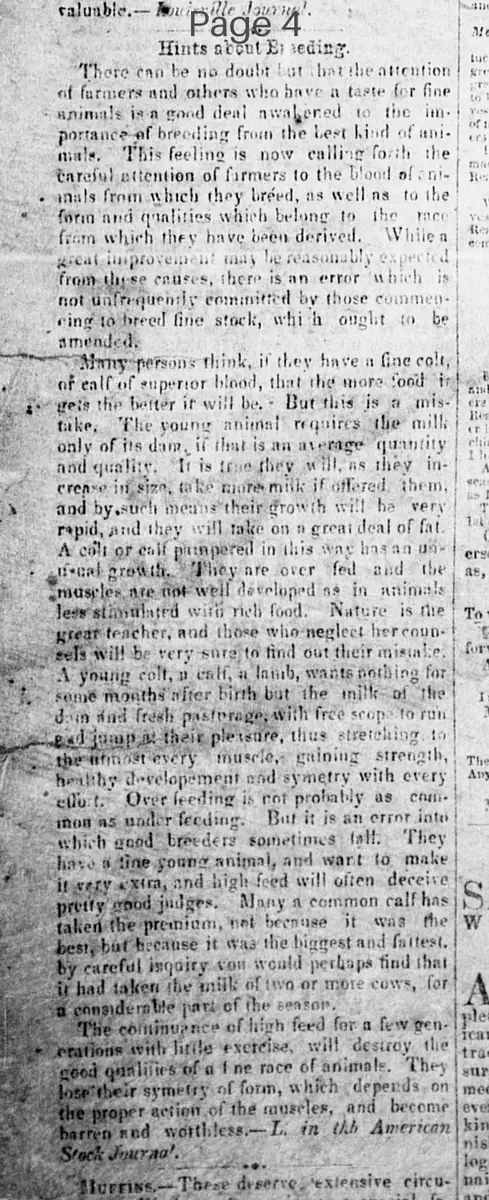
Hints about Breeding.
There can be no doubt but that the attention of farmers and others who have a taste for fine animals is a good deal awakened to the importance of breeding from the best kind of animals. This feeling is now calling forth the careful attention of farmers to the blood of animals from which they breed, as well as to the form and qualities which belong to the race from which they have been derived. While a great improvement may be reasonably expected from these causes, there is an error which is not unfrequently committed by those commencing to breed fine stock, which ought to be amended.
Many persons think, if they have a fine colt, or calf of superior blood, that the more food it gets the better it will be. But this is a mistake. The young animal requires the milk only of its dam, if that is an average quantity and quality. It is true they will, as they increase in size, take more milk if offered them, and by such means their growth will be very rapid, and they will take on a great deal of fat. A colt or calf pampered in this way has an unnatural growth. They are over fed and the muscles are not well developed as in animals less stimulated with rich food. Nature is the great teacher, and those who neglect her counsels will be very sure to find out their mistake.
A young colt, a calf, a lamb, wants nothing for some months after birth but the milk of the dam and fresh pasturage, with free scope to run and jump at their pleasure, thus stretching to the utmost every muscle, gaining strength, healthy development and symmetry with every effort. Over feeding is not probably as common as under feeding. But it is an error into which good breeders sometimes fall. They have a fine young animal, and want to make it very extra, and high feed will often deceive pretty good judges. Many a common calf has taken the premium, not because it was the best, but because it was the biggest and fattest. By careful enquiry you would perhaps find that it had taken the milk of two or more cows, for a considerable part of the season.
The continuance of high feed for a few generations with little exercise, will destroy the good qualities of a fine race of animals. They lose their symmetry of form, which depends on the proper action of the muscles, and become barren and worthless.--L. in the American Stock Journal.
There can be no doubt but that the attention of farmers and others who have a taste for fine animals is a good deal awakened to the importance of breeding from the best kind of animals. This feeling is now calling forth the careful attention of farmers to the blood of animals from which they breed, as well as to the form and qualities which belong to the race from which they have been derived. While a great improvement may be reasonably expected from these causes, there is an error which is not unfrequently committed by those commencing to breed fine stock, which ought to be amended.
Many persons think, if they have a fine colt, or calf of superior blood, that the more food it gets the better it will be. But this is a mistake. The young animal requires the milk only of its dam, if that is an average quantity and quality. It is true they will, as they increase in size, take more milk if offered them, and by such means their growth will be very rapid, and they will take on a great deal of fat. A colt or calf pampered in this way has an unnatural growth. They are over fed and the muscles are not well developed as in animals less stimulated with rich food. Nature is the great teacher, and those who neglect her counsels will be very sure to find out their mistake.
A young colt, a calf, a lamb, wants nothing for some months after birth but the milk of the dam and fresh pasturage, with free scope to run and jump at their pleasure, thus stretching to the utmost every muscle, gaining strength, healthy development and symmetry with every effort. Over feeding is not probably as common as under feeding. But it is an error into which good breeders sometimes fall. They have a fine young animal, and want to make it very extra, and high feed will often deceive pretty good judges. Many a common calf has taken the premium, not because it was the best, but because it was the biggest and fattest. By careful enquiry you would perhaps find that it had taken the milk of two or more cows, for a considerable part of the season.
The continuance of high feed for a few generations with little exercise, will destroy the good qualities of a fine race of animals. They lose their symmetry of form, which depends on the proper action of the muscles, and become barren and worthless.--L. in the American Stock Journal.
What sub-type of article is it?
Agricultural Advice
What themes does it cover?
Moral Virtue
Nature
What keywords are associated?
Animal Breeding
Overfeeding
Young Stock
Natural Development
Milk Feeding
Muscle Growth
What entities or persons were involved?
L.
Story Details
Key Persons
L.
Story Details
Farmers should breed from superior bloodlines and avoid overfeeding young animals with extra milk, allowing natural development through dam's milk and exercise to build strong muscles and symmetry, as overfeeding leads to fat, unhealthy stock that deceives judges and ruins breeds over generations.