Thank you for visiting SNEWPapers!
Sign up free
The Virginia Gazette
Richmond, Williamsburg, Richmond County, Virginia
What is this article about?
British House of Commons debates and approves an address thanking the King for his speech and supporting decisive measures against the American rebellion, including use of Hanoverian troops in garrisons to free British forces. Debate features sharp exchanges between administration supporters and opponents like Fox and Grenville. Vote: 176-72. Lord North moves militia bill, carried. Related: Sayre bailed; North plans reconciliation terms with force.
Merged-components note: Continuation of Friday's parliamentary proceedings, including the full text of the House of Commons address; original label of address component changed from 'notice' to 'foreign_news'.
Clipping
OCR Quality
Full Text
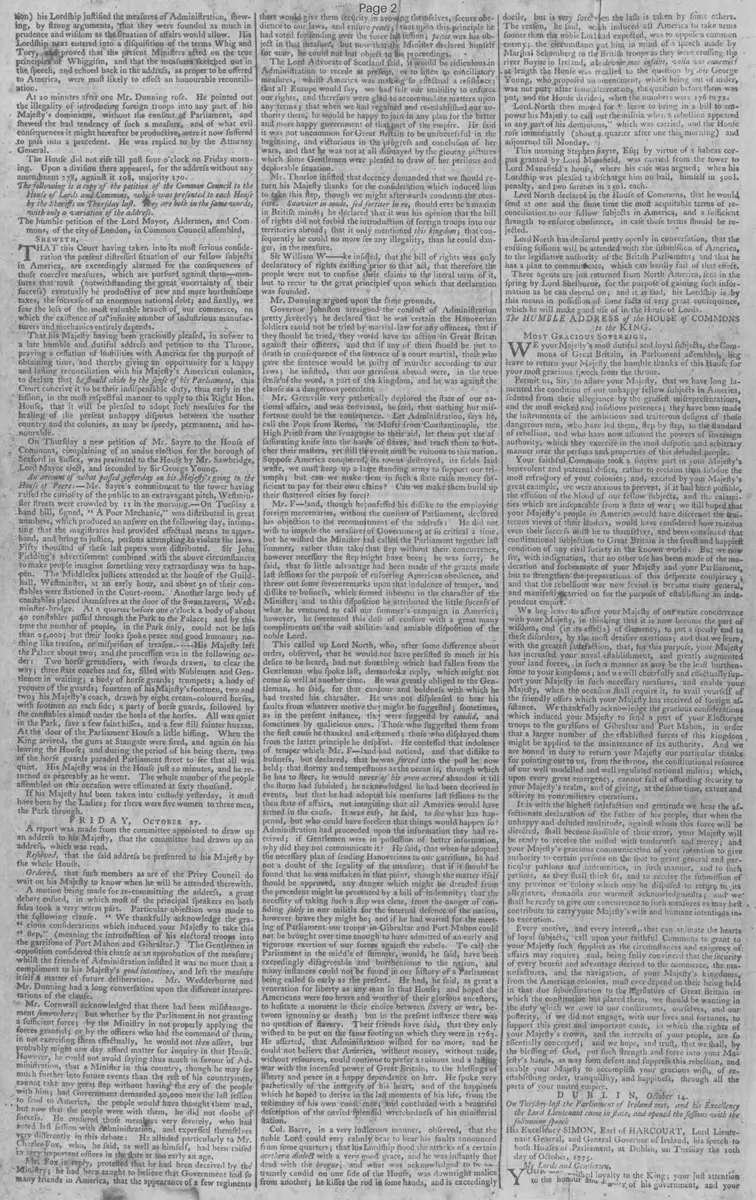
A report was made from the committee appointed to draw up an address to his Majesty, that the committee had drawn up an address, which was read.
Resolved, that the said address be presented to his Majesty by the whole House.
Ordered, that such members as are of the Privy Council do wait on his Majesty to know when he will be attended therewith.
A motion being made for re-committing the address, a great debate ensued, in which most of the principal speakers on both sides took a very warm part. Particular objection was made to the following clause. "We thankfully acknowledge the gracious considerations which induced your Majesty to take this step," (meaning the introduction of his electoral troops into the garrisons of Port Mahon and Gibraltar.) The Gentlemen in opposition considered this clause as an approbation of the measure; whilst the friends of Administration insisted it was no more than a compliment to his Majesty's good intentions, and left the measure itself matter of future deliberation. Mr. Wedderburn and Mr. Dunning had a long conversation upon the different interpretations of the clause.
Mr. Cornwall acknowledged that there had been mismanagement somewhere; but whether by the Parliament in not granting a sufficient force; by the Ministry in not properly applying the forces granted; or by the officers who had the command of them, in not exercising them effectually, he would not then assert, but probably might one day afford matter of inquiry in that House.
However, he could not avoid saying thus much in favour of Administration, that a Minister in this country, though he may see much further into future events than the rest of his countrymen, cannot take any great step without having the cry of the people with him; had Government demanded 40,000 men the last session to send to America, the people would have thought them mad, but now that the people were with them, he did not doubt of success. He censured those members very severely, who had voted last session with Administration, and expressed themselves very differently in this debate: He alluded particularly to Mr. Charles Fox, who, he said, as well as himself, had been raised to very important offices in the state at too early an age.
Mr. Fox in reply, protested that he had been deceived by the Ministry; he had been taught to believe that Government had so many friends in America, that the appearance of a few regiments there would give them security in avoiding themselves, secure obedience to our laws, and ensure peace; that upon this principle he had voted for sending over the force last session; peace was his object in that measure, but now that the Minister declared himself for war, he could not but object to his proceedings.
The Lord Advocate of Scotland said, it would be ridiculous in Administration to recede at present, or to listen to conciliatory measures, whilst America was making so effectual a resistance; that all Europe would say, we had felt our inability to enforce our rights, and therefore were glad to accommodate matters upon any terms; that when we had regained and re-established our authority there, he would be happy to join in any plan for the better and more happy government of that part of the empire. He said it was not uncommon for Great Britain to be unsuccessful in the beginning, and victorious in the progress and conclusion of her wars, and that he was not at all dismayed by the gloomy pictures which some Gentlemen were pleased to draw of her perilous and deplorable situation.
Mr. Byng insisted that decency demanded that we should return his Majesty thanks for the consideration which induced him to take this step, though we might afterwards condemn the measure. Suaviter in modo, et fortiter in re, should ever be a maxim in British minds; he declared that it was his opinion that the bill of rights did not forbid the introduction of foreign troops into our territories abroad; that it only mentioned this kingdom; that consequently he could no more see any illegality, than he could danger, in the measure.
Sir William Meredith insisted, that the bill of rights was only declaratory of rights existing prior to that act, that therefore the people were not to confine their claims to the literal term of it, but to recur to the great principles upon which that declaration was founded.
Mr. Dunning argued upon the same grounds.
Governor Johnstone arraigned the conduct of Administration pretty severely; he declared that he was certain the Hanoverian soldiers could not be tried by martial-law for any offences, that if they should be tried, they would have an action in Great Britain against their officers, and that if any of them should be put to death in consequence of the sentence of a court martial, those who gave the sentence would be guilty of murder according to our laws; he insisted, that our garrisons abroad were, in the true sense of the word, a part of this kingdom, and he was against the clause as a dangerous precedent.
Mr. Grenville very pathetically deplored the state of our national affairs, and was convinced, he said, that nothing but misfortune could be the consequence. Let Administration, says he, call the Pope from Rome, the Mufti from Constantinople, the High Priest from the synagogue to their aid, let them put this assassinating knife into the hands of slaves, and teach them to butcher their masters, yet still they event must be ruinous to this nation. Suppose America conquered, its towns destroyed, its fields laid waste, we must keep up a large standing army to support our triumph; but can we make them in such a state raise money sufficient to pay for their own chains? Can we make them build up their shattered cities by force?
Mr. Brand, though he confessed his dislike to the employing foreign mercenaries, without the consent of Parliament, declared his objection to the recommitment of the address: He did not wish to impede the measures of Government at so critical a time, but he wished the Minister had called the Parliament together last summer, rather than take that step without their concurrence, however necessary the step might have been; he was sorry, he said, that so little advantage had been made of the grants made last sessions for the purpose of enforcing American obedience, and threw out some severe remarks upon that indolence of temper, and dislike to business, which seemed inherent in the character of the Minister; and to this disposition he attributed the little success of what he ventured to call our summer's campaign in America; however, he sweetened this dose of censure with a great many compliments on the vast abilities and amiable disposition of the noble Lord.
This called up Lord North, who, after some difference about order, observed, that he would not have persisted so much in his desire to be heard, had not something which had fallen from the Gentleman who spoke last, demanded a reply, which might not come so well at another time. He was greatly obliged to the Gentleman, he said, for that candour and boldness with which he had treated his character. He was not displeased to hear his faults from whatever motive they might be suggested; sometimes, as in the present instance, they were suggested by candid, and sometimes by malicious ones. Those who suggested them from the first cause he thanked and esteemed; those who displayed them from the latter principle he despised. He confessed that indolence of temper which Mr. Brand had noticed, and that dislike to business, but declared, that he was forced into the post he now held; that stormy and tempestuous as the ocean is, through which he has to steer, he would never of his own accord abandon it till the storm had subsided; he acknowledged he had been deceived in events, but that he had adopted his measures last sessions to the then state of affairs, not imagining that all America would have armed in the cause. It was easy, he said, to see what has happened, but who could have foreseen that things would happen so? Administration had proceeded upon the information they had received; if Gentlemen were in possession of better information, why did they not communicate it? He said, that when he adopted the necessary plan of sending Hanoverians to our garrisons, he had not a doubt of the legality of the measure; that if it should be found that he was mistaken in that point, though the matter itself should be approved, any danger which might be dreaded from the precedent might be prevented by a bill of indemnity; that the necessity of taking such a step was clear, from the danger of confiding solely in our militia for the internal defence of the nation, however brave they might be; and if he had waited for the meeting of Parliament our troops in Gibraltar and Port Mahon could not be brought over time enough to have admitted of an early and vigorous exertion of our forces against the rebels. To call the Parliament in the middle of summer, would, he said, have been exceedingly disagreeable and burthensome to the nation, and many instances could not be found in our history of a Parliament being called so early as this present. He had, he said, as great a veneration for liberty as any man in that House; and hoped the Americans were too brave and worthy of their glorious ancestors, to hesitate a moment in their choice between slavery or war, between ignominy or death; but in the present instance there was no question of slavery. Their friends have said, that they only wished to be put on the same footing on which they were in 1763. He asserted, that Administration wished for no more, and he could not believe that America, without money, without trade, without resources, could continue to prefer a ruinous and a lasting war with the incensed power of Great Britain, to the blessings of liberty and peace in a happy dependence on her. He spoke very pathetically of the integrity of his heart, and of the happiness which he hoped to derive in the last moments of his life, from the testimony of his own conscience; and concluded with a beautiful description of the envied splendid wretchedness of his ministerial station.
Col. Barre, in a very ludicrous manner, observed, that the noble Lord could very calmly bear to hear his faults announced from some quarters; that his Lordship stood the attacks of a certain northern dialect with a very good grace, and he was instantly shot dead with the brogue; and what was acknowledged to be extremely candid on one side of the House, was downright malice from another; he kisses the rod in some hands, and is exceedingly docile, but is very sore when the lash is taken by some others.
The reason, he said, which induced all America to take arms sooner than the noble Lord had expected, was to oppose a common enemy; the circumstance put him in mind of a speech made by Marshal Schomberg to the British troops as they were crossing the river Boyne in Ireland, Allelez, mes infants, voila vos ennemis!
At length the House was recalled to the question by Sir George Young, who proposed an amendment, which being out of order was not put; after some altercation, the question before them was put, and the House divided, when the numbers were 176 to 72.
Lord North then moved for "leave to bring in a bill to empower his Majesty to call out the militia when a rebellion appeared in any part of his dominions," which was carried, and the House rose immediately (about a quarter after one this morning) and adjourned till Monday.
This morning Stephen Sayre, Esq; by virtue of a habeas corpus granted by Lord Mansfield, was carried from the tower to Lord Mansfield's house, where his case was argued; when his Lordship was pleased to discharge him on bail, himself in 500l. penalty, and two sureties in 250l. each.
Lord North declared in the House of Commons, that he would send at one and the same time the most equitable terms of reconciliation to our fellow subjects in America, and a sufficient strength to enforce obedience, in case those terms should be rejected.
Lord North has declared pretty openly in conversation, that the ensuing session will be attended with the submission of America, to the legislative authority of the British Parliament; and that he has a plan to communicate, which can hardly fail of that effect.
Three agents are just returned from North America, sent in the spring by Lord Shelburne, for the purpose of gaining such information as he can depend on; and it is said, his Lordship is by this means in possession of some facts of very great consequence, which he will make good use of in the House of Lords.
The HUMBLE ADDRESS of the HOUSE of COMMONS to the KING.
We, your Majesty's most dutiful and loyal subjects, the Commons of Great Britain, in Parliament assembled, beg leave to return your Majesty the humble thanks of this House for your most gracious speech from the throne.
Permit us, Sir, to assure your Majesty, that we have long lamented the condition of our unhappy fellow subjects in America, reduced from their allegiance by the grossest misrepresentations, and the most wicked and insidious pretences; they have been made the instruments of the ambitious and traitorous designs of those dangerous men, who have led them, step by step, to the standard of rebellion, and who have now aimed the powers of sovereign authority, which they exercise in the most despotic and arbitrary manner over the persons and properties of this deluded people.
Your faithful Commons took a sincere part in your Majesty's benevolent and paternal desire, rather to reclaim than subdue the most refractory of your colonies; and, excited by your Majesty's great example, we were anxious to prevent, if it had been possible, the effusion of the blood of our fellow subjects, and the calamities which are inseparable from a state of war; we still hoped that your Majesty's people in America would have discerned the traitorous views of their leaders, would have considered how ruinous even their success must be to themselves, and been convinced that constitutional subjection to Great Britain is the freest and happiest condition of any civil society in the known world: But we now see, with indignation, that no other use has been made of the moderation and forbearance of your Majesty and your Parliament, but to strengthen the preparations of this desperate conspiracy; and that the rebellions war now levied is become more general, and manifestly carried on for the purpose of establishing an independent empire.
We beg leave to assure your Majesty of our entire concurrence with your Majesty, in thinking that it is now become the part of wisdom, and (in its effects) of clemency, to put a speedy end to these disorders, by the most decisive exertions; and that we learn, with the greatest satisfaction, that, for this purpose, your Majesty has increased your naval establishment, and greatly augmented your land forces, in such a manner as may be the least burthensome to your kingdoms; and we will cheerfully and effectually support your Majesty in such necessary measures, and enable your Majesty, when the occasion shall require it, to avail yourself of the friendly offers which your Majesty has received of foreign assistance. We thankfully acknowledge the gracious considerations which induced your Majesty to send a part of your Electorate troops to the garrisons of Gibraltar and Port Mahon, in order that a larger number of the established forces of this kingdom might be applied to the maintenance of its authority. And we are bound in duty to return your Majesty our particular thanks for pointing out to us, from the throne, the constitutional resource of our well modelled and well regulated national militia; which, upon every great emergency, cannot fail of affording security to your Majesty's realm, and of giving, at the same time, extent and activity to your military operations.
It is with the highest satisfaction and gratitude we hear the affectionate declaration of the father of his people, that when the unhappy and deluded multitude, against whom this force will be directed, shall become sensible of their error, your Majesty will be ready to receive the misled with tenderness and mercy; and your Majesty's gracious communication of your intention to give authority to certain persons on the spot to grant general and particular pardons and indemnities, in such manner, and to such persons, as they shall think fit, and to receive the submission of any province or colony which may be disposed to return to its allegiance, demands our warmest acknowledgments; and we shall be ready to give our concurrence to such measures as may best contribute to carry your Majesty's wise and humane intentions into execution.
Every motive, and every interest, that can animate the hearts of loyal subjects, call upon your faithful Commons to grant to your Majesty such supplies as the circumstances and exigency of affairs may require; and, being fully convinced that the security of every benefit and advantage derived to the commerce, the manufactures, and the navigation, of your Majesty's kingdoms, from the American colonies, must ever depend on their being held in that due subordination to the legislature of Great Britain in which the constitution has placed them, we should be wanting in the duty which we owe to our constituents, ourselves, and our posterity, if we did not engage, with our lives and fortunes, to support this great and important cause, in which the rights of your Majesty's crown, and the interests of your people, are so essentially concerned; and we hope, and trust, that we shall, by the blessing of God, put such strength and force into your Majesty's hands, as may soon defeat and suppress this rebellion, and enable your Majesty to accomplish your gracious wish, of re-establishing order, tranquillity, and happiness, through all the parts of your united empire.
What sub-type of article is it?
What keywords are associated?
What entities or persons were involved?
Where did it happen?
Foreign News Details
Primary Location
America
Event Date
Friday, October 27
Key Persons
Outcome
house divided 176 to 72 in favor of presenting the address. leave granted to bring in bill empowering king to call out militia against rebellion. stephen sayre discharged on bail of 500l with two sureties of 250l each.
Event Details
Committee presents address to King acknowledging his speech on American rebellion, thanking for introducing electorate troops to Gibraltar and Port Mahon garrisons to enable British forces against rebels, and supporting increased naval and land forces plus militia. Heated debate on clause approving the troop measure; opposition sees it as endorsement, administration as compliment to intentions. Speakers including Fox (deceived by ministry on peace aims), Grenville (deplores national ruin), Johnstone (illegal precedent), and North (defends necessity, legality, and plans indemnity if needed) argue merits. Lord North declares intent to send equitable reconciliation terms and sufficient force to America simultaneously, predicts American submission next session. Three agents return from North America for Lord Shelburne with key facts. Full text of address expresses concurrence with King's firm policy, laments rebellion led by traitors, pledges support for suppression and pardons for returnees.