Thank you for visiting SNEWPapers!
Sign up free
Gazette Of The United States
New York, New York County, New York
What is this article about?
Sketch of U.S. House of Representatives proceedings from August 19-25, 1789, including debates on funding for Indian treaties (agreed to Senate's $20,000 amendment), constitutional amendments (direct taxes proposal rejected 9-39, others negatived; resolution to submit amendments to states), petitions for federal seat, adjournment timing (to September 28), judiciary bill progress, executive salaries bill, and Department of State establishment.
Merged-components note: This is a single continuous 'Sketch of Proceedings of Congress' spanning multiple pages and components, including debates on treaties, amendments, judiciary, and a related table of salaries. The table is merged as it pertains to the salary discussions in the proceedings. Label changed to domestic_news as it best describes the local/national government news content.
Clippings
1 of 3
OCR Quality
Full Text
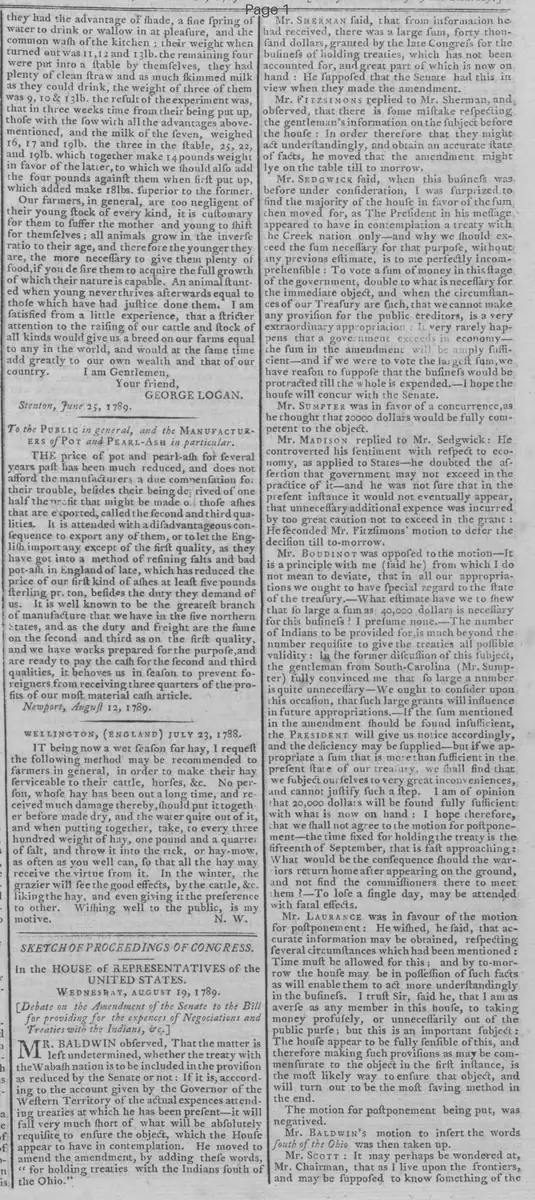
In the HOUSE of REPRESENTATIVES of the UNITED STATES.
WEDNESDAY, AUGUST 19, 1789.
[Debate on the Amendment of the Senate to the Bill for providing for the expences of Negociations and Treaties with the Indians, &c.]
R. BALDWIN observed, That the matter is left undetermined, whether the treaty with the Wabash nation is to be included in the provision as reduced by the Senate or not: If it is, according to the account given by the Governor of the Western Territory of the actual expences attending treaties at which he has been present it will fall very much short of what will be absolutely requisite to ensure the object, which the House appear to have in contemplation. He moved to amend the amendment, by adding these words, "for holding treaties with the Indians south of the Ohio."
Mr. SHERMAN said, that from information he had received, there was a large sum, forty thousand dollars, granted by the late Congress for the business of holding treaties, which has not been accounted for, and great part of which is now on hand: He supposed that the Senate had this in view when they made the amendment.
Mr. FITZSIMONS replied to Mr. Sherman, and observed, that there is some mistake respecting the gentleman's information on the subject before the house: In order therefore that they might act understandingly, and obtain an accurate state of facts, he moved that the amendment might lie on the table till to-morrow.
Mr. SEDGWICK said, when this business was before under consideration, I was surprised to find the majority of the house in favor of the sum then moved for, as The President in his message appeared to have in contemplation a treaty with the Creek nation only-and why we should exceed the sum necessary for that purpose, without any previous estimate, is to me perfectly incomprehensible: To vote a sum of money in this stage of the government, double to what is necessary for the immediate object, and when the circumstances of our Treasury are such, that we cannot make any provision for the public creditors, is a very extraordinary appropriation: It very rarely happens that a government exceeds in economy- the sum in the amendment will be amply sufficient and if we were to vote the largest sum, we have reason to suppose that the business would be protracted till the whole is expended.—I hope the house will concur with the Senate.
Mr. SUMTER was in favor of a concurrence, as he thought that 20000 dollars would be fully competent to the object.
Mr. Madison replied to Mr. Sedgwick: He controverted his sentiment with respect to economy, as applied to States-he doubted the assertion that government may not exceed in the practice of it-and he was not sure that in the present instance it would not eventually appear, that unnecessary additional expence was incurred by too great caution not to exceed in the grant: He seconded Mr. Fitzimons' motion to defer the decision till to-morrow.
Mr. Boudinot was opposed to the motion-It is a principle with me (said he) from which I do not mean to deviate, that in all our appropriations we ought to have special regard to the state of the treasury.-What estimate have we to shew that so large a sum as 40,000 dollars is necessary for this business? I presume none. The number of Indians to be provided for, is much beyond the number requisite to give the treaties all possible validity: In the former discussion of this subject, the gentleman from South-Carolina (Mr. Sumter) fully convinced me that so large a number is quite unnecessary-We ought to consider upon this occasion, that such large grants will influence in future appropriations.—If the sum mentioned in the amendment should be found insufficient, the President will give us notice accordingly, and the deficiency may be supplied—but if we appropriate a sum that is more than sufficient in the present state of our treasury, we shall find that we subject ourselves to very great inconveniences, and cannot justify such a step. I am of opinion that 20,000 dollars will be found fully sufficient with what is now on hand: I hope therefore, that we shall not agree to the motion for postponement the time fixed for holding the treaty is the fifteenth of September, that is fast approaching: What would be the consequence should the warriors return home after appearing on the ground, and not find the commissioners there to meet them?-To lose a single day, may be attended with fatal effects.
Mr. LAURANCE was in favour of the motion for postponement: He wished, he said, that accurate information may be obtained, respecting several circumstances which had been mentioned: Time must be allowed for this; and by to-morrow the house may be in possession of such facts as will enable them to act more understandingly in the business. I trust Sir, said he, that I am as averse as any member in this house, to taking money profusely, or unnecessarily out of the public purse; but this is an important subject: The house appear to be fully sensible of this, and therefore making such provisions as may be commensurate to the object in the first instance, is the most likely way to ensure that object, and will turn out to be the most saving method in the end.
The motion for postponement being put, was negatived.
Mr. BALDWIN's motion to insert the words south of the Ohio was then taken up.
Mr. SCOTT: It may perhaps be wondered at, Mr. Chairman, that as I live upon the frontiers, and may be supposed to know something of the
On the nature of Indian affairs, I have been silent upon this occasion—but, Sir, it is because I have no opinion of Indian treaties—and I hope that if we vote any sum more than sufficient to support the Commissioners, and feed the Indians, while the treaty is holding, that it will be embezzled; for I consider it as the worst kind of policy, to spend a large sum of money in making presents to those savages; it never produces any solid advantages, but constantly the reverse. The Indians have reduced war and treaties to a system of commerce and traffic. By giving them presents, we make them strong to fall upon our defenseless frontiers; and it has often been found to be the case, that the arms and ammunition which they have received at a treaty of peace, have been employed to the destruction of the donors: the sum of 20,000 dollars, I think, will be large enough.—I hope we shall concur with the senate.
Mr. MOORE was in sentiment with Mr. SCOT; he reprobated the system which had been adhered to, of making presents to the Indians.
Mr. BALDWIN said, in answer to Mr. SCOT, that the gentleman's observations are of a general nature; the superintendent of Indian affairs, and the secretary at war has made a statement, and it is to be supposed upon the best information he can obtain; if this is defective, if it is too much, let the particulars be pointed out in which the excess lies: His estimate states that 25,000 dollars are requisite for holding treaties with the southern tribes; if this provision is intended to defray the expenses of holding treaties with both northern and Southern Indians, it appears demonstrable, that we shall fail for want of the means of effecting our object, in both.
Mr. SUMTER observed that the number on which the estimate is founded arose from mis-information: So large a number is not necessary: such a number will not be assembled; they cannot be provided for, they would run a risk of suffering very much: I have no doubt Sir, that the business may be well done without assembling such a number, and it will be well done if we do not make too large provision. I hope we shall support the dignity of the United States, and let those Indians know that treaties in future shall not be violated with impunity; that we will treat with them upon generous and reciprocal terms; that while we guard them from depredations from our frontiers, they shall strictly observe the stipulations on their part. Some trifling presents may be necessary, the custom is of long standing: but extravagant and profuse presents I am opposed to; they are unnecessary. The sum of 20,000 dollars, I think will be sufficient.
Mr. Baldwin's motion being put, was negatived. The amendment of the senate was then agreed to.
Adjourned.
SATURDAY, AUGUST 22.
Several petitions were read and laid on the table. Representations from the citizens of Trenton, in New-Jersey, York-Town, and Lancaster, in Pennsylvania, were presented to the House, stating the advantages they possess in soil, climate, situation, population, cultivation and buildings; and proffering their respective towns with the circumjacent territory, of ten miles, to Congress, for the permanent seat of the federal government.
The amendments to the Constitution as altered and agreed to by the House, were read.
Mr. TUCKER then proposed the following amendment in substance: That Congress shall not exercise the power of levying direct taxes, except in cases where any of the States shall refuse, or neglect to comply with their requisitions.
Mr. PAGE said, although I wish the way may be always open for every member of this house to propose amendments to the Constitution—yet as the business is so far completed with respect to the report of the committee, I think it will be best to proceed and finish this report, and in the mean time refer this to the select committee of eleven.
Mr. TUCKER: I hope, Sir, the proposition will be attended to at the present time—as the house is upon the subject, and considerable progress is made, this amendment may be added with ease, if it should be agreed to—I think it best to finish the whole business now Congress has it before them.
Mr. JACKSON opposed the proposition: I hope, Sir, that the experience we have had will be sufficient to prevent Congress ever divesting themselves of this power. This experience forcibly points out the impropriety of adopting this amendment—requisitions upon several States it is well known, tho made several years since, remain un-complied with to this day; and no inducements in future can ever be supposed to be sufficiently operative, to induce so universal a compliance with requisitions, as to secure the public good, if a sense of common danger, war, and the facility of payment in a paper medium were not sufficient to do it: But this plan of requisitions is pregnant with difficulties of various kinds—it will excite jealousies—insurrections—and civil war, dissolve the Union, and expose us to the contempt and invasion of foreign powers: For if this power is taken from Congress, you divest the United States of the means of protecting the Union, or providing for the existence and continuation of the government.
Mr. LIVERMORE supported the motion: He said, it is more important than all that has been agreed to: This is an amendment to some purpose, and which a number of the States have particularly called for: Without some to more purpose is held out to the people, that I have the honor to represent, they will consider these as a mere musketto bite—they will not give a pinch of snuff for them all.
Mr. PAGE observed, that this proposition is one about which the warmest friends to amendments have differed in opinion: Some of them have entirely ceased urging it, and others have become the most strenuous advocates for the reverse; and now say that the government ought never to give up this power: For my part, experience has fully evinced that no dependence can be placed upon requisitions: If in a time of war, and when we made paper money by hogsheads full, they were disregarded, I have no expectation that any dependence in future can be placed in them—I shall therefore be against the proposition.
Mr. GERRY moved, that it be referred to a select committee.
Mr. TUCKER objected to this motion, he said the subject of amendments is still open as the report of the committee is not yet completed.
Mr. GERRY advocated the object of the motion; but he did not think that object fully comprehended in the motion now before the house: He then entered into a general discussion of the question, and pointed out the consequences of the exercise of this power by the general government, as involving the annihilation of the State governments.
Mr. TUCKER: I do not see the arguments in favour of giving Congress this power in so strong a light as some gentlemen do: It will be to erect an imperium in imperio; which is always considered as subversive of all government. Whenever Congress shall exercise this power, it will raise commotions in the states; whereas the mode of requisitions will operate in such an easy way, by being consonant to the habits of the people, that the supplies will be sooner realized into the public treasury in this, than by the other mode. Much time must be spent in forming a uniform system of taxation, which shall operate equally and justly through all the States, if it is possible to form such a system.—It is said that requisitions have not been complied with in former times; but it is to be expected that there will not be so much difficulty in future. The requisitions will be greatly diminished by reason of the supplies from the impost; besides, should any of the States not comply, they will in that case be liable to the exercise of the power of Congress in the very heart of such States as are delinquent; this power would be so disagreeable, that the dread of it would serve to stimulate the States to an immediate and prompt compliance with the requisitions. This amendment is proposed by several of the States, and some of the most important; and for this, and other reasons which have been offered, I hope the amendment will be adopted.
Several methods of disposing of this question for the present were proposed, but the motion for its lying on the table being put and negatived, Mr. PARTRIDGE, referring to his instructions, was solicitous that this amendment should not be too suddenly decided upon, moved the previous question, which was negatived.
Mr. SEDGWICK observed, that he believed he felt the force of the instructions from his constituents which they ought to have upon his mind, and to as great a degree as other gentlemen; but Sir, said he, a government entrusted with the freedom, and the very existence of the people, ought surely to possess, in the most ample manner, the means of supporting its own existence; and as we do not know what circumstances we may be in, nor how necessary it may be for Congress to exercise this power, I should think it a violation of the oath I have taken to support this constitution, were I now to vote for this amendment.
Mr. SHERMAN observed that if congress should exercise this power, the taxes would be laid by the immediate representatives of the people; nor would there be any necessity for adopting one uniform method of collecting direct taxes: The several states may be accommodated by a reference to their respective modes of taxation.
The question upon the paragraph being called for from all parts of the house, the ayes and noes stand thus:
AYES.
Messrs. Burke—Coles—Floyd—Grout—Hathorn—Livermore—Van Rensselaer—Sumter—Tucker—9.
NOES.
Messrs. Ames—Benson—Brown—Cadwallader—Carroll—Clymer—Fitzsimons—Foster—Gale—Gerry—Gilman—Goodhue—Hartley—Heister—Jackson—Laurance—Lee—Madison—Matthews—Moore—Muhlenberg—Page—Parker—Partridge—Sherman—Scott—Sedgwick—Seney—Sherman—Sylvester—Skinner—Smith (M)—Smith (S. C.)—Stone—Sturges—Thatcher—Trumbull—Vining—Wadsworth—39.
Mr. TUCKER then proposed some other amendments, from those proposed by the state of South-Carolina; which were severally negatived.
Mr. GERRY proposed the two following, viz.—
Congress shall not establish any company or companies of merchants with exclusive privileges.—
The other to prohibit the officers of the general government from accepting any title of nobility from any foreign power. These were both negatived.
Mr. BENSON introduced a resolution to this purport: Resolved by the house of representatives of the United States in Congress assembled, that the following amendments to the constitution of the United States having been agreed to by two thirds of both houses, be submitted to the legislatures of the several states; which when ratified in whole or in part by three fourths of said legislatures, shall be valid to all intents and purposes as parts of said constitution. This resolution was referred to a committee, consisting of Mr. BENSON, Mr. SHERMAN, and Mr. SEDGWICK, who were directed to arrange the said amendments, and report.
Mr. GOODHUE moved that the report of the joint committee on the adjournment be made the order of the day on Monday next: Passed in the affirmative.
The committee on the part of the house appointed to confer with the senate on their amendment to the treasury bill being called on to report, Mr. MADISON reported verbally, that the committee had met and conferred upon the subject; that the members on the part of the senate stated the reasons on which their amendment was founded; which not being satisfactory to the committee on the part of the house, they then submitted certain propositions to the committee of the senate, who on their part offered none: Mr. MADISON further reported that it is the opinion of the committee on the part of the house, that it would not be best for the house to recede from their disagreement.
A petition was presented from the inhabitants of the town of Alexandria, setting forth that a certain clause in the collection bill operates unequally upon the citizens of that port, and praying for alteration therein. Laid on the table.
Adjourned.
| To the Secretary of the treasury. | 5000 Dollars. |
| Secretary of foreign affairs | 3500 |
| Secretary of the department of war | 2500 |
| Comptroller | 2000 |
| Auditor | 1500 |
| Treasurer | 1600 |
| Register | 1250 |
| Superintendent of Indian affairs | 1000 |
| Governor of the Western Territory | 1000 |
| Assistant to the secretary of the Treasury | 1600 |
| Chief clerk to the secretary of foreign affairs | 800 |
| Chief clerk in the war department | 600 |
MONDAY, AUGUST 24.
A memorial from the inhabitants of George Town, on Patowmac, was introduced by Mr. CARROLL, which being read, was referred, with a petition from the inhabitants of Alexandria, to a committee, consisting of Messrs. CARROLL, LEE, and GOODHUE.
Mr. MADISON presented a petition from JOHN HURT, a Chaplain in the late Southern army, which was read and laid on the table.
Mr. FITZSIMONS of the committee appointed to bring in a bill for establishing the salaries of the officers in the executive departments, brought in a report which was read the first time.
The committee appointed to arrange the amendments agreed to by the house, and to prepare a resolution as a preamble to the same, made report: The resolution is the same brought in yesterday—
The order of the day on the report of the joint committee on an adjournment was moved for.
Mr. VINING was opposed to taking up this report: He observed that at this moment would necessarily involve great deal of debate and loss of time, and would counteract the object of gentlemen entirely while many important subjects were yet undecided which must be attended to and finished, previous to a recess: He moved for a postponement, in order to take up the Treasury Bill.
Mr. HARTLEY observed, that the gentleman's remarks furnished argument for coming to determination upon the immediate notice and decision.
He contended that it would expedite the public business, as the attention of the house to the essentials, which claimed their adjournment at the present time, as it was the best way to confine...
Mr. SEDGWICK advocated taking up the report immediately: time is once fixed, and gentlemen are fully impressed with the observation was founded on experience when the assembly of Massachusetts in one week, dispatching business given time had known as much transacted... well done as had been before the three... He further observed that a much less number than the present will be left to do business.
That when this house does adjourn on the of Sept. next, they will adjourn to the first Monday in December next.
Mr. MADISON proposed the following resolution, viz. Resolved...
Mr. VINING's motion was withdrawn.
it would not admit of the members who lived at the extreme parts of the Union going home and returning again by the time mentioned.
Mr. SCOTT on the First day of September.
Mr. LIVERMORE also objected to it; and proposed to adjourn...
ment at all: He contended for a short adjournment as proposed by...
September did not wish for any adjourn-
by the resolution So necessary: It is that necessity from observation, and conversation in our respective
laws have enacted judge better
States.
with 22d which was carried in the affirmative.
Mr. AMES the motion anpo fllk...
mau: the business now before us cannot be completed last m
Mr. SE o f h...
ning our constituents can be realized by those from a remote distance.
cannot give a suitable account of our conduct in adjourning for so recess are attended with great expense and we tance.
talk of their private concerns—I believe no member has made much business unfinished Gentle a greater proportion due strange than I have; but the public good s: I hope some plan of accommodation will take place. l- his flu revered Our own affairs ought -. influence r Tha e S Mr. Aetius the olnn ges on the Septem ext me the Mondy in December next. Mr. Jack serve that the tie was to ort; t will their constituents, and so far the advantage of an adjournment members who come from distance consulting Alarms have gone forth respecting the compensations—this will Let us view the matter another point of light eelesy incurred: If we sit two months longer, we shall so far alarms for very great expense will be aid ing in December : I think the adjournment ought to be to the first romplete the public business, as to supercede the necessity of me-t tual concessions for the accommodation of all, ought to be made : March and the Constitution will warrant this Mu- At the time proposed the cold season will be advanced—ice and atending to their private business—hence that season will be a- will prevent gentlemen at the eastward and northward from the southward—it ought to be considered that their relaxed confti- to their convenience but let us look to the members from tutions will be greatly exposed by the severe cold of this northern climate; besides it will then be their busy season for planting, &c. sooner forfeit their seats in this house, than be obliged to come here Some concessions ought to be made : The southern members would im the winter : This will operate to deprive the remote parts of the Union of their representation : I move therefore that the time be extended to the first of March. ted the expense that would attend it, and made it 20000 dollars, Mr. Gerry was opposed to so short an adjournment : He sta- a sum that would pay Congress for fifty days attendance : This he observed, rendered it demonstrable that it is most prudent for Congress to continue the session, and finish the business. If it is may be granted. I trust, said he, that there is no one that thinks absolutely necessary for any particular gentleman to go home, leave cceed without him, or that Congress thinks so, if they should, when himself of so much consequence, that the government cannot pro- such a member departs, the public business must stand still : Re- of this kind are not to influence in the deliberations of this assem- ed to beware of exciting public clamor ; but, Sir, I trust that ideas ference has been had to out-door conversation, and we are caution- Mr. Jackson said, that he was surprised to hear a gentleman cauioning the house against being influenced by popular clamor, man has within a fortnight past, raised more bugbears from that and the opinion of people without doors, especially as that gentle- fource than all the house besides. Mr. Gerry made some reply to Mr. Jackson, which was not heard distinctly. Mr. Boudinot said, that he supposed that the time between thuand the adjournment will be sufficient to complete the organi- on of the judiciary and executive departments. The adjourn- men will in the common course of events, allow the members from Georgia three or four weeks at home : A short recess is absolutely acellary : A long one will be highly injurious. Mr. Vining recapitulated a number of articles, now pending before Congress, upon which it is presumed, said he, that it is not neceary to consult our constituents : We already know their sen- timents: This business must absolutely be attended to, and com- pleated previous to a recess : I am opposed to the motion for ad- purning till March; but on a conciliatory plan will move for the fift of January. Mr. Tucker said, I conceive that the business is taken up wrong; the resolution proposed is entirely improper: It puts it in the power of the Speaker, in case the senate concur, to adjourn the House on that day, let circumstances be what they may : This is unprecedented, and cannot be agreed to. Mr. Jackson called for the previous question on Mr. Ames' motion—and on the question, Shall the main question now be put ? it passed in the affirmative. The main question then being put, it also passed in the affima- tive, by a large majority. The amendment of the Senate to the Treasury Bill, was taken into consideration : And Mr. Madison of the committee of conference made a verbal report, as mentioned in Saturday's sketch. Mr. Vining moved, that the house should now adhere to their diagreement to the amendment of the senate. Mr. Sherman, Mr. Page, and Mr. Gerry made a few ob- kmtions against the motion, which however was carried in the airmative. The house then went into a committee of the whole on the ju- dicary Bill—Mr. Boudinot in the chair. Mr. Benson moved, that the word "Federal" in the pream- ble should be struck out, which was voted in the affirmative Mr. Livermore moved that the word "four" before "judges" be struck out and three inserted. Mr. Sedgwick was in favour of the word four, the points to be dicued and settled by the judges are of the first magnitude. It is a most desirable object, said he, to have it determined by the most respectable authority, what is law. or diminished; for when they are equally divided, no decision can Mr. Jackson said that the number should be either increased be had He was therefore in favour of striking out the words. Mr. Sedgwick adverted to the courts in Great Britain, where there were four judges, and where no difficulties had been expe- nenced. tom of the British courts, where it was liable to exception. The Mr. Jackson said that we were not bound to follow the cus- question on striking out the words was lost. Mr. Livermore moved another amendment which was not fe- conded. Mr. Burke moved that "chief justice" should be struck out; it is a concomitant of royalty. said he. It was observed by Mr. Benson, that this is a provision of the constitution; Mr. Burke withdrew his motion upon this information. Mr. Tucker moved to strike out the whole clause, dividing the United States into districts for the purpoe of intituting inferi- or federal courts. He said that the state courts are fully compe- tent to purpoes for which thee courts are to be created and that they will be a burdensome and useless expense: Seconded by Mr. Sumter. Mr. Livermore said he was not in favour of striking out the whol clh e o hav heUn Sat idio uitritts, but he concurred in the other idea of the gentleman ; nt wihed for all.h- din-ia- ranturkv. to be established for th a hig court Alyacz y to take cognizance o all marie concrns but aloof all seizures. Mr. Tucker said he did not move to trike out the ditricts ent the etlet aly rewin "I such courts: but he presumed the states compole luincicn um trits. The motion was negatived. It was then moved, by Mr. Livermore to strike out the words one to be called Kentucky ditrit He oberved that as the matters would be chiefly of marine nature that would come uder t ciac the cu Ken olm ituation have nothing to do with fuch matters uchcourts there will be a needles expence This was negatived Mr. LivzR morE moved that the whole paragraph relpecting eftablifhing diftric .l. aiit ". Thic eftablich- cu doenlill
I lead to the necessity of establishing a new system of jurisprudence for the United States; it will be establishing two distinct systems of judicial proceedings; one must finally destroy the other. It is a prevailing opinion that law and courts are an abridgement of liberty; this is a sentiment with a great many, and it will not be wise to excite an increase of such ideas. I do conceive these courts are unnecessary; we have courts already fully sufficient for all the purposes for which these courts are to be established; and appeals may be made to the supreme federal court. We shall prejudice the people against the government; we have imposed duties of impost, and are raising revenue upon them: now if in addition to this we create useless courts, with a new set of judges, sheriffs or marshalls, clerks, constables, &c. will it not be con- sidered as laying a heavy and unnecessary additional burthen ? We must also erect a new set of goals; for we cannot put the criminals aud prisoners to be tried by thee courts, into the county goals. The juries, judges, &c. &c. will be a great and useless expense; and thcse courts will have a tendency to create universal uneasi- ness among the people. Committee rose and reported progress. Mr. Stone asked leave of absence from 1st Sept. Granted. Mr. Sylvester asked leave of absence for three weeks. Granted. Adjourned.
TUESDAY, AUGUST 25.
The bill for establishing the salaries of the officers in the execu- tive departments was read a second time, and referred to a com- mittee of the whole, to be taken up on Friday next. The report of the committee on the elections of New-Jersey is made the order of the day for Monday next. In committee of the whole, Mr. Boudinot in the chair. The bill to provide for the safe keeping of the acts, records and great seal of the United States, &c. was taken into considera- tion. This bill states that the department of "foreign affairs" shall be denominated the Department of State, to which a variety of duties of a domestic nature are to be annexed, and the principal officer therein to be denominated The Secretary of State. Considerable progress was made in the discussion : seve- ral clauses were altered, and others struck out; but the time not adnitting of its completion, the committee rose, and the chair- man reported progress. A message was received from the senate by Mr. Secretary Otis, informing the honourable house, that they concurred in the resolution for fixing the time of adjournment. Also that the senate had receded from that part of their amendment to the trea- sury bills to which the house had disagreed. Adjourned.
What sub-type of article is it?
What keywords are associated?
What entities or persons were involved?
Domestic News Details
Event Date
August 19 To August 25, 1789
Key Persons
Outcome
senate amendment to indian treaties bill agreed to at $20,000; direct taxes amendment negatived 9-39; other constitutional amendments negatived; resolution to submit amendments to states referred to committee; house adhered to disagreement on senate's treasury bill amendment; progress reported on judiciary bill and executive salaries; senate concurred on adjournment to september 28 and receded on treasury amendment.
Event Details
House debated and agreed to Senate's reduction of funding for Indian treaties to $20,000, rejecting addition for Wabash and southern tribes; considered petitions from Trenton, York-Town, Lancaster for federal seat; debated and rejected Tucker's amendment limiting direct taxes to non-compliant states; rejected Gerry's amendments on merchant companies and titles of nobility; referred resolution submitting amendments to states; debated adjournment date, settling on September 28 to December 7; reported on conference with Senate over treasury bill, adhering to disagreement; advanced judiciary bill in committee, striking 'Federal' from preamble but retaining four judges; introduced executive salaries bill with table of amounts; referred memorials from George Town and Alexandria; progressed bill renaming foreign affairs to State Department.