Thank you for visiting SNEWPapers!
Sign up free
Story
December 12, 1933
The Bismarck Tribune
Bismarck, Mandan, Burleigh County, Morton County, North Dakota
What is this article about?
Article discusses growing demands for changes in Eastern U.S. college football amid backlash against 1929 Carnegie Foundation reforms, which curbed subsidizing but damaged programs; highlights agitations at Yale, Harvard, and others for less restrictions and better coaching.
Clipping
OCR Quality
95%
Excellent
Full Text
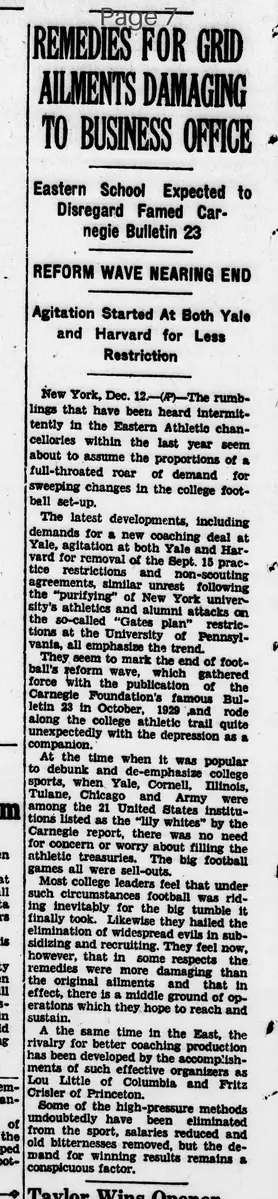
REMEDIES FOR GRID AILMENTS DAMAGING TO BUSINESS OFFICE
Eastern School Expected to Disregard Famed Carnegie Bulletin 23
REFORM WAVE NEARING END
Agitation Started At Both Yale and Harvard for Less Restriction
New York, Dec. 12.(AP)-The rumblings that have been heard intermittently in the Eastern athletic chancellories within the last year seem about to assume the proportions of a full-throated roar of demand for sweeping changes in the college football set-up.
The latest developments, including demands for a new coaching deal at Yale, agitation at both Yale and Harvard for removal of the Sept. 15 practice restrictions and non-scouting agreements, similar unrest following the "purifying" of New York university's athletics and alumni attacks on the so-called "Gates plan" restrictions at the University of Pennsylvania, all emphasize the trend.
They seem to mark the end of football's reform wave, which gathered force with the publication of the Carnegie Foundation's famous Bulletin 23 in October, 1929 and rode along the college athletic trail quite unexpectedly with the depression as a companion.
At the time when it was popular to debunk and de-emphasize college sports, when Yale, Cornell, Illinois, Tulane, Chicago and Army were among the 21 United States institutions listed as the "lily whites" by the Carnegie report. there was no need for concern or worry about filling the athletic treasuries, The big football games all were sell-outs.
Most college leaders feel that under such circumstances football was riding inevitably for the big tumble it finally took. Likewise they hailed the elimination of widespread evils in subsidizing and recruiting. They feel now. however, that in some respects the remedies were more damaging than the original ailments and that in effect, there is a middle ground of operations which they hope to reach and sustain.
A the same time in the East. the rivalry for better coaching production has been developed by the accomplishments of such effective organizers as Lou Little of Columbia and Fritz Crisler of Princeton.
Some of the high-pressure methods undoubtedly have been eliminated from the sport, salaries reduced and old bitternesses removed, but the demand for winning results remains a conspicuous factor.
Eastern School Expected to Disregard Famed Carnegie Bulletin 23
REFORM WAVE NEARING END
Agitation Started At Both Yale and Harvard for Less Restriction
New York, Dec. 12.(AP)-The rumblings that have been heard intermittently in the Eastern athletic chancellories within the last year seem about to assume the proportions of a full-throated roar of demand for sweeping changes in the college football set-up.
The latest developments, including demands for a new coaching deal at Yale, agitation at both Yale and Harvard for removal of the Sept. 15 practice restrictions and non-scouting agreements, similar unrest following the "purifying" of New York university's athletics and alumni attacks on the so-called "Gates plan" restrictions at the University of Pennsylvania, all emphasize the trend.
They seem to mark the end of football's reform wave, which gathered force with the publication of the Carnegie Foundation's famous Bulletin 23 in October, 1929 and rode along the college athletic trail quite unexpectedly with the depression as a companion.
At the time when it was popular to debunk and de-emphasize college sports, when Yale, Cornell, Illinois, Tulane, Chicago and Army were among the 21 United States institutions listed as the "lily whites" by the Carnegie report. there was no need for concern or worry about filling the athletic treasuries, The big football games all were sell-outs.
Most college leaders feel that under such circumstances football was riding inevitably for the big tumble it finally took. Likewise they hailed the elimination of widespread evils in subsidizing and recruiting. They feel now. however, that in some respects the remedies were more damaging than the original ailments and that in effect, there is a middle ground of operations which they hope to reach and sustain.
A the same time in the East. the rivalry for better coaching production has been developed by the accomplishments of such effective organizers as Lou Little of Columbia and Fritz Crisler of Princeton.
Some of the high-pressure methods undoubtedly have been eliminated from the sport, salaries reduced and old bitternesses removed, but the demand for winning results remains a conspicuous factor.
What sub-type of article is it?
Historical Event
What themes does it cover?
Fortune Reversal
Moral Virtue
What keywords are associated?
College Football Reform
Carnegie Bulletin
Athletic Changes
Eastern Schools
Coaching Demands
What entities or persons were involved?
Lou Little
Fritz Crisler
Where did it happen?
Eastern United States
Story Details
Key Persons
Lou Little
Fritz Crisler
Location
Eastern United States
Event Date
December 12
Story Details
Eastern colleges demand changes in football setup after Carnegie Bulletin 23 reforms, including new coaching at Yale, removal of practice restrictions at Yale and Harvard, and criticism of restrictions at other schools, marking the end of the reform wave that began in 1929.