Thank you for visiting SNEWPapers!
Sign up free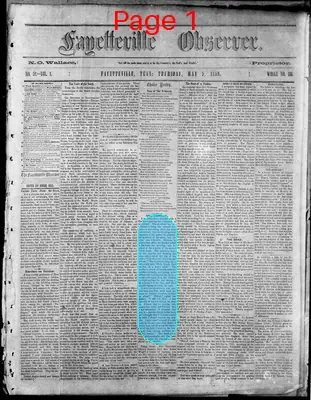
Story
May 5, 1859
Fayetteville Observer
Fayetteville, Lincoln County, Tennessee
What is this article about?
A merchant disputes an account with a Quaker, insults him, but is moved by the Quaker's meekness and learns self-control from his method of never raising his voice, mastering his temper.
Clipping
OCR Quality
98%
Excellent
Full Text
SELF-CONTROL.
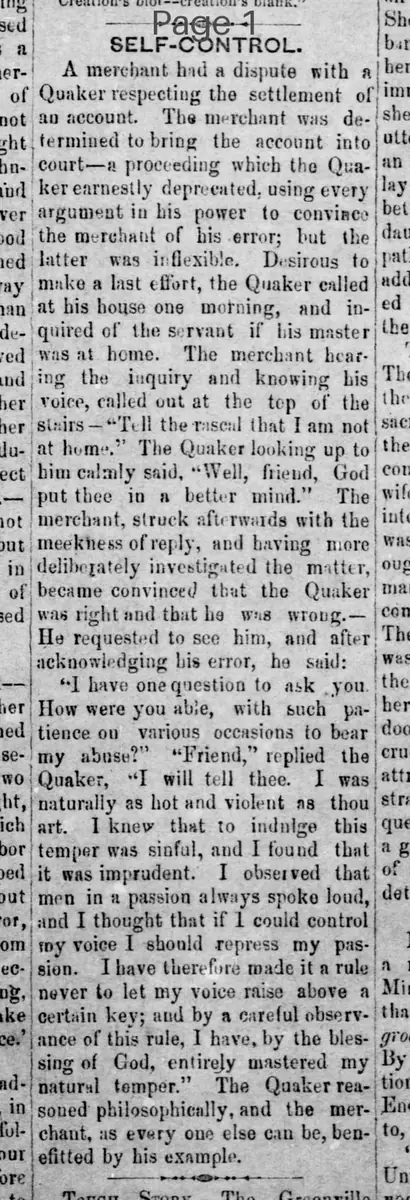
A merchant had a dispute with a Quaker respecting the settlement of an account. The merchant was determined to bring the account into court—a proceeding which the Quaker earnestly deprecated, using every argument in his power to convince the merchant of his error; but the latter was inflexible. Desirous to make a last effort, the Quaker called at his house one morning, and inquired of the servant if his master was at home. The merchant hearing the inquiry and knowing his voice, called out at the top of the stairs— "Tell the rascal that I am not at home." The Quaker looking up to him calmly said, "Well, friend, God put thee in a better mind." The merchant, struck afterwards with the meekness of reply, and having more deliberately investigated the matter, became convinced that the Quaker was right and that he was wrong. He requested to see him, and after acknowledging his error, he said: I have one question to ask you. How were you able, with such patience on various occasions to bear my abuse? "Friend," replied the Quaker, "I will tell thee. I was naturally as hot and violent as thou art. I knew that to indulge this temper was sinful, and I found that it was imprudent. I observed that men in a passion always spoke loud, and I thought that if I could control my voice I should repress my passion. I have therefore made it a rule never to let my voice raise above a certain key; and by a careful observance of this rule, I have, by the blessing of God, entirely mastered my natural temper." The Quaker reasoned philosophically, and the merchant, as every one else can be, benefitted by his example.
A merchant had a dispute with a Quaker respecting the settlement of an account. The merchant was determined to bring the account into court—a proceeding which the Quaker earnestly deprecated, using every argument in his power to convince the merchant of his error; but the latter was inflexible. Desirous to make a last effort, the Quaker called at his house one morning, and inquired of the servant if his master was at home. The merchant hearing the inquiry and knowing his voice, called out at the top of the stairs— "Tell the rascal that I am not at home." The Quaker looking up to him calmly said, "Well, friend, God put thee in a better mind." The merchant, struck afterwards with the meekness of reply, and having more deliberately investigated the matter, became convinced that the Quaker was right and that he was wrong. He requested to see him, and after acknowledging his error, he said: I have one question to ask you. How were you able, with such patience on various occasions to bear my abuse? "Friend," replied the Quaker, "I will tell thee. I was naturally as hot and violent as thou art. I knew that to indulge this temper was sinful, and I found that it was imprudent. I observed that men in a passion always spoke loud, and I thought that if I could control my voice I should repress my passion. I have therefore made it a rule never to let my voice raise above a certain key; and by a careful observance of this rule, I have, by the blessing of God, entirely mastered my natural temper." The Quaker reasoned philosophically, and the merchant, as every one else can be, benefitted by his example.
What sub-type of article is it?
Biography
Personal Triumph
What themes does it cover?
Moral Virtue
Bravery Heroism
What keywords are associated?
Self Control
Quaker
Merchant Dispute
Temper Mastery
Moral Lesson
What entities or persons were involved?
Merchant
Quaker
Where did it happen?
Merchant's House
Story Details
Key Persons
Merchant
Quaker
Location
Merchant's House
Story Details
Merchant insults Quaker during dispute but learns from Quaker's calm response and method of controlling temper by never raising voice, leading to merchant's change of heart and acknowledgment of error.