Thank you for visiting SNEWPapers!
Sign up free
The Enquirer
Richmond, Henrico County, Virginia
What is this article about?
French Minister Talleyrand's report to Napoleon details Russian aggression against the Ottoman Empire, including invasion of Moldavia and Wallachia, seizure of fortresses, and diplomatic deceptions amid Franco-Prussian tensions. Dated Warsaw, 28 Jan. 1807.
Clipping
OCR Quality
Full Text
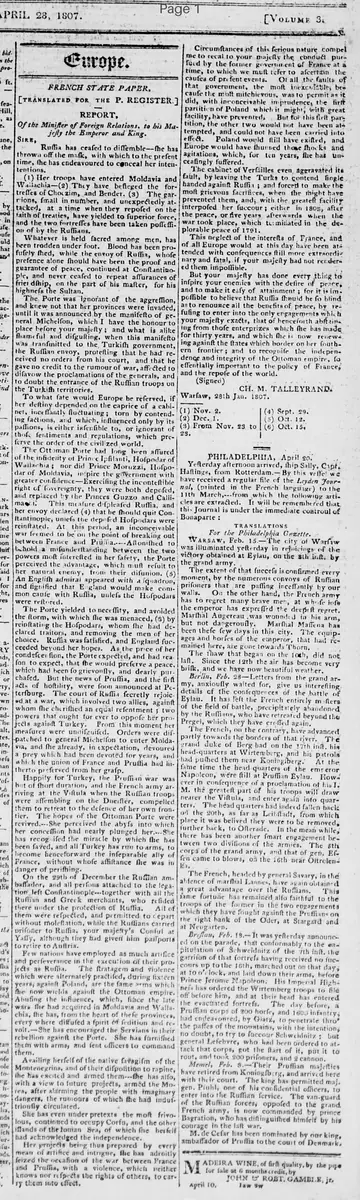
FRENCH STATE PAPER.
[translated for the P. Register.]
REPORT,
Of the Minister of Foreign Relations, to his Majesty the Emperor and King
Sire,
Russia has ceased to dissemble—she has thrown off the mask, with which to the present time, she has endeavoured to conceal her intentions.
(1) Her troops have entered Moldavia and Wallachia—(2) They have besieged the fortresses of Choczim, and Bender. (3) The garrisons, small in number, and unexpectedly attacked, at a time when they reposed on the faith of treaties, have yielded to superior force, and the two fortresses have been taken possession of by the Russians.
Whatever is held sacred among men, has been trodden under foot. Blood has been profusely shed, while the envoy of Russia, whose presence alone should have been the proof and guarantee of peace, continued at Constantinople, and never ceased to repeat assurances of friendship, on the part of his master, for his highness the Sultan.
The Porte was ignorant of the aggression, and knew not that her provinces were invaded, until it was announced by the manifesto of general Michelson, which I have the honour to place before your majesty: and what is alike shameful and disgusting. when this manifesto was transmitted to the Turkish government, the Russian envoy, protesting that he had received no orders from his court, and that he gave no credit to the rumour of war, affected to disavow the proclamations of the generals, and to doubt the entrance of the Russian troops on the Turkish territories.
To what fate would Europe be reserved, if her destiny depended on the caprice of a cabinet, incessantly fluctuating; torn by contending factions, and which, influenced only by its passions, is either insensible to, or ignorant of those sentiments and regulations, which preserve the order of the civilized world.
The Ottoman Porte had long been assured of the infidelity of Prince Ypsilanti, Hospodar of Wallachia; nor did Prince Moruzzi, Hospodar of Moldavia, inspire the government with greater confidence—Exercising the incontestable right of sovereignty, they were both deposed, and replaced by the Princes Ypsilanti and Callimachi.
This measure displeased Russia, and her envoy declared (4) that he should quit Constantinople, unless the deposed Hospodars were reinstated. At this period, an inconceivable war seemed to be on the point of breaking out between France and Prussia.—Astonished to behold a misunderstanding between the two powers most interested in her safety, the Porte perceived the advantage, which must result to her natural enemy, from their disunion. (5) An English admiral appeared with a squadron, and signified that England would make common cause with Russia, unless the Hospodars were restored.
The Porte yielded to necessity, and avoided the storm, with which she was menaced, (6) by reinstating the Hospodars, whom she had declared traitors, and removing the men of her choice. Russia was satisfied, and England succeeded beyond her hopes. As the price of her condescension, the Porte expected, and had reason to expect, that she would preserve a peace, which had been so grievously, and dearly purchased. But the news of Prussia, and the first acts of hostility, were soon announced at Petersburg. The court of Russia secretly rejoiced at a war, which involved two allies, against whom she cherished an equal resentment ; two powers that ought for ever to oppose her projects against Turkey. From this moment her measures were undisguised. Orders were dispatched to general Michelson to enter Moldavia, and she already, in expectation, devoured a prey which had been devoted for years, and which the union of France and Prussia had hitherto preserved from her grasp.
Happily for Turkey, the Prussian war was but of short duration, and the French army arriving at the Vistula when the Russian troops were assembling on the Dnieper, compelled them to retreat to the defence of her own frontier. The hopes of the Ottoman Porte were revived.—She perceived the abyss into which her concession had nearly plunged her.—She has recognized the miracle by which she has been saved, and all Turkey has run to arms, to become henceforward the inseparable ally of France, without whose assistance she was in danger of perishing.
On the 29th of December the Russian ambassador, and all persons attached to the legation left Constantinople—together with all the Russian and Greek merchants, who resided there under the protection of Russia. All of them were respected, and permitted to depart without molestation, while the Russians carried prisoner to Russia. your majesty's Consul at Yassy, although they had given him passports to retire to Austria.
Few nations have employed as much artifice and perseverance in the execution of their projects as Russia. The stratagem and violence which were alternately practised, during sixteen years, against Poland, are the same arms which she now wields against the Ottoman empire.
Abusing the influence, which, since the late wars she had acquired in Moldavia and Wallachia, she has, from the heart of these provinces, every where diffused a spirit of sedition and revolt.—She has encouraged the Servians in their rebellion against the Porte. She has furnished them with arms, and sent officers to command them.
Availing herself of the native savagism of the Montenegrins, and of their disposition to rapine, she has excited and armed them—she has also, with a view to future projects, armed the Morea, after alarming the people with imaginary dangers, the rumours of which she had industriously circulated.
She has even under pretexts the most frivolous, continued to occupy Corfu, and the other islands of the Ionian Sea, of which she herself had acknowledged the independence.
Her projects being thus prepared by every mean of artifice and intrigue, she has adroitly seized the occasion of the war between France and Prussia, with a violence, which neither knows nor respects the rights of others, to carry them into effect,
[Volume 3.
Circumstances of this serious nature compel me to recall to your majesty the conduct pursued by the former government of France at a time, to which we must refer to ascertain the causes of present events.
Of all the faults of that government, the most inexcusable, because the most mischievous. was to permit as it did, with inconceivable imprudence, the first partition of Poland which it might, with great facility, have prevented But for this first partition, the other two would not have been attempted, and could not have been carried into effect. Poland would still have existed, and Europe would have shunned those shocks and agitations, which, for ten years, she has unceasingly suffered.
The cabinet of Versailles even. aggravated its fault, by leaving the Turks to contend single handed against Russia ; and forced to make the most grievous sacrifices, when she might have prevented them, and;, with the greatest facility interposed her succour; either in 1774, after the peace, or nine years afterwards when the war took place, which terminated in the deplorable peace of 1791.
This neglect of the interests of France, and of all Europe would at this day have been attended with consequences still more extraordinary and fatal, if your majesty had not rendered them impossible.
But your majesty has done every thing to inspire your enemies with the desire of peace; and to make it easy of attainment : for it is impossible to believe that Russia should be so blind as to renounce all the benefits of peace, by refusing to enter into the only engagements which your majesty exacts, that of henceforth abstaining from those enterprizes which she has made for thirty years, and which she is now renewing against the states which border on her southern frontier; and to recognize the independence and integrity of the Ottoman empire, so essentially important to the policy of France, and the repose of the world.
(Signed)
CH. M. TALLEYRAND,
Warsaw, 28th Jan. 1807.
(1) Nov. 2.
(4) Sept. 29.
(3) Dec. 1.
(5) Oct. 12.
(3) From Nov. 23 to
(6) Oct. 15,
28.
What sub-type of article is it?
What keywords are associated?
What entities or persons were involved?
Where did it happen?
Foreign News Details
Primary Location
Ottoman Empire
Event Date
28th Jan. 1807
Key Persons
Outcome
russian troops entered moldavia and wallachia, besieged and captured fortresses of choczim and bender; blood profusely shed; ottoman porte reinstated hospodars under pressure; russian ambassador left constantinople on 29th december.
Event Details
Report details Russian invasion of Ottoman provinces Moldavia and Wallachia, seizure of fortresses despite diplomatic assurances; historical context of Hospodar depositions, Franco-Prussian war influence, Russian intrigues in Balkans and Ionian islands; calls for recognition of Ottoman integrity.