Thank you for visiting SNEWPapers!
Sign up free
Constitutional Whig
Richmond, Virginia
What is this article about?
A citizen critiques Rep. William McCreery's report supporting petitions to stop Sunday mail delivery, arguing it blends religious and civil affairs, violates constitutional separation of church and state, and sets a dangerous precedent for government actions based on religious beliefs.
Clipping
OCR Quality
Full Text
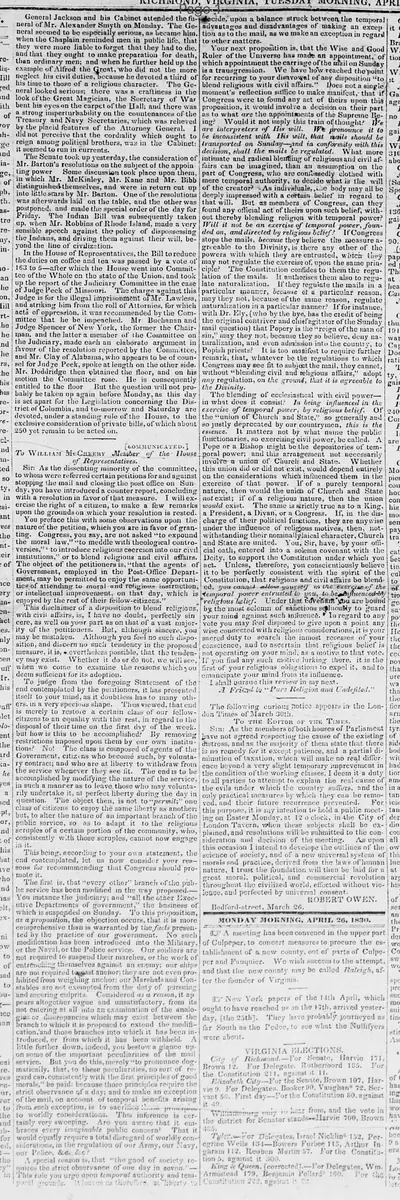
To WILLIAM McCREERY, Member of the House of Representatives.
Sir: As the dissenting minority of the committee, to whom were referred certain petitions for and against stopping the mail and closing the post office on Sunday, you have introduced a counter report, concluding with a resolution in favor of that measure. I will exercise the right of a citizen, to make a few remarks upon the grounds on which your resolution is rested.
You preface this with some observations upon the nature of the petition, which you are in favor of granting. Congress, you say, are not asked "to expound the moral law," "to meddle with theological controversies," "to introduce religious coercion into our civil institutions," or to blend religious and civil affairs. The object of the petitioners is, "that the agents of Government, employed in the Post-Office Department, may be permitted to enjoy the same opportunities of attending to moral and religious instruction, or intellectual improvement, on that day, which is enjoyed by the rest of their fellow-citizens."
This disclaimer of a disposition to blend religious with civil affairs, is, I have no doubt, perfectly sincere, as well on your part as on that of a vast majority of the petitioners. But, although sincere, you may be mistaken. Although you feel no such disposition, and discern no such tendency in the proposed measure, it is, nevertheless possible, that the tendency may exist. Whether it do or do not, we will see, when we come to examine the reasons which you deem sufficient for its adoption.
To judge from the foregoing Statement of the end contemplated by the petitioners, it has presented itself to your mind, as it doubtless has to many others, in a very specious shape. Thus viewed, that end is merely to restore a certain class of our fellow-citizens to an equality with the rest, in regard to the disposal of their time on the first day of the week. But how is this to be accomplished? By removing restrictions imposed upon them by our own institutions? No! The class is composed of agents of the Government, citizens who become such, by voluntary contract; and who are at liberty to withdraw from the service whenever they see fit. The end is to be accomplished by modifying the nature of the service, in such a manner as to leave those who may voluntarily undertake it, at perfect liberty during the day in question. The object then, is not to "permit" one class of citizens to enjoy the same liberty as another; but, to alter the nature of an important branch of the public service, so as to adapt it to the religious scruples of a certain portion of the community, who, consistently with those scruples, cannot now engage in it.
This being, according to your own statement, the end contemplated, let us now consider your reasons for recommending that Congress should promote it.
The first is, that "every other" branch of the public service has been modified in the way proposed. You instance the judiciary; and "all the other Executive Departments of government," the business of which is suspended on Sunday. To this proposition, as a proposition, the objection occurs, that it is more comprehensive than is warranted by the facts presented by the practice of our government. No such modification has been introduced into the Military, or the Naval, or the Police service. Our soldiers are not required to suspend their marches, or the work of entrenching themselves against an enemy; our ships are not required to cast anchor; they are not even prohibited from weighing anchor; our Marshals and Constables are not exempted from the duty of pursuing and securing culprits. Considered as a reason, it appears altogether vague and unsatisfactory, from its not entering at all into an examination of the analogies or discrepancies which may exist between the branch to which it is proposed to extend the modification, and those branches into which it has been introduced, or from which it has been withheld. A little further down, indeed, you bestow a glance upon some of the important peculiarities of the mail service. But you do this, merely "to pronounce dogmatically, that, to these peculiarities, no sort of regard can, consistently with the first principles of good morals," be paid: because those principles require the strict observance of a day: and to make an exception of the mail, on account of temporal benefits arising from such exception, is to sacrifice it to worldly considerations. This inference is certainly very sweeping. Are you aware that it embraces every imaginable public concern? That it would equally require a total disregard of worldly considerations, in the regulation of our Army, our Navy, our Police, &c. &c?
A special reason is, that "the good of society requires the strict observance of one day in seven." This rule you urge upon temporal authority and temporal grounds. Thus say us therefore, at least, to decide, upon a balance struck between the temporal advantages and disadvantages of making an exception as to the mail, as we make an exception in regard to other matters.
Your next proposition is, that the Wise and Good Ruler of the Universe has made an appointment, of which appointment the carriage of the mail on Sunday is a transgression. We have now reached the point for recurring to your disavowal of any disposition "to blend religious with civil affairs." Does not a single moment's reflection suffice to make manifest, that if Congress were to found any act of theirs upon this proposition, it would involve a decision on their part as to what are the appointments of the Supreme Being? Would it not imply this train of thought? We are interpreters of His will. We pronounce it to be inconsistent with His will, that mails should be transported on Sunday—and in conformity with this decision, shall the mails be regulated. What more intimate and radical blending of religious and civil affairs can be imagined, than an assumption on the part of Congress, who are confessedly clothed with mere temporal authority, to decide what is the will of the creator? As individuals, the body may all be deeply impressed with a certain belief in regard to that will. But as members of Congress, can they found any official act of theirs upon such belief, without thereby blending religion with temporal power? Will it not be an exercise of temporal power, founded on, and directed by religious belief? If Congress stops the mails, because they believe the measure agreeable to the Divinity, is there any other of the powers with which they are entrusted, which they may not regulate the exercise of, upon the same principle? The Constitution confides to them the regulation of the mails. It authorises them also to regulate naturalization. If they regulate the mails in a particular manner, because of a particular reason, may they not, because of the same reason, regulate naturalization in a particular manner? If for instance, with Dr. Ely, (who by the bye, has the credit of being the original contriver and chief agitator of the Sunday mail question) that Popery is the "reign of the man of sin," may they not, because they so believe, deny naturalization, and even admission into the country, to Popish priests? It is too manifest to require further remark, that, whatever be the regulations to which Congress may see fit to subject the mail, they cannot, without "blending civil and religious affairs," adopt any regulation, on the ground, that it is agreeable to the Divinity.
The blending of ecclesiastical with civil power—in what does it consist? In being influenced in the exercise of temporal power, by religious belief. Of the "union of Church and State," so generally and so justly deprecated by our countrymen, this is the essence. It matters not by what name the public functionaries, so exercising civil power, be called. A Pope or a Bishop might be the depositories of temporal power; and this arrangement not necessarily involve a union of Church and State. Whether this union did or did not exist, would depend entirely on the considerations which influenced them in the exercise of that power. If of a purely temporal nature, then would the union of Church and State not exist; if of a religious nature, then the union would exist. The same is strictly true as to a King, a President, a Divan, or a Congress. If, in the discharge of their political functions, they are anywise under the influence of religious motives, then, notwithstanding their nominally laical character, Church and State are united. You, Sir, have, by your official oath, entered into a solemn covenant with the Deity, to support the Constitution under which you act. Unless, therefore, you conscientiously believe it to be perfectly consistent with the spirit of the Constitution, that religious and civil affairs be blended, you cannot allow yourself in the exercise of the temporal power entrusted to you, to be influenced by religious belief. Under that covenant you are bound by the most solemn of sanctions seriously to guard your mind against such influence. In regard to any vote you may feel disposed to give upon a point anywise connected with religious considerations, it is your sacred duty to search the inmost recesses of your conscience, and to ascertain that religious belief is not operating on your mind, as a motive to that vote. If you find any such motive lurking there, it is the first of your religious obligations to expel it, and to emancipate your mind from its influence.
I shall pursue this review in my next.
A Friend to "Pure Religion and Undefiled."
What sub-type of article is it?
What themes does it cover?
What keywords are associated?
What entities or persons were involved?
Letter to Editor Details
Author
A Friend To "Pure Religion And Undefiled."
Recipient
William Mccreery, Member Of The House Of Representatives.
Main Argument
the proposed resolution to stop mail on sundays improperly blends religious and civil affairs by allowing congress to base legislation on religious beliefs, violating the constitution's separation of church and state and potentially justifying other religiously motivated policies.
Notable Details