Thank you for visiting SNEWPapers!
Sign up free
Buckeye Valley News And Buckeye Review
Buckeye, Maricopa County, Arizona
What is this article about?
Article describes Washington, D.C.'s diverse attractions for visitors, including famous residents like Andrew Mellon, government information services, natural woodlands with wildlife, Rock Creek Park, National Zoo, botanic garden, and outdoor sports facilities, emphasizing the city's spaciousness and unspoiled nature.
Clipping
OCR Quality
Full Text
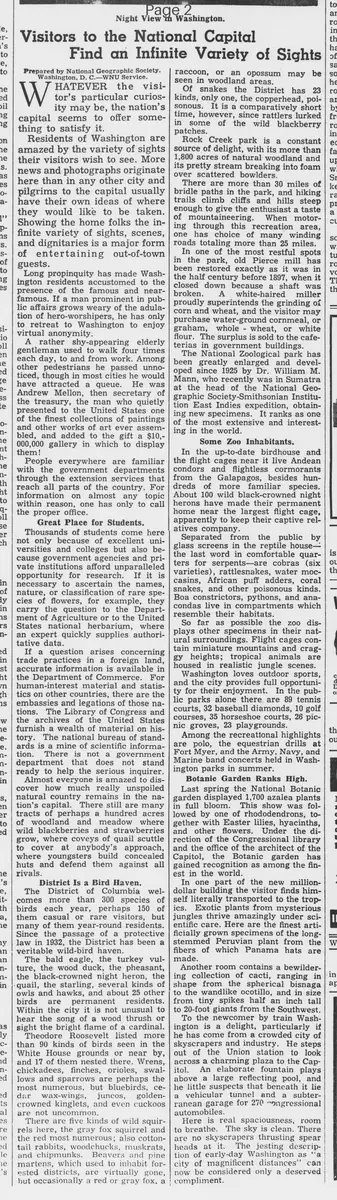
Visitors to the National Capital Find an Infinite Variety of Sights
Prepared by National Geographic Society. Washington, D. C.-WNU Service.
Whatever the visitor's particular curiosity may be, the nation's capital seems to offer something to satisfy it. Residents of Washington are amazed by the variety of sights their visitors wish to see. More news and photographs originate here than in any other city and pilgrims to the capital usually have their own ideas of where they would like to be taken.
Showing the home folks the infinite variety of sights, scenes, and dignitaries is a major form of entertaining out-of-town guests.
Long propinquity has made Washington residents accustomed to the presence of the famous and near-famous. If a man prominent in public affairs grows weary of the adulation of hero-worshipers, he has only to retreat to Washington to enjoy virtual anonymity.
A rather shy-appearing elderly gentleman used to walk four times each day, to and from work. Among other pedestrians he passed unnoticed, though in most cities he would have attracted a queue. He was Andrew Mellon, then secretary of the treasury, the man who quietly presented to the United States one of the finest collections of paintings and other works of art ever assembled, and added to the gift a $10,000,000 gallery in which to display them!
People everywhere are familiar with the government departments through the extension services that reach all parts of the country. For information on almost any topic within reason, one has only to call the proper office.
Great Place for Students.
Thousands of students come here not only because of excellent universities and colleges but also because government agencies and private institutions afford unparalleled opportunity for research. If it is necessary to ascertain the names, nature, or classification of rare species of flowers, for example, they carry the question to the Department of Agriculture or to the United States national herbarium, where an expert quickly supplies authoritative data.
If a question arises concerning trade practices in a foreign land, accurate information is available in the Department of Commerce. For human-interest material and statistics on other countries, there are the embassies and legations of those nations. The Library of Congress and the archives of the United States furnish a wealth of material on history. The national bureau of standards is a mine of scientific information. There is not a government department that does not stand ready to help the serious inquirer.
Almost everyone is amazed to discover how much really unspoiled natural country remains in the nation's capital. There still are many tracts of perhaps a hundred acres of woodland and meadow where wild blackberries and strawberries grow, where coveys of quail scuttle to cover at anybody's approach, where youngsters build concealed huts and defend them against all rivals.
District Is a Bird Haven.
The District of Columbia welcomes more than 300 species of birds each year, perhaps 150 of them casual or rare visitors, but many of them year-round residents. Since the passage of a protective law in 1932, the District has been a veritable wild-bird haven.
The bald eagle, the turkey vulture, the wood duck, the pheasant, the black-crowned night heron, the quail, the starling, several kinds of owls and hawks, and about 25 other birds are permanent residents.
Within the city it is not unusual to hear the song of a wood thrush or sight the bright flame of a cardinal. Theodore Roosevelt listed more than 90 kinds of birds seen in the White House grounds or near by, and 17 of them nested there. Wrens, chickadees, finches, orioles, swallows and sparrows are perhaps the most numerous, but bluebirds, cedar wax-wings, juncos, golden-crowned kinglets, and even cuckoos are not uncommon.
There are five kinds of wild squirrels here, the gray fox squirrel and the red most numerous; also cottontail rabbits, woodchucks, muskrats, and chipmunks. Beavers and pine martens, which used to inhabit forested districts, are virtually gone, but occasionally a red or gray fox, a raccoon, or an opossum may be seen in woodland areas.
Of snakes the District has 23 kinds, only one, the copperhead, poisonous. It is a comparatively short time, however, since rattlers lurked in some of the wild blackberry patches.
Rock Creek park is a constant source of delight, with its more than 1,800 acres of natural woodland and its pretty stream breaking into foam over scattered bowlders.
There are more than 30 miles of bridle paths in the park, and hiking trails climb cliffs and hills steep enough to give the enthusiast a taste of mountaineering.
When motoring through this recreation area, one has choice of many winding roads totaling more than 25 miles.
In one of the most restful spots in the park, old Pierce mill has been restored exactly as it was in the half century before 1897, when it closed down because a shaft was broken.
A white-haired miller proudly superintends the grinding of corn and wheat, and the visitor may purchase water-ground cornmeal, or graham, whole-wheat, or white flour. The surplus is sold to the cafeterias in government buildings.
The National Zoological park has been greatly enlarged and developed since 1925 by Dr. William M. Mann, who recently was in Sumatra at the head of the National Geographic Society-Smithsonian Institution East Indies expedition, obtaining new specimens. It ranks as one of the most extensive and interesting in the world.
Some Zoo Inhabitants.
In the up-to-date birdhouse and the flight cages near it live Andean condors and flightless cormorants from the Galapagos, besides hundreds of more familiar species.
About 100 wild black-crowned night herons have made their permanent home near the largest flight cage, apparently to keep their captive relatives company.
Separated from the public by glass screens in the reptile house the last word in comfortable quarters for serpents-are cobras (six varieties), rattlesnakes, water moccasins, African puff adders, coral snakes, and other poisonous kinds.
Boa constrictors, pythons, and anacondas live in compartments which resemble their habitats.
So far as possible the zoo displays other specimens in their natural surroundings. Flight cages contain miniature mountains and craggy heights; tropical animals are housed in realistic jungle scenes.
Washington loves outdoor sports, and the city provides full opportunity for their enjoyment. In the public parks alone there are 89 tennis courts, 32 baseball diamonds, 10 golf courses, 35 horseshoe courts, 26 picnic groves, 23 playgrounds.
Among the recreational highlights are polo, the equestrian drills at Fort Myer, and the Army, Navy, and Marine band concerts held in Washington parks in summer.
Botanic Garden Ranks High.
Last spring the National Botanic garden displayed 1,700 azalea plants in full bloom. This show was followed by one of rhododendrons, together with Easter lilies, hyacinths, and other flowers. Under the direction of the Congressional library and the office of the architect of the Capitol, the Botanic garden has gained recognition as among the finest in the world.
In one part of the new million-dollar building the visitor finds himself literally transported to the tropics. Exotic plants from mysterious jungles thrive amazingly under scientific care. Here are the finest artificially grown specimens of the long-stemmed Peruvian plant from the fibers of which Panama hats are made.
Another room contains a bewildering collection of cacti, ranging in shape from the spherical bisnaga to the wandlike ocotillo, and in size from tiny spikes half an inch tall to 20-foot giants from the Southwest.
To the newcomer by train Washington is a delight, particularly if he has come from a crowded city of skyscrapers and industry. He steps out of the Union station to look across a charming plaza to the Capitol. An elaborate fountain plays above a large reflecting pool, and he little suspects that beneath it lie a vehicular tunnel and a subterranean garage for 270 congressional automobiles.
Here is real spaciousness, room to breathe. The sky is clean. There are no skyscrapers thrusting spear heads at it. The jesting description of early-day Washington as "a city of magnificent distances" can now be considered only a deserved compliment.
What sub-type of article is it?
What themes does it cover?
What keywords are associated?
What entities or persons were involved?
Where did it happen?
Story Details
Key Persons
Location
Washington, D.C.
Story Details
Descriptive article highlighting the variety of sights, natural areas, wildlife, government resources, parks, zoo, and recreational opportunities in Washington, D.C., for visitors and residents, including anecdotes about prominent figures and specific attractions like Rock Creek Park and the National Zoo.