Thank you for visiting SNEWPapers!
Sign up free
The Enquirer
Richmond, Henrico County, Virginia
What is this article about?
Bell's Weekly Messenger discusses the recently concluded American treaty, emphasizing its concessions on neutral rights while preserving Britain's core maritime rights like search, contraband, and blockade, amid the war with France where American ships carry French commerce.
Clipping
OCR Quality
Full Text
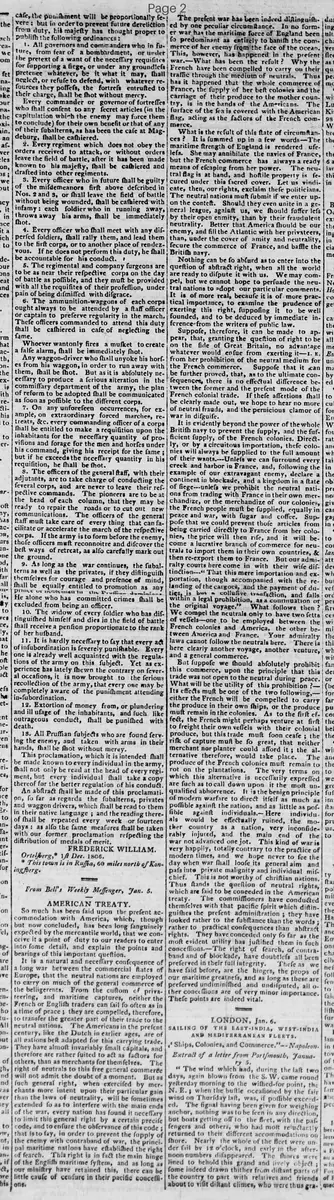
AMERICAN TREATY.
So much has been said upon the present accommodation with America, which, though but now concluded, has been long sanguinely expected by the mercantile world, that we conceive it a point of duty to our readers to enter into some detail, and explain the points and bearings of this important question.
It is a natural and necessary consequence of a long war between the commercial states of Europe, that the neutral nations are employed to carry on much of the general commerce of the belligerents. From the custom of privateering, and maritime captures, neither the French or English traders can sail so often as in a time of peace; they are compelled, therefore, to transfer the greater part of their trade to the neutral nations. The Americans in the present century, like the Dutch in earlier ages, are of all nations best adapted for this carrying trade. They have almost invariably small capitals, and therefore are rather suited to act as factors for others, than as merchants for themselves. The right of neutrals to this free general commerce will not admit the doubt of a moment. But as such general right, when exercised by merchants more intent upon their particular gain than the laws of neutrality, will be sometimes extended so as to interfere with the main ends of the war, every nation has found it necessary to limit this general right by a certain precise code, and to ensure the observance of this code; that is to say, in order to prevent the supply of the enemy with contraband of war, the principal maritime nations have established the right of search. This right is in fact the main hinge of the English maritime system, and as long as our ministry have retained this, there can be little cause of censure in their pacific concessions.
The present war has been indeed distinguished by one peculiar circumstance. In no former war has the maritime force of England been so predominant as entirely to banish the commerce of her enemy from the face of the ocean. This, however, has happened in the present war. What has been the result? Why the French have been compelled to carry on their traffic through the medium of neutrals. Thus has it happened that the whole commerce of France, the supply of her best colonies and the carriage of their produce to the mother country, is in the hands of the Americans. The surface of the sea is covered with the American flag, acting as the carriers of the French commerce.
What is the result of this state of circumstances? It is summed up in a few words--The maritime strength of England is rendered useless. She may annihilate the navies of France, but the French commerce has always a ready means of escaping from her power. The neutral flag is at hand, and hostile property is secured under this sacred cover. 'Let us vindicate, then, our rights,' exclaim these politicians. 'The neutral nations must submit if we enter upon the contest. Should they even unite in a general league, against us, we should suffer less by their open enmity, than by their fraudulent neutrality. Better that America should be our enemy, and fill the Atlantic with her privateers, than, under the cover of amity and neutrality, secure the commerce of France, and baffle the British navy.'
Nothing can be so absurd as to enter into the question of abstract right, when all the world are ready to dispute it with us. We may compel, but we cannot hope to persuade the neutral nations to adopt our particular comments. It is of more real, because it is of more practical importance, to examine the prudence of exerting this right, supposing it to be well founded, and to be deduced by immediate inference from the writers of public law.
Suppose, therefore, it can be made to appear, that, granting the question of right to be on the side of Great Britain, no advantage whatever would ensue from exerting it--i.e. from her prohibition of the neutral medium for the French commerce. Suppose that it can be further proved, that, as to the ultimate consequences, there is no effectual difference between the former and the present mode of the French colonial trade. If these assertions shall be clearly made out, we hope to hear no more of neutral frauds, and the pernicious clamor of war in disguise.
It is evidently beyond the power of the whole British navy to prevent the supply, and the sufficient supply, of the French colonies. Directly, or by a circuitous importation, these colonies will always be supplied to the full amount of their wants. Unless we can surround every creek and harbor in France, and, following the example of our extravagant enemy, declare a continent in blockade, and a kingdom in a state of siege--unless we prohibit the neutral nations from trading with France in their own merchandise, or the merchandise of our colonies, the French people must be supplied, equally in peace and war, with sugar and coffee. Suppose that we could prevent those articles from being carried directly to France from her colonies, the price will then rise, and it will become a lucrative branch of commerce for neutrals to import them in their own countries, and then re-export them to France. But our admiralty courts here come in with their wise distinction--'That this mere importation and exportation, though accompanied with the relanding of the cargoes, and the payment of duties, is but a collusive transaction, and falls within a legal prohibition, as a continuation of the original voyage.'
What follows then?
We compel the neutrals only to have two sets of vessels--one to be employed between the French colonies and America, the other between America and France. Your admiralty laws cannot follow the neutrals here. There is here clearly another voyage, another venture, and a general commerce.
But suppose we should absolutely prohibit this commerce, upon the principle that this trade was not open to the neutral during peace. What will be the utility of this prohibition?--Its effects must be one of the two following,--either the French will be compelled to carry the produce in their own ships, or the produce must remain in the colonies. As to the first effect, the French might perhaps venture at first to freight their own vessels with their colonial produce, but this trade must soon cease; the risk of capture must be so great, that neither merchant nor planter could afford it; the alternative therefore, would take place. The produce of the French colonies must remain to rot on the plantations. The very terms on which this alternative is necessarily expressed are such as to call down upon it the most unqualified abhorrence. It is the benign principle of modern warfare to direct itself as much as possible against the nation, and as little as possible against individuals. Here individuals would be effectually ruined, the mother country as a nation, very inconsequently injured, and the main end of the war not advanced one jot. This kind of war is very happily, totally contrary to the practice of modern times, and we hope never to see the day when war shall lose its general aim and pass into private malignity and individual mischief. This is not worthy of christian nations.
Thus stands the question of neutral rights, which are said to be conceded in the American treaty. The commissioners have conducted themselves with that pacific spirit which distinguishes the present administration; they have looked rather to the substance than the words; rather to practical consequences than abstract rights. They have conceded only so far as the most evident utility has justified them in such concessions. The right of search, of contraband and of blockade, have doubtless all been preserved in their full integrity. These as we have said before, are the hinges, the props of our maritime greatness, and as long as these are preserved undiminished and undisputed, all other concessions are of very minor importance. These points are indeed vital.
What sub-type of article is it?
What keywords are associated?
Where did it happen?
Foreign News Details
Primary Location
America
Event Date
Recently Concluded, As Of Jan. 5
Outcome
concessions on neutral rights while preserving britain's rights of search, contraband, and blockade; american ships continue carrying french commerce under neutral flag.
Event Details
The article analyzes the American treaty's implications for neutral trade during the Anglo-French war, arguing that enforcing strict neutral rights would not benefit Britain and that the treaty wisely concedes on abstract rights but retains core maritime privileges, preventing effective blockade of French colonial trade via American intermediaries.