Thank you for visiting SNEWPapers!
Sign up free
Gazette Of The United States
New York, New York County, New York
What is this article about?
In February 1789, French provincial assemblies in Saintonge, Angoumois, and Roussillon saw clergy and nobility renounce tax privileges to share burdens with the third estate. The Duke of Orleans instructed representatives on liberties, press freedom, property rights, taxation consent, and ministerial responsibility ahead of the States-General.
Clipping
OCR Quality
Full Text
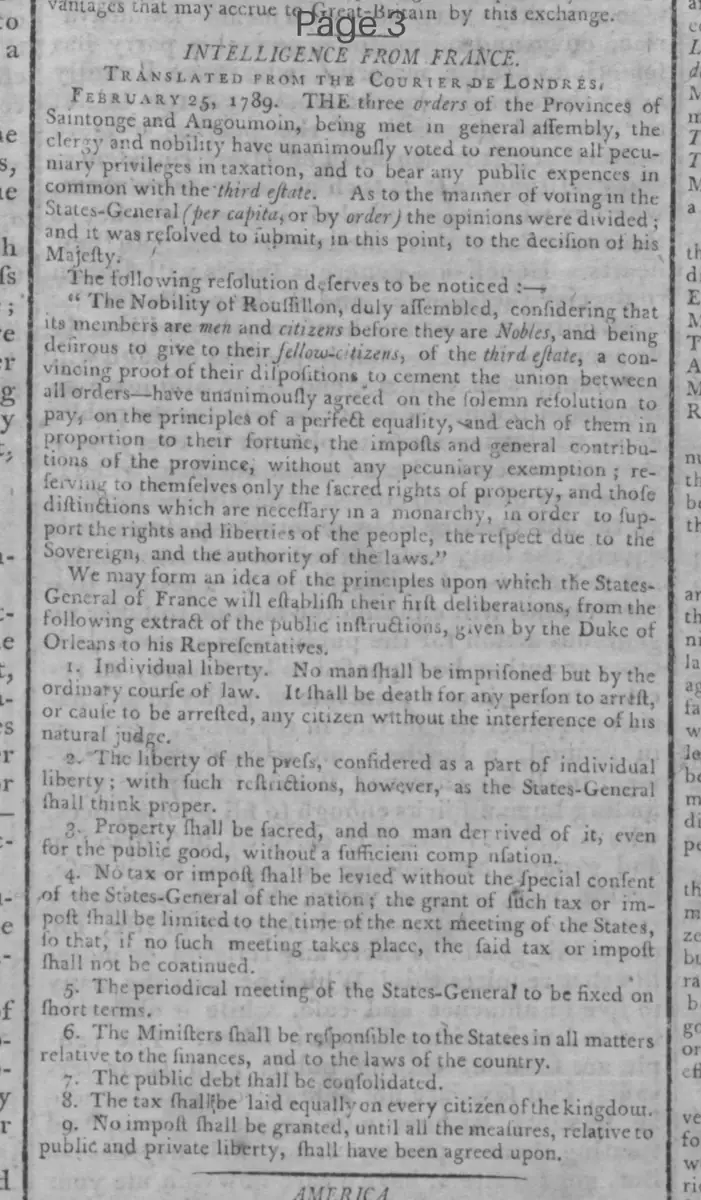
Translated from the Courier de Londres
FEBRUARY 25, 1789. THE three orders of the Provinces of Saintonge and Angoumois, being met in general assembly, the clergy and nobility have unanimously voted to renounce all pecuniary privileges in taxation, and to bear any public expenses in common with the third estate. "As to the manner of voting in the States-General (per capita, or by order) the opinions were divided; and it was resolved to submit, in this point, to the decision of his Majesty."
The following resolution deserves to be noticed:
" The Nobility of Roussillon, duly assembled, considering that its members are men and citizens before they are Nobles, and being desirous to give to their fellow-citizens, of the third estate, a convincing proof of their dispositions to cement the union between all orders—have unanimously agreed on the solemn resolution to pay, on the principles of a perfect equality, and each of them in proportion to their fortune, the im posts and general contributions of the province, without any pecuniary exemption; reserving to themselves only the sacred rights of property, and those distinctions which are necessary in a monarchy, in order to support the rights and liberties of the people, the respect due to the Sovereign, and the authority of the laws."
We may form an idea of the principles upon which the States-General of France will establish their first deliberations, from the following extract of the public instructions, given by the Duke of Orleans to his Representatives.
I. Individual liberty. No man shall be imprisoned but by the ordinary course of law. It shall be death for any person to arrest, or cause to be arrested, any citizen without the interference of his natural judge.
2. The liberty of the press, considered as a part of individual liberty; with such restrictions, however, as the States-General shall think proper.
3. Property shall be sacred, and no man deprived of it, even for the public good, without a sufficient compensation.
4. No tax or impost shall be levied without the special consent of the States-General of the nation; the grant of such tax or impost shall be limited to the time of the next meeting of the States, so that, if no such meeting takes place, the said tax or impost shall not be continued.
5. The periodical meeting of the States-General to be fixed on short terms.
6. The Ministers shall be responsible to the States in all matters relative to the finances, and to the laws of the country.
7. The public debt shall be consolidated.
8. The tax shall be laid equally on every citizen of the kingdom.
9. No impost shall be granted, until all the measures, relative to public and private liberty, shall have been agreed upon.
What sub-type of article is it?
What keywords are associated?
What entities or persons were involved?
Where did it happen?
Foreign News Details
Primary Location
France
Event Date
February 25, 1789
Key Persons
Outcome
clergy and nobility in saintonge, angoumois, and roussillon unanimously renounce pecuniary tax privileges to share expenses equally with the third estate; voting manner in states-general deferred to the king; duke of orleans' instructions outline principles for liberties, taxation, and governance.
Event Details
Assemblies of the three orders in Saintonge and Angoumois vote to renounce tax privileges and share public expenses with the third estate, deferring States-General voting method to the king. Nobility of Roussillon resolves to pay taxes equally without exemptions, reserving property rights and monarchical distinctions. Extract from Duke of Orleans' instructions to representatives covers individual liberty, press freedom, sacred property, taxation by States-General consent, periodic meetings, ministerial responsibility, debt consolidation, equal taxation, and prioritizing liberties before imposts.