Thank you for visiting SNEWPapers!
Sign up free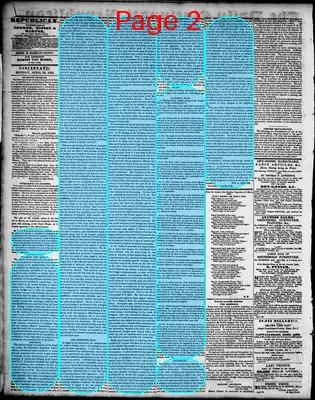
The Daily Cincinnati Republican, And Commercial Register
Cincinnati, Hamilton County, Ohio
What is this article about?
Wm. A. Harper introduces himself as a new proprietor of the Republican newspaper, shares his republican political principles rooted in Revolutionary War stories from his grandfather, expresses general support for Andrew Jackson's administration with criticisms of the Postmaster General and opposition to the U.S. Bank while proposing a state-owned national bank alternative, and praises Cincinnati's potential as a publishing and business hub. Dated April 20, 1835.
Merged-components note: These sequential components form a single coherent editorial section, including an introduction and Wm. A. Harper's extended piece on politics, banking, and Cincinnati.
Clipping
OCR Quality
Full Text
SPEAKING FOR MYSELF
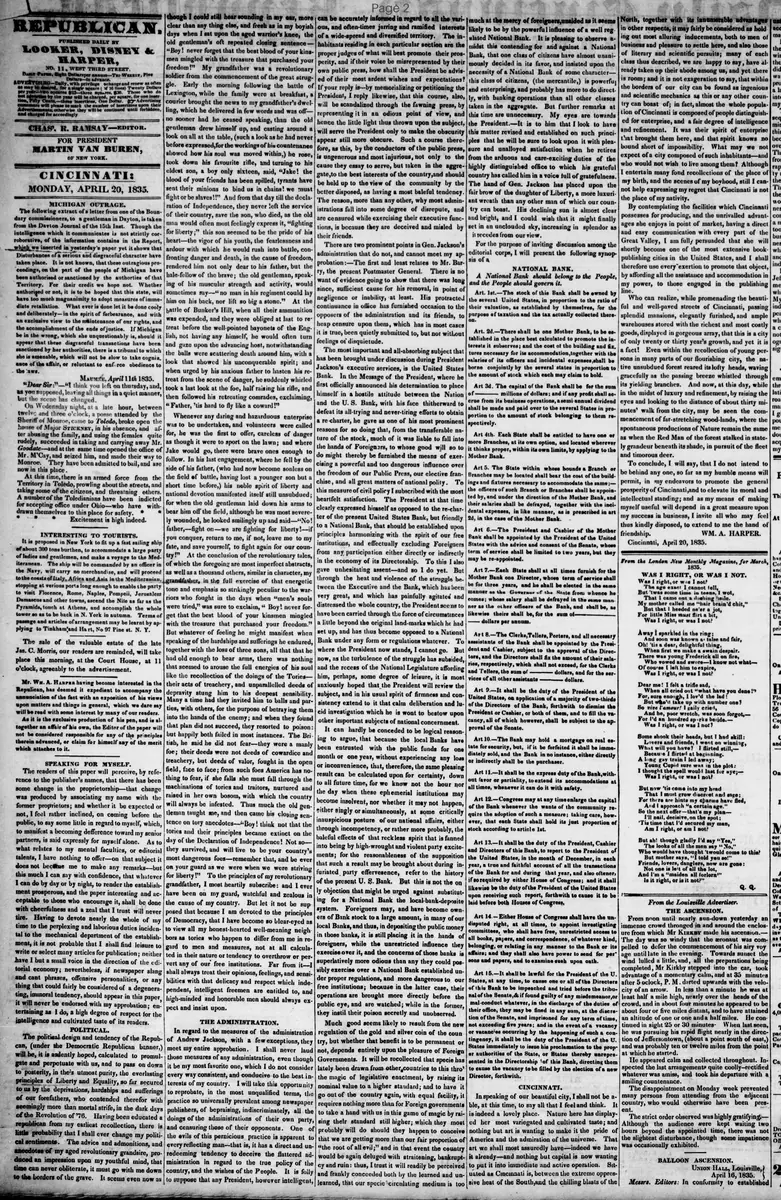
The readers of this paper will perceive, by reference to the publisher's names, that there has been some change in the proprietorship—that change was produced by associating my name with the former proprietors; and whether it be expected or not, I feel rather inclined, on coming before the public, to say some little in regard to myself, which, to manifest a becoming deference toward my senior partners, is said expressly for myself alone. As to what relates to my mental faculties, or editorial talents, I have nothing to offer—on that subject it does not become me to make any remarks—but this much I can say with confidence, that whatever I can do by day or by night, to render the establishment prosperous, and the paper interesting and acceptable to those who encourage it, shall be done with cheerfulness and a zeal that I trust will never tire. Having to devote nearly the whole of my time to the perplexing and laborious duties incidental to the mechanical department of the establishment, it is not probable that I shall find leisure to write or select many articles for publication; neither have I but a small voice in the direction of the editorial economy; nevertheless, if newspaper slang and cant phrases, offensive personalities, or anything that could fairly be considered of a degenerating, immoral tendency, should appear in this paper, it will never be endorsed with my approbation; entertaining as I do, a high degree of respect for the intelligence and cultivated taste of its readers.
POLITICAL.
The political design and tendency of the Republican, (under the Democratic Republican banner,) will be, it is ardently hoped, calculated to promulgate and perpetuate with us, and to pass on down to posterity, in its utmost purity, the everlasting principles of Liberty and Equality, so far secured to us by the deprivations, hardships and sufferings of our forefathers, who contended therefor with seemingly more than mortal strife, in the dark days of the Revolution of '76. Having been educated a republican from my earliest recollection, there is little probability that I shall ever change my political sentiments. The advice and admonitions, and anecdotes of my aged revolutionary grandsire, produced an impression upon my youthful mind, that time can never obliterate, it must go with me down to the borders of the grave. It seems even now as though I could still hear sounding in my ear, more clear than anything else, and fresh as in my boyish days when I sat upon the aged warrior's knee, the old gentleman's oft repeated closing sentence—
"Boy! never forget that the best blood of your kinsmen mingled with the treasure that purchased your freedom!"
My grandfather was a revolutionary soldier from the commencement of the great struggle. Early the morning following the battle of Lexington, while the family were at breakfast, a courier brought the news to my grandfather's dwelling, which he delivered in few words and was off—no sooner had he ceased speaking, than the old gentleman drew himself up, and casting around a look on all at the table, (such a look as he had never before expressed, for the workings of his countenance showed how his soul was moved within,) he rose, took down his favourite rifle, and turning to his eldest son, a boy only sixteen, said, "Jake! the blood of your friends has been spilled, tyrants have sent their minions to bind us in chains! we must fight or be slaves!!" And from that day till the declaration of Independence, they never left the service of their country, save the son, who died, as the old man would often most feelingly express it, "fighting for liberty;" this son seemed to be the pride of his heart—the vigor of his youth, the fearlessness and ardour with which he would rush into battle, confronting danger and death, in the cause of freedom rendered him not only dear to his father, but the hale-fellow of the brave; the old gentleman, speaking of his muscular strength and activity, would sometimes say—“no man in his regiment could lay him on his back, nor lift so big a stone." At the battle of Bunker's Hill, when all their ammunition was expended, and they were obliged at last to retreat before the well-pointed bayonets of the English, not having any himself, he would often turn and gaze upon the advancing host, notwithstanding the balls were scattering death around him, with a look that showed his unconquerable spirit; and when urged by his anxious father to hasten his retreat from the scene of danger, he suddenly whirled took a last look at the foe, half raising his rifle, and then followed his retreating comrades, exclaiming "Father, 'tis hard to fly like a coward!"
Whenever any daring and hazardous enterprise was to be undertaken, and volunteers were called for, he was the first to offer, careless of danger as though it were to sport on the lawn; and where Jake would go, there were brave ones enough to follow. In his last engagement, where he fell by the side of his father, (who had now become sonless on the field of battle, having lost a younger son but a short time before,) his noble spirit of liberty and national devotion manifested itself still unsubdued: for when the old gentleman laid down his arms to bear him off the field, although he was most severely wounded, he looked smilingly up and said—“No! father,—fight on—we are fighting for liberty!—if you conquer, return to me, if not, leave me to my fate, and save yourself, to fight again for our country!"
At the conclusion of the revolutionary tales, of which the foregoing are most imperfect abstracts, as well as a thousand others, similar in character, my grandfather, in the full exercise of that energetic tone and emphasis so strikingly peculiar to the warriors who fought in the days when "men's souls were tried," was sure to exclaim, "Boy! never forget that the best blood of your kinsmen mingled with the treasure that purchased your freedom."
But whatever of feeling he might manifest when speaking of the hardships and sufferings he endured, together with the loss of three sons, all that that he had old enough to bear arms, there was nothing that seemed to arouse the full energies of his soul like the recollection of the doings of the Tories—their acts of treachery, and unparalleled deeds of depravity stung him to his deepest sensibility. Many a time had they invited him to balls and parties, with others, for the purpose of betraying them into the hands of the enemy; and when they found that plan did not succeed, they resorted to poison: but happily both failed in most instances. The British, he said he did not fear—they were a manly foe; their deeds were not deeds of cowardice and treachery, but deeds of valor, fought in the open field, face to face; from such foes America has nothing to fear, if she falls she must fall through the machinations of tories and traitors, nurtured and raised in her own bosom, with which the country will always be infested. Thus much the old gentleman taught me, and then came his closing sentence on tory anecdotes—“Boy! think not that the tories and their principles became extinct on the day of the Declaration of Independence! Not so—they survived, and will live to be your country's most dangerous foes—remember that, and be ever on your guard as we were when we were striving for liberty!"
To the principles of my revolutionary grandfather, I most heartily subscribe: and I ever have been on my guard, watchful and zealous in the cause of my country. But let it not be supposed that because I am devoted to the principles of Democracy, that I have become so blear-eyed as to view all my honest-hearted well-meaning neighbors as tories who happen to differ from me in regard to men and measures, not at all calculated in their nature or tendency to overthrow or pervert any of our free institutions. Far from it—I shall always treat their opinions, feelings, and sensibilities with that delicacy and respect which independent, intelligent freemen are entitled to, and high-minded and honorable men should always expect and insist upon.
THE ADMINISTRATION.
In regard to the measures of the administration of Andrew Jackson, with a few exceptions, they meet my entire approbation. I shall never laud those measures of any administration, even though it be my most favorite one, which I do not consider every way consistent, and conducive to the best interests of my country. I will take this opportunity to reprobate, in the most unqualified terms, the practice so universally prevalent among newspaper publishers, of bepraising, indiscriminately, all the doings of the administrations of their own party, and censuring those of their opponents. One of the evils of this pernicious practice is apparent to every reflecting man—that is, it has a direct and unredeeming tendency to deceive the flattered administration in regard to the true policy of the country, and the wishes of the People. It is folly to suppose that any President, however intelligent, can be accurately informed in regard to all the various, and often-times jarring and ramified interests of a wide-spread and diversified territory. The inhabitants residing in each particular section are the proper judges of what will best promote their prosperity. and if their voice be misrepresented by their own public press, how shall the President be advised of their most ardent wishes and expectations? If your reply is—by memorializing or petitioning the President, I reply likewise, that this course, also, will be scandalized through the fawning press, by representing it in an odious point of view, and hence the little light thus thrown upon the subject, will serve the President only to make the obscurity appear still more obscure. Such a course therefore, as this, by the conductors of the public press, is ungenerous and most injurious, not only to the cause they essay to serve, but taken in the aggregate, to the best interests of the country, and should be held up to the view of the community by the better disposed, as having a most baleful tendency. The reason, more than any other, why most administrations fall into some degree of disrepute, and are censured while exercising their executive functions, is because they are deceived and misled by their friends.
There are two prominent points in Gen. Jackson's administration that do not, and cannot meet my approbation:—The first and least relates to Mr. Barry, the present Postmaster General. There is no want of evidence going to show that there was long since, sufficient cause for his removal, in point of negligence or inability, at least. His protracted continuance in office has furnished occasion to the opposers of the administration and its friends, to heap censure upon them, which has in most cases it is true, been quietly submitted to, but not without feelings of disquietude.
The most important and all-absorbing subject that has been brought under discussion during President Jackson's executive services, is the United States Bank. In the Message of the President, where he first officially announced his determination to place himself in a hostile attitude between the Nation and the U. S. Bank, with his face thitherward to defeat its all-trying and never-tiring efforts to obtain a re-charter, he gave as one of his most prominent reasons for so doing that, from the transferable nature of the stock, much of it was liable to fall into the hands of Foreigners, to whose good will so to do might thereby be furnished the means of exercising a powerful and too dangerous influence over the freedom of our Public Press, our elective franchise, and all great matters of national polity. To this measure of civil policy I subscribed with the most heartfelt satisfaction. The President at that time clearly expressed himself as opposed to the re-charter of the present United States Bank, but friendly to a National Bank, that should be established upon principles harmonizing with the spirit of our free institutions, and effectually excluding Foreigners from any participation either directly or indirectly in the economy of its Directorship. To this I also gave unhesitating assent—and so I do yet. But through the heat and violence of the struggle between the Executive and the Bank, which has been very great, and which has painfully agitated and distressed the whole country, the President seems to have been carried through the force of circumstances a little beyond the original land-marks which he had set up, and has thus become opposed to a National Bank under any form or regulations whatever. To where the President now stands, I cannot go. But now, as the turbulence of the struggle has subsided, and the recess of the National Legislature affording him, perhaps, some degree of leisure, it is most anxiously hoped that the President will review the subject, and in his usual spirit of firmness and consistency extend to it that calm deliberation and lucid investigation which he is wont to bestow upon other important subjects of national concernment. It can hardly be conceded to be logical reasoning to argue, that because the local Banks have been entrusted with the public funds for one month or one year, without experiencing any loss or inconvenience, that, therefore, the same pleasing result can be calculated upon for certainty, down to all future time, for we know not the hour nor the day when these ephemeral institutions may become insolvent, nor whether it may not happen, either singly or simultaneously, at some critically inauspicious posture of our national affairs, either through incompetency, or rather more probably, the baleful effects of that reckless spirit that is fanned into being by high-wrought and violent party excitements; for the reasonableness of the supposition that such a result may be brought about during infuriated party effervescence, refer to the history of the present U. S. Bank. But this is not the only objection that might be urged against substituting for a National Bank the local-bank-deposite system. Foreigners may, and have become owners of Bank stock to a large amount, in many of our local Banks, and thus, in depositing the public money in those banks, it is still placing it in the hands of foreigners, while the unrestricted influence they exercise over it, and the concerns of those banks is superlatively more odious than any they could possibly exercise over a National Bank established under proper regulations, and more dangerous to our free institutions; because in the latter case, their operations are brought more directly before the public eye, and are watched; while in the former, they instil their poison secretly and unobserved.
Much good seems likely to result from the new regulation of the gold and silver coin of the country, but whether that benefit is to be permanent or not, depends entirely upon the pleasure of Foreign Governments. It will be recollected that specie has lately been drawn from other countries to this thro' the magic of legislative enactment, by raising its nominal value to a higher standard; and to have it go out of the country again, with equal facility, it requires nothing more than for Foreign governments to take a hand with us in this game of magic by raising their standard still higher; which they most probably will do should they happen to conceive that we are getting more than our fair proportion of "the root of all evil;" and in that event the country would be again deluged with straitening, bankruptcy and ruin: thus, I trust it will readily be perceived and frankly conceded both by the learned and unlearned, that our specie circulating medium is too much at the mercy of foreigners, unaided as it seems likely to be by the powerful influence of a well regulated National Bank. It is pleasing to observe amidst this contending for and against a National Bank, that one class of citizens have almost unanimously decided in its favor, and insisted upon the necessity of a National Bank of some character—this class of citizens, (the mercantile,) is powerful and enterprising, and probably has more to do directly, with banking operations than all other classes taken in the aggregate. But further remarks at this time are unnecessary. My eyes are towards the President.—It is to him that I look to have this matter revised and established on such principles that he will be sure to look upon it with pleasure and unalloyed satisfaction when he retires from the arduous and care-exciting duties of the highly distinguished office to which his grateful country has called him in a voice full of gratefulness. The hand of Gen. Jackson has placed upon the fair brow of the daughter of Liberty, a more luxuriant wreath than any other man of which our country can boast. His declining sun is almost clear and bright, and I could wish that it might finally set in an unclouded sky, increasing in splendor as it recedes from our view.
For the purpose of inviting discussion among the editorial corps, I will present the following synopsis of a
NATIONAL BANK.
A National Bank should belong to the People, and the People should govern it.
Art. 1st.—The stock of this Bank shall be owned by the several United States, in proportion to the ratio of their valuation, as established by themselves, for the purpose of taxation and the tax actually collected thereon.
Art. 2d.—There shall be one Mother Bank, to be established in the place best calculated to promote the interests it subserves; and the cost of the building and fixtures necessary for its accommodation, together with the salaries of its officers and incidental expenses, shall be borne conjointly by the several states in proportion to the amount of stock which each may claim to hold.
Art 3d. The capital of the Bank shall be for the sum of -millions of dollars; and if any profit shall accrue from its business operations, a semi-annual dividend shall be made and paid over to the several States in proportion to the amount of stock belonging to them respectively.
Art 4th. Each State shall be entitled to have one or more Branches, at its own option, and located wherever it thinks proper, within its own limits, by applying to the Mother Bank.
Art 5. The State within whose bounds a Branch or Branches may be located shall bear the cost of the building and fixtures necessary to accommodate the same;—the officers of such Branch or Branches shall be appointed by, and under the direction of the Mother Bank, and their salaries shall be defrayed, together with the incidental expenses, in like manner, as is prescribed in art 2d, in the case of the Mother Bank.
Art 6.—The President and Cashier of the Mother Bank shall be appointed by the President of the United States with the advice and consent of the Senate, whose term of service shall be limited to two years, but they may be re-appointed.
Art 7.—Each State shall at all times furnish for the Mother Bank one Director, whose term of service shall be for three years, and he shall be elected in the same manner as the Governor of the State from whence he comes; whose salary shall be defrayed in the same manner as the other officers of the Bank, and shall be, as likewise theirs shall be, for the sum of dollars per annum.
Art 8.—The Clerks, Tellers, Porters, and all necessary assistants of the Bank shall be appointed by the President and Cashier, subject to the approval of the Directors, and the Directors shall fix the amount of their salaries, respectively, which shall not exceed, for the Clerks and Tellors, the sum of - dollars, and for the services of all other assistants dollars.
Art 9.—It shall be the duty of the President of the United States, on application of a majority of two-thirds of the Directors of the Bank, forthwith to dismiss the President or Cashier, or both of them, and to fill the vacancy, all of which however, shall be subject to the approval of the Senate.
Art 10.—The Bank may hold a mortgage on real estate for security, but, if it be forfeited it shall be immediately sold, and the Bank in no instance, either directly or indirectly shall be the purchaser.
Art 11.—It shall be the express duty of the Bank, without favor or partiality, to extend its accommodations at all times, whenever it can do it with safety.
Art 12.—Congress may at any time enlarge the capital of the Bank whenever the wants of the community require the adoption of such a measure; taking care, however, that each State shall hold its just proportion of stock according to article 1st.
Art 13,—It shall be the duty of the President, Cashier and Directors of this Bank, to report to the President of the United States, in the month of December, in each year, a true and faithful account of all the transactions of the Bank for and during that year, and also oftener, if so required by either House of Congress; and it shall likewise be the duty of the President of the United States upon receiving such report, forthwith to cause it to be laid before both Houses of Congress,
Art 14.—Either House of Congress shall have the undisputed right, at all times, to appoint investigating committees, who shall have free, unrestricted access to all books, papers, and correspondence, of whatever kind, belonging, or relating in any manner to the Bank or its affairs; and they shall also have power to send for persons and papers, and to examine such upon oath.
Art 15.—It shall be lawful for the President of the U. States, at any time, to cause one or all of the Directors of this Bank to be impeached and tried before the tribunal of the Senate, & if found guilty of any misdemeanor, or mal-conduct whatever, in the discharge of the duties of their office, they may be fined in any sum, at the discretion of the Senate, and imprisoned for any term of time, not exceeding five years; and in the event of a vacancy or vacancies occurring by the happening of such a contingency, it shall be the duty of the President of the U. States immediately to issue his proclamation to the proper authorities of the State, or States thereby unrepresented in the Directorship of this Bank, directing them to cause the vacancy to be filled by the election of a new Director, forthwith.
CINCINNATI.
In speaking of our beautiful city, I shall not be able, at this time, to say all that I feel and think. It is indeed a lovely place. Nature here has displayed her most variegated and cultivated taste; and nothing but art is wanting to make it the pride of America and the admiration of the universe. That art we shall most assuredly have—indeed we have it already—and nothing but capital is now wanting to put it into immediate and active operation. Situated as Cincinnati is, between the extreme oppressive heat of the South, and the chilling blasts of the North, together with its innumerable advantages in other respects, it may fairly be considered as holding out most alluring inducements, both to men of business and pleasure to settle here, and also those of literary and scientific pursuits; many of each class thus described, we are happy to say, have already taken up their abode among us, and yet there is room; and it is not exaggeration to say, that within the borders of our city can be found as ingenious and scientific mechanics as this or any other country can boast of; in fact, almost the whole population of Cincinnati is composed of people distinguished for enterprise, and a fair degree of intelligence and refinement. It was their spirit of enterprise that brought them here, and that spirit knows no bound short of impossibility. What may we not expect of a city composed of such inhabitants—and who would not wish to live among them? Although I entertain many fond recollections of the place of my birth, and the scenes of my boyhood, still I cannot help expressing my regret that Cincinnati is not the place of my nativity.
By contemplating the facilities which Cincinnati possesses for producing, and the unrivalled advantages she enjoys in point of market, having a direct and easy communication with every part of the Great Valley, I am fully persuaded that she will shortly become one of the most extensive book publishing cities in the United States, and I shall therefore use every exertion to promote that object, by affording all the assistance and accommodation in my power, to those engaged in the publishing line.
Who can realize, while promenading the beautiful and well-paved streets of Cincinnati, passing splendid mansions, elegantly furnished, and ample warehouses stored with the richest and most costly goods, displayed in gorgeous array, that this is a city of only twenty or thirty years' growth, and yet it is a fact! Even within the recollection of young persons in many parts of our flourishing city, the native unsubdued forest reared its lofty heads, waving gracefully as the passing breeze whistled through its yielding branches. And now, at this day, while in the midst of luxury and refinement, by raising the eyes and looking to the distance of about thirty minutes' walk from the city, may be seen the commencement of far-stretching wood-lands, where the spontaneous productions of Nature remain the same as when the Red Man of the forest stalked in stately grandeur beneath its shade, in pursuit of the fleet and timorous deer.
To conclude, I will say, that I do not intend to be behind any one, so far as my humble means will permit, in my endeavors to promote the general prosperity of Cincinnati, and to elevate its moral and intellectual standing; and as my means of making myself useful will depend in a great measure upon my success in business, I invite all who may feel thus kindly disposed, to extend to me the hand of friendship.
WM. A. HARPER
Cincinnati, April 20, 1835.
What sub-type of article is it?
What keywords are associated?
What entities or persons were involved?
Editorial Details
Primary Topic
Exposition Of Republican Principles, Support For Jackson Administration With Bank Reform Proposal, And Promotion Of Cincinnati
Stance / Tone
Patriotic Support For Democratic Ideals And Jackson With Constructive Criticism On Banking, Enthusiastic Boosterism For Cincinnati
Key Figures
Key Arguments