Thank you for visiting SNEWPapers!
Sign up free
Phenix Gazette
Alexandria, Virginia
What is this article about?
In a congressional speech, Mr. Arnold of Pennsylvania defends his state's pivotal role in electing Andrew Jackson, accuses him of betraying Pennsylvania's principles on tariffs, internal improvements, and the national bank, contrasts PA's prosperity with Virginia's, and warns of Union dissolution risks from Southern nullification tendencies. Interruptions and points of order ensue.
Merged-components note: Sequential reading order across pages and direct textual continuation of Mr. Arnold's speech extracts in Congress; relabeled to domestic_news as it covers U.S. political matters.
Clippings
1 of 2
OCR Quality
Full Text
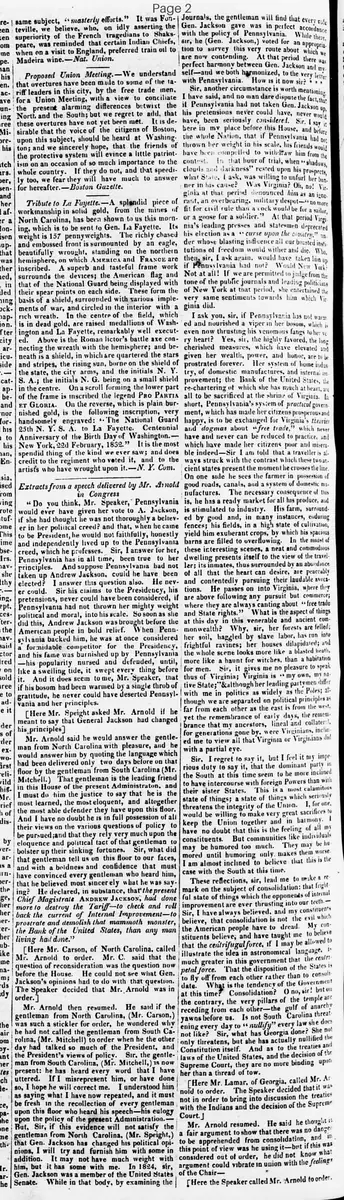
"Do you think, Mr. Speaker,' Pennsylvania would ever have given her vote to A. Jackson, if she had thought he was not thoroughly a believer in her political creed? and that, when he came to be President, he would not faithfully, honestly and independently live up to the Pennsylvania creed, which he professes. Sir, I answer for her, Pennsylvania has in all time, been true to her principles. And suppose Pennsylvania had not taken up Andrew Jackson, could he have been elected? I answer this question also. He never could. Sir his claims to the Presidency, his pretensions, never could have been considered, if Pennsylvania had not thrown her mighty weight political and moral, into his scale. So soon as she did this, Andrew Jackson was brought before the American people in bold relief. When Pennsylvania backed him, he was at once considered a formidable competitor for the Presidency, and his fame was burnished up by Pennsylvania —his popularity nursed and defended, until, like a swelling tide, it swept every thing before it. And it does seem to me, Mr. Speaker, that if his bosom had been warmed by a single throb of gratitude, he never could have deserted Pennsylvania and her principles."
[Here Mr. Speight asked Mr. Arnold if he meant to say that General Jackson had changed his principles]
Mr. Arnold said he would answer the gentleman from North Carolina with pleasure, and he would answer him by quoting the language which had been delivered only two days before on that floor by the gentleman from South Carolina (Mr. Mitchell.) That gentleman is the leading friend in this House of the present Administration, and I must do him the justice to say that he is the most learned, the most eloquent, and altogether the most able defender they have upon this floor. And I have no doubt he is in full possession of all their views on the various questions of policy to be pursued; and that they rely very much upon the eloquence and political tact of that gentleman to bolster up their sinking fortunes. Sir, what did that gentleman tell us on this floor to our faces, and with a boldness and confidence that must have convinced every gentleman who heard him, that he believed most sincerely what he was saying? He declared, in substance, that the present Chief Magistrate Andrew Jackson, had done more to destroy the Tariff to check and roll back the current of Internal Improvement to prostrate and demolish that mammoth monster, the Bank of the United States, than any man living had done."
Here Mr. Carson, of North Carolina, called Mr. Arnold to order. Mr. C. said that the question of reconsideration was the question now before the House. He could not see what Gen. Jackson's opinions had to do with that question.
The Speaker decided that Mr. Arnold was in order.]
Mr. Arnold then resumed. He said if the gentleman from North Carolina, (Mr. Carson.) was such a stickler for order, he wondered why he had not called the gentleman from South Carolina, (Mr. Mitchell) to order when he the other day had talked so much of the President, and the President's views of policy. Sir. the gentleman from South Carolina, (Mr. Mitchell,) is now present: he has heard every word that I have uttered. If I misrepresent him, or have done so, I hope he will correct me. I understood him as saying what I have now repeated, and it must be fresh in the recollection of every gentleman upon this floor who heard his speech—his eulogy upon the policy of the present Administration.
But, Sir, if this evidence will not satisfy the gentleman from North Carolina, (Mr. Speight,) that Gen. Jackson has changed his political opinions, I will try and furnish him with some in addition. It may not have much weight with him, but it has some with me. In 1824, sir, Gen. Jackson was a member of the United States Senate. While in that body, by examining the Journals. the gentleman will find that every vote Gen. Jackson gave was in perfect accordance with the policy of Pennsylvania sir he Gen Jackson voted for an appropriation to survey this very route about which we are now contending.
At that period there was perfect harmony between Gen. Jackson and myself—and we both harmonized, to the very letter with Pennsylvania.
How is it now sir?
Sir, another circumstance is worth mentioning. I have said and no man dare dispute the fact that it Pennsylvania had not taken Gen Jackson up his pretensions never could have, never would have been seriously considered here in my place before this House, and before the whole Nation, that if Pennsylvania had not thrown her weight in his scale, his friends would have been compelled to withdraw him from the contest. in that hour of trial, when "shadows clouds and darkness" rested upon his prospects, what State, I ask, was willing to unfurl her banner in his cause? Was Virginia? Oh, no! Virginia at that period denounced him as an ignorant, an overbearing. military despot "no more fit for civil rule than a cock would be for a sailor, or a goose for a soldier."
At that period Virginia's leading presses and statesmen deprecated his election as a "curse upon the country." under whose blasting influence all our boasted institutions of freedom would wither and die. Who. then, sir, I ask again. would have taken him up if Pennsylvania had not? Would New York: Not at all! If we are permitted to judge from the tone of the public journals and leading politicians of New York at that period, she entertained the very same sentiments towards him which Virginia did.
I ask you. sir. if Pennsylvania has not warmed and nourished a viper in her bosom, which is even now thrusting his venomous fangs to her very heart? Yes, sir, the highly favored, the long cherished measures, which have elevated and given her wealth, power, and honor, are to be prostrated forever. Her system of home industry, of domestic manufactures. and internal improvement; the Bank of the United States, the re-chartering of which she has much at heart, are all to be sacrificed at the shrine of Virginia. In short, Pennsylvania's system of practical government, which has made her citizens prosperous and happy, is to be exchanged for Virginia's theories and dogmas about "free trade," which never have and never can be reduced to practice, and which have made her citizens poor and miserable indeed Sir I am told that a traveller is always struck with the contrast which these two ancient states present the moment he crosses the line. On one side he sees the farmer in possession of good roads, canals, and a system of domestic manufactures. The necessary consequence of this is, he has a ready market for all his produce, and is stimulated to industry. His farm, surrounded by good and, in many instances, enduring fences; his fields, in a high state of cultivation, yield him exuberant crops, by which his spacious barns are filled to overflowing. In the midst of these interesting scenes, a neat and commodious dwelling presents itself to the view of the traveller; its inmates, thus surrounded by an abundance of all that the heart can desire, are peaceably and contentedly pursuing their laudable avocations. He passes on into Virginia, where they are above following any pursuit but commerce; where they are always canting about "free trade and State rights." What is the aspect of things at this day in this venerable and ancient commonwealth? Why. sir, her forests are felled; her soil, haggled by slave labor, has run into frightful ravines; her houses dilapidated; and the whole scene looks more like a blasted heath, more like a haunt for witches. than a habitation for men. Sir. it gives me no pleasure to speak thus of Virginia; Virginia is "my own, my native State;" & although her leading partymen differ with me in politics as widely as the Poles; although we are separated on political principles as far from each other as the east is from the west, yet the remembrance of early days, the remembrance that my ancestors, lineal and collateral, for generations gone by. were Virginians. incline me to view all that Virginia or Virginians did with a partial eye.
Sir. I regret to say it, but I feel it my imperious duty to say it, that the dominant party in the South at this time seem to be more inclined to have intercourse with foreign Powers than with their sister States. This is a most calamitous state of things; a state of things which seriously threatens the integrity of the Union. I, Sir one. would keep the Union together and in harmony. I would be willing to make very great sacrifices to have no doubt that this is the feeling of all my constituents. But communities like individuals may be humored too much. They may be humored until humoring only. makes them worse I am almost inclined to believe that this is the case with the South at this time.
These reflections, sir, lead me to make a remark on the subject of consolidation: that frightful state of things which the opponents of internal improvement are ever thrusting into our teeth.
Sir, I have always believed. and my constituents believe, that consolidation is not the evil which the American people have to dread. My constituents believe; and have taught me to believe that the centrifugal force, if I may be allowed to illustrate the idea in astronomical language. that the centrifugal force, the disposition of the States is much greater in this government that the centripetal force. That the tendency of the Government at this time? Consolidation? O no, sir! but on the contrary, the very pillars of the temple are shaking every day to "nullify" every law she does not like? Sir, what has Georgia done? She not only threatens, but she has actually nullified the Constitution itself. And as to the treaties and laws of the United States, and the decision of the Supreme Court, they are no more binding upon her than a thread of tow.
[Here Mr. Lamar, of Georgia, called Mr. Arnold to order. The Speaker decided that it was not in order to bring into discussion the treaties with the Indians and the decision of the Supreme Court.]
Mr. Arnold resumed. He said he thought a fair argument to show that there was no danger to be apprehended from consolidation, and in this point of view was he using it—but if this was considered out of order, he did not know what argument could vibrate in union with the feelings of the Chair
Here the Speaker called Mr. Arnold to order.
and stated that he (the Speaker) had no "feelings" on the subject.
Mr. Arnold said he must submit to the decision of the Chair, and the vanity to believe would be acceptable to none of the Chair.
He had, however, some views on the subject of our Indian relations which he must reserve for an occasion more congenial to the discussion of that interesting question.
Mr. A. said, in conclusion, he would say that he stood himself by the constitution and the Union of the States. Whenever they are overthrown, and he confessed that the times were very threatening; and when the liberty of the People leaves this country, then I want to leave it myself. Sir, I call upon gentlemen to remember what I this day utter. If this Union is once dissolved, the People of the United States will be the most wretched upon the face of the earth. The South American provinces will have a perfect system of harmony compared with ours. The worst and most sanguinary scenes of the French Revolution will be thrown in the shade by the civil wars which will desolate this country, and drench it in the blood of its own citizens.
What sub-type of article is it?
What keywords are associated?
What entities or persons were involved?
Where did it happen?
Domestic News Details
Primary Location
United States Congress
Key Persons
Event Details
Mr. Arnold delivers a speech in Congress defending Pennsylvania's support for Andrew Jackson's election, accusing Jackson of abandoning Pennsylvania's principles on tariffs, internal improvements, and the Bank of the United States. He quotes Mr. Mitchell's praise of Jackson's policies against these. Interruptions occur from Mr. Speight, Mr. Carson, and Mr. Lamar, with the Speaker ruling on order. Arnold contrasts Pennsylvania's prosperity with Virginia's decline and warns of threats to the Union from Southern states.