Thank you for visiting SNEWPapers!
Sign up free
Scandinavian American
Seattle, King County, Washington
What is this article about?
Norway's post-WWII reconstruction program, agreed by six parties in 1945, has made significant progress by 1947, including improved rations, full employment, industrial expansion, social welfare laws, cultural investments, and fleet rebuilding, as per government report.
Clipping
OCR Quality
Full Text
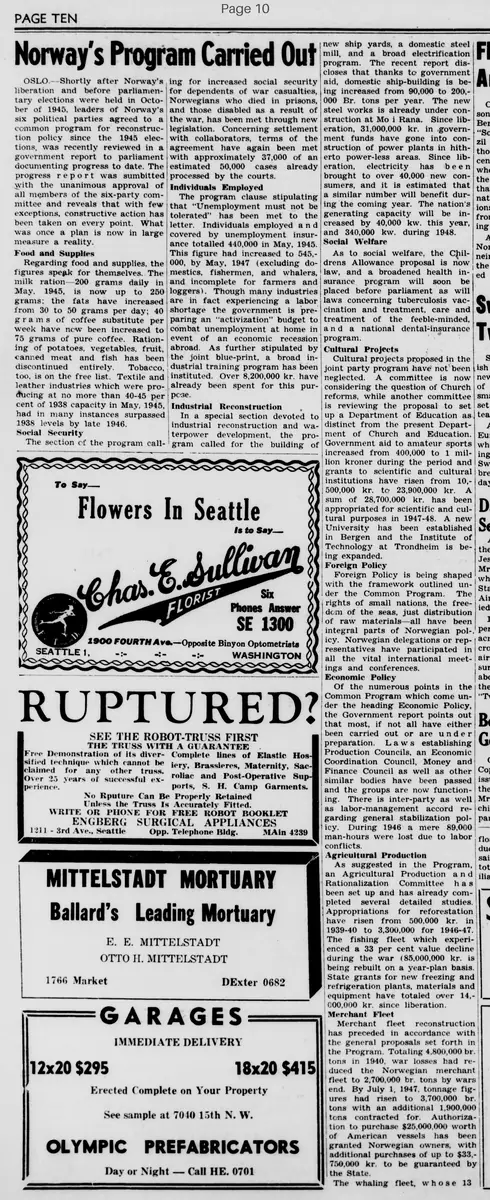
Norway's Program Carried Out
OSLO.—Shortly after Norway's liberation and before parliamentary elections were held in October of 1945, leaders of Norway's six political parties agreed to a common program for reconstruction policy since the 1945 elections, was recently reviewed in a government report to parliament documenting progress to date. The progress report was submitted with the unanimous approval of all members of the six-party committee and reveals that with few exceptions, constructive action has been taken on every point. What was once a plan is now in large measure a reality.
Food and Supplies
Regarding food and supplies, the figures speak for themselves. The milk ration—200 grams daily in May, 1945, is now up to 250 grams; the fats have increased from 30 to 50 grams per day; 40 grams of coffee substitute per week have now been increased to 75 grams of pure coffee. Rationing of potatoes, vegetables, fruit, canned meat and fish has been discontinued entirely. Tobacco, too, is on the free list. Textile and leather industries which were producing at no more than 40-45 per cent of 1938 capacity in May, 1945, had in many instances surpassed 1938 levels by late 1946.
Social Security
The section of the program calling for increased social security for dependents of war casualties, Norwegians who died in prisons, and those disabled as a result of the war, has been met through new legislation. Concerning settlement with collaborators, terms of the agreement have again been met with approximately 37,000 of an estimated 50,000 cases already processed by the courts.
Individuals Employed
The program clause stipulating that "Unemployment must not be tolerated" has been met to the letter. Individuals employed and covered by unemployment insurance totalled 440,000 in May, 1945. This figure had increased to 545,000, by May, 1947 (excluding domestics, fishermen, and whalers, and incomplete for farmers and loggers). Though many industries are in fact experiencing a labor shortage the government is preparing an "activization" budget to combat unemployment at home in event of an economic recession abroad. As further stipulated by the joint blue-print, a broad industrial training program has been instituted. Over 8,200,000 kr. have already been spent for this purpose.
Industrial Reconstruction
In a special section devoted to industrial reconstruction and waterpower development, the program called for the building of new ship yards, a domestic steel mill, and a broad electrification program. The recent report discloses that thanks to government aid, domestic ship-building is being increased from 90,000 to 200,000 gr. tons per year. The new steel works is already under construction at Mo i Rana. Since liberation, 31,000,000 kr. in government funds have gone into construction of power plants in hitherto power-less areas. Since liberation, electricity has been brought to over 40,000 new consumers, and it is estimated that a similar number will benefit during the coming year. The nation's generating capacity will be increased by 40,000 kw. this year, and 340,000 kw. during 1948.
Social Welfare
As to social welfare, the Children's Allowance proposal is now law, and a broadened health insurance program will soon be placed before parliament as will laws concerning tuberculosis vaccination and treatment, care and treatment of the feeble-minded, and a national dental-insurance program.
Cultural Projects
Cultural projects proposed in the joint party program have not been neglected. A committee is now considering the question of Church reforms, while another committee is reviewing the proposal to set up a Department of Education as distinct from the present Department of Church and Education. Government aid to amateur sports increased from 400,000 to 1 million kroner during the period and grants to scientific and cultural institutions have risen from 10,500,000 kr. to 23,900,000 kr. A sum of 28,700,000 kr. has been appropriated for scientific and cultural purposes in 1947-48. A new University has been established in Bergen and the Institute of Technology at Trondheim is being expanded.
Foreign Policy
Foreign Policy is being shaped with the framework outlined under the Common Program. The rights of small nations, the freedom of the seas, just distribution of raw materials—all have been integral parts of Norwegian policy. Norwegian delegations or representatives have participated in all the vital international meetings and conferences.
Economic Policy
Of the numerous points in the Common Program which come under the heading Economic Policy, the Government report points out that most, if not all have either been carried out or are under preparation. Laws establishing Production Councils, an Economic Coordination Council, Money and Finance Council as well as other similar bodies have been passed and the groups are now functioning. There is inter-party as well as labor-management accord regarding general stabilization policy. During 1946 a mere 89,000 man-hours were lost due to labor conflicts.
Agricultural Production
As suggested in the Program, an Agricultural Production and Rationalization Committee has been set up and has already completed several detailed studies.
Appropriations
Appropriations for reforestation have risen from 500,000 kr. in 1939-40 to 3,300,000 for 1946-47. The fishing fleet which experienced a 33 per cent value decline during the war (85,000,000 kr.) is being rebuilt on a year-plan basis. State grants for new freezing and refrigeration plants, materials and equipment have totaled over 14,000,000 kr. since liberation.
Merchant Fleet
Merchant fleet reconstruction has proceeded in accordance with the general proposals set forth in the Program. Totaling 4,800,000 gr. tons in 1940, war losses had reduced the Norwegian merchant fleet to 2,700,000 gr. tons by war's end. By July 1, 1947, tonnage figures had risen to 3,700,000 gr. tons with an additional 1,900,000 tons contracted for. Authorization to purchase $25,000,000 worth of American vessels has been granted Norwegian owners, with additional purchases of up to $33,750,000 kr. to be guaranteed by the State.
The whaling fleet, whose 13 floating factories had been reduced to 5 by 1945, will soon set sail for the whaling fields with a total of 10 factory ships, plus auxiliary craft.
What sub-type of article is it?
What keywords are associated?
Where did it happen?
Foreign News Details
Primary Location
Norway
Event Date
1945 1947
Outcome
program largely implemented: increased rations, employment from 440,000 to 545,000, shipbuilding to 200,000 gr. tons/year, merchant fleet to 3,700,000 gr. tons, etc.
Event Details
Norway's six political parties agreed on a common reconstruction program post-liberation in 1945. Government report to parliament details progress: improved food rations (milk 200g to 250g, fats 30g to 50g, coffee substitute to pure coffee); discontinued rationing of potatoes, vegetables, etc.; textile production surpassing 1938 levels; new social security laws for war victims; 37,000 collaborator cases processed; employment rose to 545,000 by May 1947; industrial training with 8,200,000 kr.; shipyards expanded, steel mill under construction, electrification to 40,000 new consumers; children's allowance law passed; cultural projects including new university in Bergen; foreign policy on small nations' rights; economic councils established; agricultural committee set up; reforestation appropriations increased; fishing fleet rebuilt with 14,000,000 kr.; merchant fleet rebuilt to 3,700,000 gr. tons with contracts for more; whaling fleet to 10 factory ships.