Thank you for visiting SNEWPapers!
Sign up free
Letter to Editor
August 31, 1862
Sunday Dispatch
New York, New York County, New York
What is this article about?
A letter from New York dated August 30, 1862, urges the construction of revolving iron monitors or towers at harbor entrances, particularly New York, as cost-effective defenses against potential foreign invasion during the Civil War, arguing they are superior to stationary forts.
Clipping
OCR Quality
92%
Excellent
Full Text
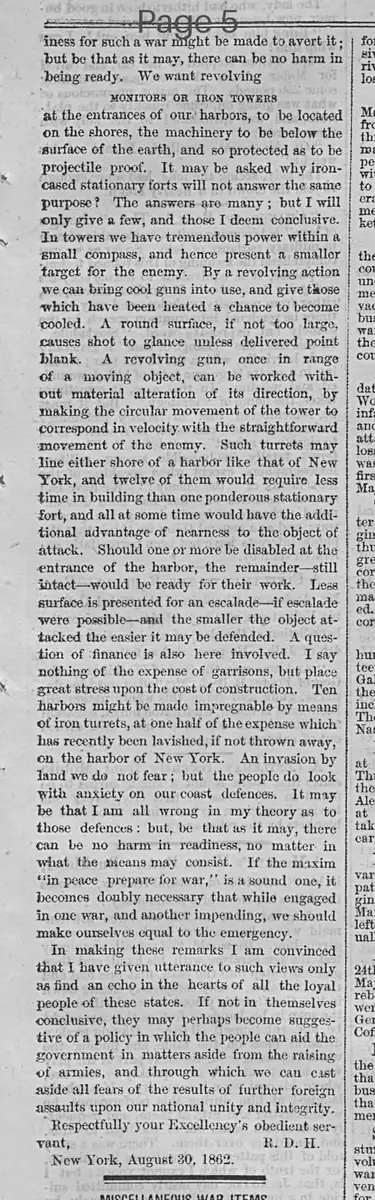
Readiness for such a war might be made to avert it but be that as it may, there can be no harm in being ready. We want revolving
MONITORS OR IRON TOWERS at the entrances of our harbors, to be located on the shores, the machinery to be below the surface of the earth, and so protected as to be projectile proof. It may be asked why iron-cased stationary forts will not answer the same purpose? The answers are many; but I will only give a few, and those I deem conclusive.
In towers we have tremendous power within a small compass, and hence present a smaller target for the enemy. By a revolving action we can bring cool guns into use, and give those which have been heated a chance to become cooled. A round surface, if not too large, causes shot to glance unless delivered point blank. A revolving gun, once in range of a moving object, can be worked without material alteration of its direction, by making the circular movement of the tower to correspond in velocity with the straightforward movement of the enemy. Such turrets may line either shore of a harbor like that of New York, and twelve of them would require less time in building than one ponderous stationary fort, and all at some time would have the additional advantage of nearness to the object of attack. Should one or more be disabled at the entrance of the harbor, the remainder-still intact-would be ready for their work. Less surface is presented for an escalade--if escalade were possible--and the smaller the object attacked the easier it may be defended. A question of finance is also here involved. I say nothing of the expense of garrisons, but place great stress upon the cost of construction. Ten harbors might be made impregnable by means of iron turrets, at one half of the expense which has recently been lavished, if not thrown away, on the harbor of New York. An invasion by land we do not fear; but the people do look with anxiety on our coast defences. It may be that I am all wrong in my theory as to those defences: but, be that as it may, there can be no harm in readiness, no matter in what the means may consist. If the maxim "in peace prepare for war," is a sound one, it becomes doubly necessary that while engaged in one war, and another impending, we should make ourselves equal to the emergency.
In making these remarks I am convinced that I have given utterance to such views only as find an echo in the hearts of all the loyal people of these states. If not in themselves conclusive, they may perhaps become suggestive of a policy in which the people can aid the government in matters aside from the raising of armies, and through which we can cast aside all fears of the results of further foreign assaults upon our national unity and integrity.
Respectfully your Excellency's obedient servant,
R. D. H.
New York, August 30, 1862.
MONITORS OR IRON TOWERS at the entrances of our harbors, to be located on the shores, the machinery to be below the surface of the earth, and so protected as to be projectile proof. It may be asked why iron-cased stationary forts will not answer the same purpose? The answers are many; but I will only give a few, and those I deem conclusive.
In towers we have tremendous power within a small compass, and hence present a smaller target for the enemy. By a revolving action we can bring cool guns into use, and give those which have been heated a chance to become cooled. A round surface, if not too large, causes shot to glance unless delivered point blank. A revolving gun, once in range of a moving object, can be worked without material alteration of its direction, by making the circular movement of the tower to correspond in velocity with the straightforward movement of the enemy. Such turrets may line either shore of a harbor like that of New York, and twelve of them would require less time in building than one ponderous stationary fort, and all at some time would have the additional advantage of nearness to the object of attack. Should one or more be disabled at the entrance of the harbor, the remainder-still intact-would be ready for their work. Less surface is presented for an escalade--if escalade were possible--and the smaller the object attacked the easier it may be defended. A question of finance is also here involved. I say nothing of the expense of garrisons, but place great stress upon the cost of construction. Ten harbors might be made impregnable by means of iron turrets, at one half of the expense which has recently been lavished, if not thrown away, on the harbor of New York. An invasion by land we do not fear; but the people do look with anxiety on our coast defences. It may be that I am all wrong in my theory as to those defences: but, be that as it may, there can be no harm in readiness, no matter in what the means may consist. If the maxim "in peace prepare for war," is a sound one, it becomes doubly necessary that while engaged in one war, and another impending, we should make ourselves equal to the emergency.
In making these remarks I am convinced that I have given utterance to such views only as find an echo in the hearts of all the loyal people of these states. If not in themselves conclusive, they may perhaps become suggestive of a policy in which the people can aid the government in matters aside from the raising of armies, and through which we can cast aside all fears of the results of further foreign assaults upon our national unity and integrity.
Respectfully your Excellency's obedient servant,
R. D. H.
New York, August 30, 1862.
What sub-type of article is it?
Persuasive
Political
What themes does it cover?
Military War
What keywords are associated?
Harbor Defense
Iron Towers
Revolving Monitors
New York Harbor
Civil War Preparation
Coast Defenses
Foreign Invasion
What entities or persons were involved?
R. D. H.
Your Excellency
Letter to Editor Details
Author
R. D. H.
Recipient
Your Excellency
Main Argument
revolving iron monitors or towers at harbor entrances provide superior, cost-effective defense compared to stationary forts, enabling readiness against potential foreign invasion while engaged in the civil war.
Notable Details
Smaller Target And Revolving Action Advantages
Cost Comparison To New York Harbor Fortifications
Echoes Sentiments Of Loyal People
Prepares For War Maxim