Thank you for visiting SNEWPapers!
Sign up free
The New Orleans Daily Democrat
New Orleans, Orleans County, Louisiana
What is this article about?
Biographical sketch of Prince Lucien Murat, known as 'Prince Mewratt,' who lived in Bordentown, New Jersey, supported by his American wife while he lived idly; later gained wealth and status in France under the Second Empire before its fall.
Clipping
OCR Quality
Full Text
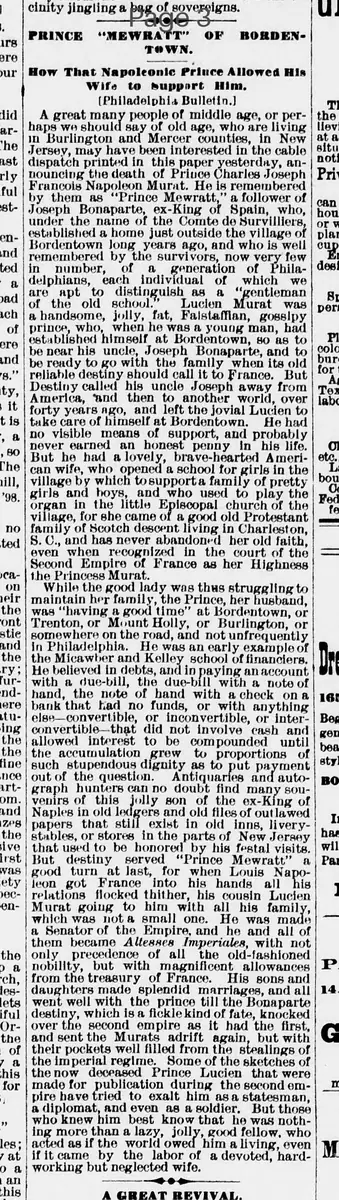
"MEWRATT"
OF
BORDEN-
TOWN.
How That Napoleonic Prince Allowed His Wife to Support Him.
(Philadelphia Bulletin.)
A great many people of middle age, or perhaps we should say of old age, who are living in Burlington and Mercer counties, in New Jersey, may have been interested in the cable dispatch printed in this paper yesterday, announcing the death of Prince Charles Joseph Francois Napoleon Murat. He is remembered by them as "Prince Mewratt," a follower of Joseph Bonaparte, ex-King of Spain, who, under the name of the Comte de Survilliers, established a home just outside the village of Bordentown long years ago, and who is well remembered by the survivors, now very few in number, of a generation of Philadelphians, each individual of which we are apt to distinguish as a "gentleman of the old school."
Lucien Murat was a handsome, jolly, fat, Falstaffian, gossipy prince, who, when he was a young man, had established himself at Bordentown, so as to be near his uncle, Joseph Bonaparte, and to be ready to go with the family when its old reliable destiny should call it to France. But Destiny called his uncle Joseph away from America, and then to another world, over forty years ago, and left the jovial Lucien to take care of himself at Bordentown. He had no visible means of support, and probably never earned an honest penny in his life. But he had a lovely, brave-hearted American wife, who opened a school for girls in the village by which to support a family of pretty girls and boys, and who used to play the organ in the little Episcopal church of the village, for she came of a good old Protestant family of Scotch descent living in Charleston, S. C., and has never abandoned her old faith, even when recognized in the court of the Second Empire of France as her Highness the Princess Murat.
While the good lady was thus struggling to maintain her family, the Prince, her husband, was "having a good time" at Bordentown, or Trenton, or Mount Holly, or Burlington, or somewhere on the road, and not unfrequently in Philadelphia. He was an early example of the Micawber and Kelley school of financiers. He believed in debts, and in paying an account with a due-bill, the due-bill with a note of hand, the note of hand with a check on a bank that had no funds, or with anything else—convertible, or inconvertible, or inter-convertible—that did not involve cash and allowed interest to be compounded until the accumulation grew to proportions of such stupendous dignity as to put payment out of the question. Antiquaries and autograph hunters can no doubt find many souvenirs of this jolly son of the ex-King of Naples in old ledgers and old files of outlawed papers that still exist in old inns, livery-stables, or stores in the parts of New Jersey that used to be honored by his festal visits. But destiny served "Prince Mewratt" a good turn at last, for when Louis Napoleon got France into his hands all his relations flocked thither, his cousin Lucien Murat going to him with all his family, which was not a small one. He was made a Senator of the Empire, and he and all of them became Altesses Imperiales, with not only precedence of all the old-fashioned nobility, but with magnificent allowances from the treasury of France. His sons and daughters made splendid marriages, and all went well with the prince till the Bonaparte destiny, which is a fickle kind of fate, knocked over the second empire as it had the first and sent the Murats adrift again, but with their pockets well filled from the stealings of the imperial regime. Some of the sketches of the now deceased Prince Lucien that were made for publication during the second empire have tried to exalt him as a statesman, a diplomat, and even as a soldier. But those who knew him best know that he was nothing more than a lazy, jolly, good fellow, who acted as if the world owed him a living, even if it came by the labor of a devoted, hard-working but neglected wife.
What sub-type of article is it?
What themes does it cover?
What keywords are associated?
What entities or persons were involved?
Where did it happen?
Story Details
Key Persons
Location
Bordentown, New Jersey
Event Date
Over Forty Years Ago
Story Details
Prince Lucien Murat, nephew of Joseph Bonaparte, settled in Bordentown near his uncle's exile home; after Joseph's death, his American wife supported the family by running a girls' school and playing organ, while he lived idly and accrued debts; later, under the Second Empire, he gained senatorial position, imperial status, and wealth before the empire's fall.