Thank you for visiting SNEWPapers!
Sign up free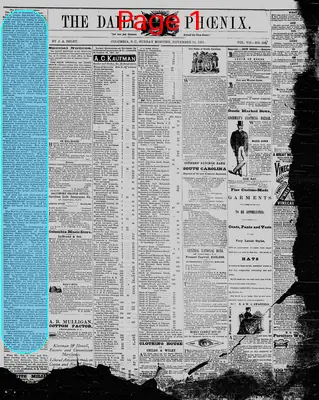
The Daily Phoenix
Columbia, Richland County, South Carolina
What is this article about?
Newspaper article accuses South Carolina Governor Scott of fraudulently over-issuing $20 million in state bonds during Reconstruction, contradicting his prior reports. References Tax-payers' Convention resolution against further issues and New York Tribune's call to expose Southern corruption involving figures like Clayton, Bullock, and Littlefield.
Clipping

OCR Quality
Full Text
THAT OTHER $20,000,000 FRAUD.
Some of the Republican papers throughout the country are seeking to make it appear that Gov. Scott has successfully refuted the charges against him of an enormous issue of South Carolina bonds. It is even said that his card of the 6th instant, as published in the World, effects such a refutation. A more unmitigated fallacy it would be hard to put in print. What he did say in that card was that there had been printed $20,040,000 State bonds, $3,500,000 sterling bonds, and $5,040,000 registered stock—total, $28,580,000; and of this amount there had been issued $11,040,000 State bonds and $2,540,000 registered stock—a total issue of $13,580,000. In a letter bearing date September 20, 1871, addressed to Senator Scott, of the Congressional Ku Klux Committee, in response to an official call for such information, this same Governor Scott gave the total issue of bonds and stocks at that time as $9,528,564.10. With these facts before him, the reader can see for himself that so far from refuting a charge of over-issue, Governor Scott admits on the 6th of November that there have been printed, in round numbers, $28,500,000 in bonds and stocks to pay a bond and stock debt of $9,500,000 on the 20th of the prior September. Out of his own mouth proceeds not a refutation, but a plea of guilty. He has not explained the enormous over-issue of some $20,000,000, because he cannot without casting his own words. At the South Carolina Tax-payers Convention, held in Columbia in May last, there was unanimously adopted the following resolution:
Resolved, That this Convention, representing the property-holders and tax-payers of the State of South Carolina, do hereby deem it our duty to declare that the so-called sterling loan, or any other bonds or obligations hereafter issued purporting to be under and by virtue of the authority of this State, as at present constituted, will not be held binding upon us; and that we recommend to the people of the State in every manner and at all times to resist the payment thereof, or the enforcement of any tax to pay the same, by all legitimate means within their power.
At this time the Governor had pledged himself that there had only been an issue of $3,200,000 in bonds, much of it to convert prior indebtedness. Now, in his card of the 6th of November, he says: $3,500,000 of sterling bonds have been printed but not issued. These are the very bonds above referred to. Why did he prepare them for issue in despite of the warning of the Tax-payers' Convention if he did not intend, at the first convenient opportunity, to issue them? Further he stated that but $3,200,000 of bonds had been issued when the above resolution pledging resistance to further issues was adopted, and now says that $11,040,000 of bonds and $2,540,000 of stock (total, $13,580,000) have been put out. Here are $10,380,000 in bonds and stocks already disposed of when Gov. Scott knew the property-holders and tax payers of the State were pledged against every dollar of them. This is not a mere plain robbery but a swindle, too—a robbery of the people and a fraud on the bond-buyer. And what has Gov. Scott said to all this? How does he explain his own statements of $9,500,000 due in September and $28,500,000 prepared to pay it in November? He is silent, and the public will know how to construe the sign.
The New York Tribune, the ablest Republican paper in America, takes a very different view of things than does the Columbia Union. That paper, in an article on the New York election, headed "Shall the Lesson be Heeded?" says, among other things:
"For months, the developments of rascality in the management of the reconstructed governments of several Southern States have been growing more and more conclusive. No intelligent man longer doubts that those governments have been flagrantly expensive and corrupt—that they have increased taxation, incurred debt and issued bonds, to an enormous extent. The facts are in part concealed or obscured, but cannot long remain so; enough is already known to justify the very gravest apprehensions. In the two Carolinas, especially, the robberies appear to have been quite as gigantic, when the relative wealth of the respective communities is considered, as in this city. Yet men whom we have esteemed honest, talk as though all exposure and reprehension of these villainies should be left to Democratic journals—that we ought to ignore, or befog, or belittle them. They represent such exposure as calculated to damage the Republican party generally; we hold that, even if this be so, that party will be far worse damaged by seeking to cover up those iniquities, and thus making them, to some extent, its own. Let it promptly and fearlessly expose and denounce the criminals, if it would vindicate itself from all complicity in their crimes."
The same article, afterwards in speaking of Clayton, of Arkansas; Bullock, of Georgia; Littlefield, of Florida, and the bonds issued by the Scott administration, says:
"We prejudge no case in particular. Possibly, Clayton is all that he ought to be, and Bullock an innocent, persecuted saint, who has retired from the Governorship of Georgia with clean hands and a pure heart. Possibly, there have been no frauds in the reconstructed legislatures—no bonds issued by Littlefields and Kimptons but just such as should have been."
And concludes as follows:
"Men and brethren! there is to be a general overhauling of pretensions, a sweeping out of dark corners, a dragging to light of hidden iniquities, the coming winter. If there be those who dread such an ordeal, they may wisely put an ocean between them and the scene of their misdoings without further delay."
What sub-type of article is it?
What themes does it cover?
What keywords are associated?
What entities or persons were involved?
Where did it happen?
Story Details
Key Persons
Location
South Carolina, Columbia
Event Date
1871
Story Details
Governor Scott accused of over-issuing $20 million in South Carolina bonds, contradicting earlier statements of $9.5 million debt; Tax-payers' Convention resolves against new bonds; New York Tribune urges exposure of Reconstruction-era corruption in Southern states.