Thank you for visiting SNEWPapers!
Sign up free
Richmond Enquirer
Richmond, Richmond County, Virginia
What is this article about?
Report on French legislative proceedings and historical context for implementing the 1831 treaty with the US, involving 25 million francs indemnity for spoliations during Napoleonic wars. Minister Humann presents bill on Jan 15, 1835, with contingent clause amid tensions from US President Jackson's message. Detailed history of claims from Berlin-Milan Decrees and neutral rights violations.
Merged-components note: These components form a single continuous article on US-France relations, with sequential reading orders across pages 1 and 2.
Clippings
1 of 2
OCR Quality
Full Text
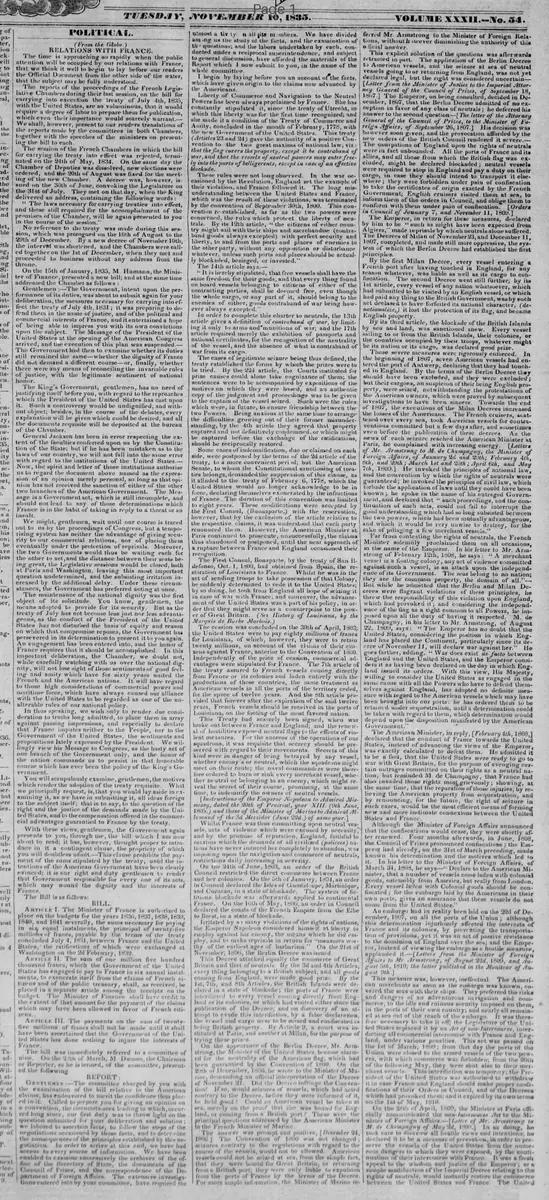
(from the Globe)
RELATIONS WITH FRANCE.
The time is approaching so rapidly when the public attention will be occupied by our relations with France, that we think it well to begin to lay before our readers the Official Document from the other side of the water, that the subject may be fully understood.
The reports of the proceedings of the French Legislative Chambers during their last session, on the bill for carrying into execution the treaty of July 4th, 1831, with the United States, are so voluminous, that it would require a degree of labor to prepare them for publication, which even their importance would scarcely warrant.—
We shall, however, present to our readers translations of the reports made by the committees in both Chambers, together with the speeches of the ministers on presenting the bill to each.
The session of the French Chambers in which the bill for carrying the treaty into effect was rejected, terminated on the 24th of May, 1834. On the same day the Chamber of Deputies was dissolved, new elections were ordered, and the 20th of August was fixed for the meeting of the new Chamber. A decree was, however, issued on the 30th of June, convoking the Legislature on the 31st of July. They met on that day, when the King delivered an address, containing the following words:
" The laws necessary for carrying treaties into effect, and those still required for the accomplishment of the promises of the Chamber, will be again presented to you in the course of the session."
No reference to the treaty was made during this session, which was prorogued on the 16th of August to the 29th of December. By a new decree of November 10th, the interval was shortened, and the Chambers were called together on the 1st of December, when they met and proceeded to business without any address from the throne.
On the 15th of January, 1835, M. Humann, the Minister of Finance, presented a new bill; and at the same time addressed the Chamber as follows:
Gentlemen: The Government, intent upon the performance of its duties, was about to submit again for your deliberation, the measures necessary for carrying into effect the treaty of July 4th, 1831: it was preparing to defend them in the name of justice, and of the political and commercial interests of France, and it entertained a hope of being able to impress you with its own convictions upon the subject. The Message of the President of the United States at the opening of the American Congress arrived, and the execution of this plan was suspended.—
The Government had then to examine whether its duties still remained the same—whether the dignity of France did not demand a different course—or, finally, whether there were any means of reconciling the invariable rules of justice, with the legitimate sentiment of national honor.
The King's Government, gentlemen, has no need of justifying itself before you, with regard to the reproaches which the President of the United States has cast upon it. Such a controversy would be undignified, and without object; besides, in the course of the debates, every explanation will be given which could be desired, and all the documents requisite will be deposited at the bureau of the Chamber.
General Jackson has been in error respecting the extent of the faculties conferred upon us by the Constitution of the State; but if he has been mistaken as to the laws of our country, we will not fall into the same error with regard to the institutions of the United States.—
Now, the spirit and letter of those institutions authorise us to regard the document above named as the expression of an opinion merely personal, so long as that opinion has not received the sanction of either of the other two branches of the American Government. The Message is a Government act, which is still incomplete, and should not lead to any of those determinations which France is in the habit of taking in reply to a threat or an insult.
We might, gentlemen, wait until our course is traced out to us by the proceedings of Congress, but a temporising system has neither the advantage of giving security to our commercial relations, nor of placing them eventually under the protection of reprisals. Moreover, the two Governments would thus be waiting each for the other to act, and the distance between their seats being great, the Legislative sessions would be closed, both at Paris and Washington, leaving this most important question undetermined, and the subsisting irritation increased by the additional delay. Under these circumstances, the Government has preferred acting at once.
The maintenance of the national dignity was the first object of its solicitude. You know, gentlemen, the means adopted to provide for its security. But as the treaty of July has not become less just nor less advantageous, as the conduct of the President of the United States has not disturbed the basis of equity and reason on which that compromise reposes, the Government has persevered in its determination to present it to you again.
An engagement has been entered into, and the honor of France requires that it should be accomplished. In this important deliberation, the Chamber, we doubt not, while carefully watching with us over the national dignity, will not lose sight of those sentiments of good feeling and amity which have for sixty years united the French and the American nations. It will have regard to those high considerations of commercial power and maritime force, which have always caused our alliance with the United States to be regarded as one of the unalterable rules of our national policy.
In thus speaking, we wish only to render due consideration to truths long admitted, to place them in array against passing impressions, and especially to declare that France imputes neither to the People, nor to the Government of the United States, the sentiments and propositions lately expressed by the President. We willingly view his Message to Congress, as the hasty act of one branch of the Government "only," and the honor of the nation commands us to persist in that honorable course which has ever been the policy of the King's Government.
You will scrupulously examine, gentlemen, the motives which render the adoption of the treaty requisite. What we principally request, is, that you would lay aside in examining it, as we have in submitting it, all ideas foreign to the subject itself; that is to say, to the question of the right and the justice of the demands made by the United States, and to the compensation offered in the commercial advantages guaranteed to France by the treaty.
With these views, gentlemen, the Government again presents to you, through me, the bill which I am now about to read; it has, however, thought proper to introduce in it a contingent clause, the propriety of which you will doubtless admit.—This clause prohibits the payment of the sums stipulated by the treaty, until the intentions of the American Government have been clearly evinced; it is our right and duty gentlemen to render that Government responsible for every one of its acts, which may wound the dignity and the interests of France.
The Bill is as follows:
BILL.
Article I. The Minister of France is authorized to place on the budgets for the years 1836, 1837, 1838, 1839, 1840, and 1841 severally, the sums necessary for paying in six equal instalments, the principal of twenty-five millions of francs, payable by the terms of the treaty concluded July 4, 1831, between France and the United States, 'the ratifications of which were exchanged at Washington on the 2d February, 1832.'
Article II. The sum of one million five hundred thousand francs, which the Government of the United States has engaged to pay to France in six annual instalments, to exonerate itself from the claims of French citizens and of the public treasury, shall, as received, be placed in a separate article among the receipts on the budget. The Minister of Finance shall have credit to the extent of that amount for the payment of the claims which may have been allowed in favor of French citizens
Article III. The payments on the said sum of twenty-five millions of francs shall not be made until it shall have been ascertained that the Government of the United States has done nothing to injure the interests of France.
The bill was immediately referred to a committee of nine. On the 28th of March, M. Duroc, the Chairman or Reporter, as he is termed, of the committee, presented the following
REPORT:
Gentlemen:—The committee charged by you with the examination of the bill relative to the American claims, has endeavored to merit the confidence thus placed in it. Called to prepare you for giving an opinion on a convention, the circumstances leading to which, occurred long since, our first duty was to throw light on the question submitted for your deliberation and solution we labored to ascertain facts, to follow the steps of the negotiations occasioned by those facts, and to determine the consequences of the principles established by this negotiation. In order to arrive at this end, we have had access to every source of information. We have been enabled to examine successively the archives of the office of the Secretary of State, the documents of the Council of Prizes, and the correspondence of the Department of Foreign Affairs. The extensive investigations entered into by your committee, have required the
NOVEMBER 10, 1835.
utmost activity in all its members. We have divided among us the study of the facts, and the examination of the questions; and the labors undertaken by each, conducted under a reciprocal superintendence, and subject to general discussion, have afforded the materials of the Report which I now submit to you, in the name of the whole committee.
I begin by laying before you an account of the facts, which have given origin to the claims now advanced by the Americans.
Liberty of Commerce and Navigation to the Neutral Powers has been always proclaimed by France. She has constantly stipulated it, since the treaty of Utrecht, in which this liberty was for the first time recognized; and she made it a condition of the Treaty of Commerce and Amity, concluded in the month of February, 1778, with the new Government of the United States. This treaty (Articles 23 and 24) gave the authority of a positive Convention to the two great maxims of national law, viz: that the flag covers the property, except it be contraband of war, and that the vessels of neutral powers may enter freely into the ports of belligerents, except in case of an effective blockade.
These rules were not long observed. In the war occasioned by the Revolution, England set the example of their violation, and France followed it. The long misunderstanding between the United States and France, which was the result of these violations, was terminated by the convention of September 30th, 1800. This convention re-established, as far as the two powers were concerned, the rules which protect the liberty of neutrals. By its 12th article, " the citizens of either country might sail with their ships and merchandise (contraband goods always excepted) with perfect security and liberty, to and from the ports and places of enemies to the other party, without any opposition or disturbance whatever, unless such ports and places should be actually blockaded, besieged, or invested."
The 14th article says:
" It is hereby stipulated, that free vessels shall have the same freedom for their goods, and that every thing found on board vessels belonging to citizens of either of the contracting parties, shall be deemed free, even though the whole cargo, or any part of it, should belong to the enemies of either, goods contraband of war being however always excepted."
In order to complete this charter to neutrals, the 13th article gives a definition of contraband of war, by limiting it only to arms and munitions of war; and the 17th article required merely the exhibition of passports and national certificates, for the recognition of the neutrality of the vessel, and the absence of what is contraband of war from its cargo.
The cases of legitimate seizure being thus defined, the treaty established the forms by which the prizes were to be tried. By the 22d article, the Courts instituted for prize causes could alone take cognizance of them; the sentences were to be accompanied by expositions of the motives on which they were based, and an authentic copy of the judgment and proceedings was to be given to the captain of the vessel seized. Such were the rules which were, in future, to ensure friendship between the two Powers. Being anxious at the same time to arrange the difficulties growing out of their former misunderstanding, by the 4th article they agreed that property captured and not definitively condemned, or which might be captured before the exchange of the ratifications, should be reciprocally restored.
Some cases of indemnification, due or claimed on each side, were postponed by the terms of the 2d article of the treaty, to a more convenient period; but the American Senate, to whom the Constitutional sanctioning of treaties belongs, demanded the suppression of this clause, as it alluded to the treaty of February 6, 1778, which the United States would no longer acknowledge to be in force, declaring themselves exonerated by the infractions of France. The duration of this convention was limited to eight years. These modifications were accepted by the First Consul, (Buonaparte,) with the reservation, however, that by the exclusion of the article relative to the respective claims, it was understood that each party renounced them. However, the American Minister at Paris continued to prosecute, unsuccessfully, the claims thus abandoned or postponed, until the near approach of a rupture between France and England occasioned their recognition.
The First Consul, Bonaparte, by the treaty of San Ildefonso, Oct. 1, 1800, had obtained from Spain, the restoration of Louisiana to France. Whilst he was in the act of sending troops to take possession of that Colony, he suddenly determined to cede it to the United States; by so doing, he took from England all hope of seizing it in case of war with France; and moreover, the advancement of the United States was a part of his policy, in order that they might serve as a counterpoise to the power of Great Britain. (See History of Louisiana, by the Marquis de Barbé Marbois.)
The cession was concluded on the 30th of April, 1803; the United States were to pay eighty millions of francs for Louisiana, of which, however, they were to retain twenty millions, on account of the claims of their citizens against France, anterior to the Convention of 1800.
Independently of the price of cession, commercial advantages were stipulated for France. The 7th article of the treaty assured to French vessels coming directly from France or its colonies and laden entirely with the productions of those countries, the same treatment as American vessels in all the ports of the territory ceded, for the space of twelve years. And the 8th article provided that forever after the expiration of the said twelve years, French vessels should be received in the ports of Louisiana, on the footing of the most favored nation.
This Treaty had scarcely been signed, when war broke out between France and England; and the renewal of hostilities exposed neutral flags to the effects of violent measures. For the success of the operations of our squadrons, it was requisite that secrecy should be preserved with regard to their movements. Secrets of this kind were in danger of being betrayed by any vessel, whether enemy's or neutral, which the squadrons might meet on their route; the naval commanders were therefore ordered to burn or sink every merchant vessel, whether neutral or belonging to an enemy, which might reveal the secret of their course, promising, at the same time, to indemnify the owners of neutral vessels.
[Instructions of the Emperor Napoleon to Admiral Missiessy, dated the 20th of Prairial, year XIII. (9th June, 1805.) and those of the Minister of Marine to Admiral Allemand of the 3d Messidor (June 22d.) of same year.]
Whilst France was thus committing upon neutral vessels, acts of violence which were excused by necessity, and by the promise of reparation, England, faithful to maxims which the demands of all civilized (policied) nations have never induced her completely to abandon, was imposing upon the navigation and commerce of neutrals, restrictions daily increasing in severity.
On the 24th of June, 1803, an order of the British Council restricted the direct commerce between France and her colonies. On the 5th of January, 1804, an order in Council declared the Isles of Guadaloupe, Martinique, and Curacao, in a state of blockade. The system of fictitious blockade was afterwards applied to continental France. On the 10th of May, 1806, an order in Council declared the coasts of the French Empire from the Elbe to Brest, in a state of blockade.
Irritated by so many violations of the rights of nations, the Emperor Napoleon considered himself at liberty to employ against his enemy, the means which he did employ, and to make reprisals in return for "measures worthy of the earliest ages of barbarism." On the 21st of November, 1806, the Berlin Decree was issued.
This Decree attacked equally the commerce of Great Britain and that of neutrals. By the 3d and 4th Articles, every thing belonging to a British subject, and all goods coming from England, were made good prize. By the 1st, 7th, and 8th Articles, the British Islands were declared in a state of blockade; the ports of France were interdicted to every vessel coming directly from England or its colonies, or which had visited either since the publication of the Decree, and on discovery of an attempt to evade this interdiction, by a false declaration, the vessel and cargo were to be seized and confiscated as being British property. By Article 9, a court was instituted at Paris, and another at Milan, for the purpose of trying these prizes.
On the appearance of the Berlin Decree, Mr. Armstrong, the Minister of the United States, became alarmed for the neutrality of the American flag, which had been guaranteed by the Convention of 1800. On the 29th of December, 1806, he wrote to the Minister of Marine, demanding an official interpretation of the Decree of November 21. Did the Decree infringe the Convention? If so, would seizures of vessels, which had acted contrary to the Decree, before they were informed of it, be held good? Could an American vessel be taken at sea, merely on the proof that she was bound for England, or coming from a British port? These were the principal questions addressed by the American Minister to the French Minister of Marine.
The answer was prompt and positive, [December 24, 1806] The Convention of 1800 was not changed; seizures contrary to the regulations with regard to the course of the vessels, would not be allowed. American vessels could not be seized at sea, from the simple fact, that they were bound for Great Britain, or returning from a British port; they were only liable to expulsion from the ports of France by the terms of the Decree.
For more ample information, the Minister of Marine referred Mr. Armstrong to the Minister of Foreign Relations, without however diminishing the authority of this official answer.
This explicit solution of the questions was afterwards retracted in part. The application of the Berlin Decree to American vessels, and the seizure at sea of neutral vessels going to or returning from England, was not yet declared legal, but the right was considered uncertain—[Letter from the Minister of Justice to the Imperial Attorney General of the Council of Prizes, of September 18, 1807.] The Emperor, on being consulted, decided in December, 1807, that the Berlin Decree admitted of no exception in favor of any class of neutrals; he deferred his answer to the second question—[The letter of the Attorney General of the Council of Prizes, to the Minister of Foreign Affairs, of September 26, 1807.] His decision was however soon given; and the provocation afforded by the new orders of the British Council rendered it severe.—
The usurpations of England upon the rights of neutrals were in fact unbounded. All the ports of France and its allies, and all those from which the British flag was excluded, might be declared blockaded: neutral vessels were required to stop in England and pay a duty on their cargo, in case they should intend to transport it elsewhere; they were forbidden under pain of confiscation to take the certificates of origin exacted by the French Government; English cruisers visited them at sea, to inform them of the orders in Council, and oblige them to conform with them under pain of confiscation. [Orders in Council of January 7, and November 11, 1807.]
The Emperor, in return for these measures, by him to be "such as might have been expected from Algiers," made reprisals by which neutrals alone suffered.
The Decrees of Milan of November 23, and December 11, 1807, completed, and made still more oppressive, the system of which the Berlin Decree had established the first principles.
By the first Milan Decree, every vessel entering a French port after having touched in England, for any reason whatever, was liable as well as its cargo to confiscation. The second Decree went still further; by its 1st article, every vessel of any nation whatsoever, which had submitted to be visited by an English vessel, or which had paid any thing to the British Government, was by such act declared to have forfeited its national character, (denationalize,) it lost the protection of its flag, and became English property.
By its third article, the blockade of the British Islands by sea and land, was sanctioned anew. Every vessel sailing to or from the British Islands, their colonies, or the countries occupied by their troops, whatever might be its nation or its cargo, was declared good prize.
These severe measures were rigorously enforced. In the beginning of 1807, seven American vessels had entered the port of Antwerp, declaring that they had touched in England. By the terms of the Berlin Decree they should have been excluded, and they were excluded; but their cargoes, on suspicion of their being English property, were seized, notwithstanding the protestations of the American owners, which were proved by subsequent investigations to have been sincere. Towards the end of 1807, the executions of the Milan Decrees increased the losses of the Americans. The French cruisers, scattered over every sea, took American vessels for contraventions committed but a few days after, and sometimes even before the publication of these decrees. As the news of each seizure reached the American Minister at Paris, he complained with increasing energy. [Letters of Mr. Armstrong to M. de Champagny, the Minister of Foreign Affairs, of January 2d and 25th; February 4th, 8th, and 29th; March 1st and 20th; April 6th, and May 7th, 1808.] He invoked the principles of national law, and the convention by which the rights of neutrals were guaranteed; he invoked the principles of civil law, which forbade the application of laws until they could have been known; he spoke in the name of his outraged Government, and declared that " such proceedings, and the continuation of such acts, could not fail to interrupt the good understanding which had so long subsisted between the two powers, which had been mutually advantageous, and which it would be very unwise to destroy, for the sake of pillaging a few merchant vessels."
Far from contesting the rights of neutrals, the French Minister solemnly proclaimed them on all occasions, in the name of the Emperor. In his letter to Mr. Armstrong of February 12th, 1808, he says: " A merchant vessel is a floating colony, any act of violence committed against such a vessel, is an attack upon the independence of its Government. The seas belong to no nation; they are the common property, the domain of all."—
But while he admitted that the Berlin and Milan Decrees were flagrant violations of these principles, he threw the responsibility of this violation upon England which had provoked it; and considering the independence of the flag as a right common to all Powers, he imposed upon all the duty of having it respected.' M. de Champagny, in his letter to Mr. Armstrong, of August 22, 1808, says: " The Emperor has no doubt that the United States, considering the position in which England has placed the Continent, particularly since its decree of November 11, will declare war against her." He goes farther, adding, " War does exist de facto between England and the United States, and the Emperor considers it as having been declared on the day in which England issued its orders. With this view, His Majesty, willing to consider the United States as engaged in the same cause with all the Powers who have to defend themselves against England, has adopted no definite measure with regard to the American vessels which may have been brought into our ports: he has ordered them to be retained under sequestration, until a determination could be taken with regard to them, which determination would depend upon the disposition manifested by the American Government."
The American Minister, in reply. [February 4th, 1808.] declared that the conduct of France towards the United States, instead of advancing the views of the Emperor, was exactly calculated to defeat them. He admitted it to be a fact, that the United States were ready to go to war with Great Britain, for the purpose of avenging certain outrages committed on their rights as a neutral nation, but reminded M. de Champagny, that France had also invaded those rights most grievously; showing, at the same time, that the reparation of those injuries, by relieving the American property from sequestration, and by renouncing, for the future, the right of seizure in such cases, would be the most efficient means of forming new and more intimate connexions between the United States and France.
Although the Minister of Foreign Affairs announced that the confiscations would cease, they were shortly after renewed. Four months afterwards, in June, 1808, the Council of Prizes pronounced confiscations; the Emperor had already, on the 31st of March preceding, made known his determination and the motives which led to it. In his letter to the Minister of Foreign Affairs, of March 31, 1808, he says—" Declare to the American Minister, that a number of vessels come laden with colonial goods, ostensibly from America, but really from London. Every vessel laden with Colonial goods should be confiscated ; for the embargo laid by the Americans in their own ports, gives an assurance that these vessels do not come from the United States.'
An embargo had in reality been laid on the 22d of December, 1807, on all the ports of the Union; although this determination injuriously affected the interests of France and its colonies, by preventing the transportation of provisions, yet it was an act of passive resistance to the dominion of England over the sea; and the Emperor, instead of viewing the embargo as a hostile measure, applauded it—[Letters from the Minister of Foreign Affairs to Mr Armstrong, of August 22d, 1808, and August 8th, 1810; the latter published in the Moniteur of August 9th.]
This measure was, however, ineffectual. The American merchants as soon as the embargo was known, covered the seas with their ships. They preferred the risks and dangers of an adventurous navigation and commerce, to the idle and ruinous security imposed on them, in the ports of their own country, and nearly all remained at sea out of the reach of the embargo. It was therefore necessary to take it off; the Legislature of the United States replaced it by an Act of non-Intercourse, interdicting all commercial intercourse with France and England, under various penalties. This act was passed on the 1st of March, 1809; from that day the ports of the Union were closed to the armed vessels of the two powers, with which commerce was forbidden; from the 20th of the following May, they were shut also to their merchant vessels. This interdiction was temporary; the President of the United States was authorised to withdraw it in case France and England should make proper modifications of their Orders in Council, and of the Decrees which had provoked them; and it expired by its own terms on the 1st of May, 1810
On the 25th of April, 1809, the Minister at Paris officially communicated the non-Intercourse Act to the Minister of Foreign Affairs.—[Letter of Mr. Armstrong to M. de Champagny of May 2d, 1809.] In so doing, he took care to disavow all hostile views and intentions; he declared it to be a measure of precaution, in order to preserve the vessels of the United States from the numerous dangers to which they were exposed, by the continuation of their intercourse with France It was a fresh appeal to the wisdom and justice of the Emperor; as a simple modification of the Imperial Decree relating to the rights of neutrals, would instantly restore the commerce between the United States and France The United States did not, in fact, require a repeal of the Decrees: having the utmost deference for the dignity of the chief of a great Empire, they declared that they would be satisfied, if an interpretation were given to them, which would thenceforward free American vessels from harassments and capture—finally entering into the views which the Emperor had so often manifested. Mr. Armstrong declared, as he said he was authorized, that in case France should give the required interpretation, and England should refuse an explanation which would be equivalent, the President of the United States would recommend an instant declaration of war against the latter Power.
These propositions were not accepted. The Emperor persisted in requiring a repeal of the Orders of the British Council before he would revoke the Imperial decrees, and left it with the United States to obtain such repeal, by their own means.—[Letter from M. de Champagny to Mr. Armstrong, of August 22d, 1809.] This attempt at reconciliation was then abandoned, and the Non-Intercourse act remained in full vigor.
The reprisals provoked by the Non-Intercourse Act were not made immediately. The first was the Decree of Rambouillet, of March 23d, 1810. This Decree ordered the seizure and sale of all American vessels, which should enter or have entered the ports of the Empire, of its colonies, or of the countries occupied by the Imperial arms, after the 20th of May, 1809. The produce of the sales was to be transferred to the Caisse d'Amortissement—[Sinking fund].
The decree of Rambouillet was, in part, at least, a confirmation of preceding seizures. American vessels which were forbidden from entering the ports of the empire by the Non-intercourse Act, endeavored to elude this interdiction: they frequented the foreign ports occupied by the imperial arms, and thus established an indirect intercourse with France; the ports of Biscay, Naples and Holland, being their principal places of rendezvous.
This indirect trade, which lessened the rigor of the Non-intercourse Act in favor of both countries, was tolerated by both; and it was by express permission of General Thouvenot, who was himself authorized by the French Government, that a number of American vessels entered the port of Saint Sebastian's, towards the end of 1809 and beginning of 1810.—[Letters from the Minister of War to the Minister of Foreign Affairs, of June 3d, 1809 and from the Minister of War to General Thouvenot, of the 19th of June, 1809.]
Under such circumstances, were these vessels seized in virtue of an Imperial decision. On the 14th of February, 1810, M. de Champagny, in a note to Mr. Armstrong, informed him, that the Emperor, as soon as he received knowledge of the Non-intercourse Act, had ordered reprisals to be made in the ports of Holland, Spain, Italy and Naples, and that the American vessels had been seized, because the Americans had seized French vessels.
Although the French Minister, in his communication, had made an express distinction between sequestration and confiscation, the American Minister made a forcible complaint, in his reply of March 10th, 1810. He represented that the Non-intercourse Act was a defensive measure, the penal provision of which, intended only to give force to the warning, had not been applied to a single French vessel; whereas, in the course of the reprisals ordered in the ports of the empire and of its allies, at least a hundred American vessels had been sequestered.—[Report made by M. de Champagny to the Emperor August 25th, 1810.] He compared the publicity given to the Non-intercourse Act, which was promulgated long before its execution, with the secret and tardy reprisals, the effect of which extended even beyond the limits of the empire. Whence came this sudden determination?
The Non-intercourse Act was officially communicated on the 28th of April, 1809. No discontent had been expressed with regard to it; no measure of retaliation had been announced; friendly though fruitless negotiations had been set on foot; and it was in this state of apparent security that the American vessels had entered the ports of allies of the empire, where they were seized by virtue of a retrospective decision.
The vessels seized at Saint Sebastian's were carried to Bayonne, where they were sold. The cargoes sequestered in the ports of Holland, were ceded to the Emperor by the treaty of March 16th, 1810, for his disposition, according to circumstances, and to the political relations with the United States.
The commercial intercourse between France and the United States was again interrupted. On the 1st of May, 1810, the American Congress prolonged the prohibitions of the Non-intercourse Act, as well as the discretionary power of the President to withdraw them. If before the 3d of March, 1811, either of the two belligerent powers should repeal or modify its decrees, and cease to do violence to the neutral commerce of the U. States, the President was to declare it by proclamation; and in case the other power should not follow this example, the Non-intercourse Act was to be put in force against it, three months after the President's proclamation.
The act of May 1st was communicated to the belligerent powers, and France set the example of a return to the customs of civilized nations. The Minister of Foreign Affairs announced to the American Minister, by a letter of August 5th, 1810, which was inserted in the Moniteur four days afterwards, that the Berlin and Milan decrees were revoked, with the understanding, however, that in consequence of this declaration, the English should revoke their orders in council, or the Americans, agreeably to the act of May 1st, should cause their rights to be respected.
The repeal of the Berlin and Milan decrees was accompanied by a testimonial of great good will towards the United States. "His Majesty loves the Americans; their prosperity and the extension of their commerce are conformable with the views of his policy. The independence of the United States forms one of the principal titles of France to glory. Since that period the Emperor has with pleasure enlarged the United States; and he will regard as in unison with the interests of his empire, every circumstance which can contribute to the independence, the prosperity, and the liberty of America."
This return to good feeling was, however, accompanied by a most rigorous proceeding. We have seen that American vessels and cargoes had been seized in several ports of the empire, or in those of its allies, as at Antwerp, Saint Sebastian's, and in Holland. A part of these vessels and cargoes still remained under sequestration, the remainder had been sold, and the produce of the sales deposited in the Caisse d'Amortissement. On the 5th of August, 1810, a decree was issued at Trianon, ordering the sale of the American vessels and goods which were still under sequestration, and the payment into the National Treasury of the produce of all the sales of those which had been made previously, as well as of those ordered by the decree.
The Trianon Decree was not made public in any way; it was unknown in the United States. Before his return to America, Mr. Armstrong was informed by the Minister of Finance (the Duke of Gaeta) that the Rambouillet Decree had been repealed as soon as the repeal of the Non-intercourse Act had been made known in France; and that the seizure of the property was a measure of retaliation, which would be conducted conformably with the principle of reprisals.
The Federal Government, confiding fully in these promises, fulfilled the conditions on which they were made. On the 2d of November, 1810, the President of the United States, by a Proclamation, announced the repeal of the Berlin and Milan Decrees, and the removal of all the restrictions imposed upon the commerce of France, by the Non-Intercourse Act. Orders conformable with the terms of this Proclamation, were given on the same day, by the Treasury Department to the Custom-house officers, and they were commanded to apply on and after the 2d of February following, to the vessels of every kind, and productions, of England and its dependencies, all the prohibitions of the Non-Intercourse Act.
As soon as the Emperor had been informed of these measures, he gave orders for carrying his promises into effect. A letter from the Minister of Finance [dated December 25th, 1810, and published in the Moniteur of the 27th] announced to the Director-General of the Custom-houses, that the Decrees of Berlin and Milan were not to be applied to any American vessel which should enter the ports of the Empire, or should have entered them since the 1st of November, 1810. With regard to those which had been sequestered since the 1st of November, the Federal Government was informed that they would be released on the 2d of February, 1811, provided the United States should at that time have fulfilled their engagements, of causing their flag to be respected. [Letter from the Minister of Foreign Affairs to M. Serurier, Minister Plenipotentiary of France in the United States, of December 30th, 1810]
This engagement was fulfilled. Mr. Barlow's letter of November 3d, 1811, shows that the commerce of England was strictly excluded from the ports of the Union. The United States thenceforward relied on the inviolability of their flag. However, by an Imperial decision, given at a session of the Council of Trade and Manufactures, on the 9th of September, 1811, eight American vessels taken since the 1st of November, 1810, were confiscated.
At the same time French vessels of war destroyed the trading vessels of the United States at sea, as contravening the Berlin and Milan Decrees. The Duke of Bassano, Minister of Foreign Affairs, when informed of these acts of violence, reprobated them severely, and in his letter to the Minister of Marine, of June 6th, 1812, stated that they would afford just cause of complaint. The United States did indeed complain. Several American newspapers in February, 1812, repeated the complaints which the Minister of the United States had preferred, with more discretion, but not less energetically at Paris; and there would probably have been a burst of public opinion against the French Government, if the countenance of the outrages of Great Britain against the American flag had not made a diversion in favor of France. The English Government, in fact, refused to repeal its Orders in Council, which had provoked this struggle of reprisals, to the injury of neutrals; in justification of this refusal, it alleged that the Imperial Decrees were not in reality revoked, and in proof cited the captures made subsequent to their asserted repeal.
The Government of the United States insisted upon the sincerity of the repeal of the French decrees.—[Letter from Mr. Monroe, Secretary of State of the United States, to Mr. Foster, Consul-General of Great Britain, 14, 1812.] In order, however, to leave no pretext to England, the American Minister at Paris pressed the French Government to issue an official or authentic act on the subject. At length, on the 10th of May, 1812, he received a copy of a decree, dated April 28th, 1811, by which the Berlin and Milan Decrees were repealed.
This being communicated to the British Government, it repealed its Orders in Council from and after August 1, 1812. But this partial and conditional repeal came too late: the long resistance of the British Government had exhausted the patience of the United States, and on the 19th of June, 1812, they declared war against Great Britain. The Emperor had thus attained the end which he had been pursuing so earnestly for more than five years: England had a new enemy.
As soon as amicable relations had been restored between the U. States and France, Mr. Barlow, Minister of the U. States at Paris, demanded indemnification for the injuries sustained by the commerce of his country. The declaration of war against England had given the Americans a new claim to the good will of the Emperor, and from that moment the negotiation was carried on with a desire to bring it to an equitable conclusion. In order to render it more active, and to ensure its success, the conferences were transferred to Wilna, where the Duke of Bassano, Minister of Foreign Affairs, then was. The Reports of this minister to the Emperor show exactly the progress of the negotiation.
The American Minister demanded indemnification for all the losses occasioned by the Berlin and Milan Decrees. The French Minister took the 1st of November, 1810, the date of the repeal of those decrees, as the point from which indemnification might be given; all losses anterior to that date being imputed by him to a system of retaliation, which did not admit of discussion.—First Report of the Duke of Bassano, of October 6th, 1812.]
Mr. Barlow insisted on his demand: he examined his claims, showed their amount, and declared that their settlement would be an essential condition of the treaty of Commerce and Navigation, which he was negotiating with France. The Imperial Government would not acknowledge that decrees provoked and justified by the necessities of defence and war, could be unlawful acts, for which it was necessary to make reparation; but it acknowledged, that exception should be made in favor of vessels which had sailed for French ports before the decrees could have been known to them).—[Second Report made by the Duke of Bassano on the 11th of November, 1812.]
The Minister of Foreign Affairs admitted that indemnification was due on three classes of vessels, to wit: 1, "Those which had sailed for France before the decrees were known to them; 2, Those taken since their repeal; and 3, Those burnt or destroyed at sea." The negotiation was in this state when Mr. Barlow died, during the retreat from Moscow: it was then suspended.
A third report, made by M. de Bassano, on the 5th of February, 1813, informs us, that the examination of the affair was continued, but during the absence of Mr. Barlow's successor. The principle of indemnification was admitted; the application of this principle was regulated; and nothing remained but to determine the mode of making the compensation.
Several propositions were discussed in the two first reports of M. de Bassano. Could the United States be indemnified by procuring for them the cession of the Floridas, which Spain at that time possessed but nominally? The United States persevered in refusing this method of indemnification; they had many claims to urge against Spain; and they considered that the Floridas might hereafter be ceded to them in payment of those demands.
Could the United States be indemnified by procuring, at the expense of New Mexico, an extension of the western limits of Louisiana, which had been ceded by France? This mode of indemnification was contrary to the policy of the Emperor, who wished to attach to himself the ancient Spanish Colonies, and favored their independence.
Another proposition had been made by some Americans, which, though not openly advanced by the Minister of the United States, yet received his secret assent; it was to surrender the American claims for eighty licenses, and a remission of one-fifth of the custom-house duties on eighty cargoes. It was calculated that this remission would be equivalent to forty-two millions of francs. There would, however, remain still to be accounted for by France, all claims for the cargoes sold without condemnation, particularly those sequestrated at St. Sebastian's.—[Letter from M. Petry to the Duke of Bassano.] This proposition was as much at variance with the interests of the United States as with those of France; for, it gave an implied adhesion to the system of licenses and prohibitive tariffs, against which the United States had been constantly protesting. The American Minister was wrong in supporting it; the French Minister repelled it in severe terms. We may indeed add, that in his third report he treated it as a private speculation, and as an unworthy piece of intrigue.
The only possible mode of indemnification remaining was, "to fix upon a sum, which should be paid by the French Treasury to the Federal Government, in several instalments." This was proposed to the Emperor by the Duke of Bassano, in his third report, on the 5th of February, 1813. Nothing would then be necessary but to fix upon this sum. In a report made January 14, 1814, the Duke of Vicenza, then Minister of Foreign Affairs, fixed it provisionally at thirteen millions. He, like the Duke of Bassano, adopted the plan of dividing the claims into Categories, and he added to those which had been admitted by his predecessor, one "of vessels sequestered in the port of St. Sebastian's, although they had arrived under the persuasion that the ports of Biscay were open to them." The estimate of the amount due for each class, was made from the lists of the vessels, and of sales furnished by the Minister of Commerce.
The indemnification to be made for vessels of the First class, amounted to 1,800,000 francs Second class, do. do. 1,700,000 Third class, do. do. 2,200,000 Fourth class, do. do. 7,300,000 Making in all, 13,000,000 francs.
The Duke of Vicenza, in presenting this rough estimate of the amount of indemnification, added, "that as the prices brought at the sales were in general below the real value, and the lists of the vessels were not yet complete, it was reasonable to suppose that the indemnification to be granted would exceed that sum, and might be stated at about eighteen millions of francs." The Duke of Vicenza's report is the last document of the negotiation, during the existence of the Empire. Respecting this negotiation, we may in a few words state, that on it the propriety of indemnification was admitted within the limits of certain classes, which left the principles of the Berlin and Milan Decrees unquestioned; comprehending only those vessels which were taken or destroyed by an irregular application of those decrees, or from motives unconnected with them.
The Bourbons were replaced on the throne of France, and they paid the price of their restoration. The United States would not unite their demands with those made by the victorious Powers of Europe, in coalition. At least they lay claim to this honor.—[Mr. Gallatin's letter to the Duke of Richelieu, Minister of Foreign Affairs, of December 11th, 1816] They were the friends of France, and they are not named in the treaties imposed on her by her enemies.
The claims of the United States were urged anew by Mr. Gallatin, their Minister in France. His note of November 9, 1816, is the basis of the new negotiation; in it are forcibly brought forward, all the arguments furnished by the general rules of national law, and by the positive stipulations of the Convention of 1800. The losses for which indemnification was required, were divided into two great categories.
1st. Vessels not condemned—comprising those burnt at sea or sequestered at Antwerp, St. Sebastian's, and in Holland.
2d. Vessels condemned improperly, either in violation of the Convention of 1800, or without regular trial, or by applications of the decrees, either retrospective or posterior to their repeal.
To this note of Mr. Gallatin, no answer was given; but it was followed by conferences, of which we find details in the subsequent notes of the American negotiators The Duke of Richelieu appeared, at first, disposed to grant indemnification, but only for the vessels burnt and sequestered; afterwards, when he saw the demands constantly increasing against France, in virtue of the Convention of 1815, he feared it would be impossible to satisfy them, and refused to contract any new engagements.
He therefore avoided binding his Government by a positive promise; and declaring that the examination of the question was only suspended, he postponed its continuation to a more favorable period.—[Letter from Mr. James Brown, the American Minister in France, to the Baron de Damas, Minister of Foreign Affairs, December 19th, 1827 Mr. Gallatin, in his letter to the Duke of Richelieu, of April 22, 1827, vehemently protested against this postponement, he took particular pains to prevent it from bearing the character of an implied rejection of those demands. The French Government had just been treating with the Powers which had signed the treaties of 1815, for the liberation of France. The Convention of the 20th of April, 1815, was about to be presented to the Chambers. It might be said at some future period, that this general settlement of the debts of France necessarily implied an abandonment of these claims, which were not comprehended in it. Mr Gallatin, on the 3d of April, 1815, demanded that the result of the arrangements just then concluded with the other nations, should not be considered nor announced by the French Government, as totally liberating France from all foreign demands.
The Duke of Richelieu in his reply of April 7, 1815, promised to refer this demand to the Council, by which it was favorably received; and when the Ministry came days after presented to the Chambers, the Convention of 1815, they announced that France was free from all debts to subjects of European Powers, and thus made an implied reservation of the rights of American citizens Since that period, the demands made by individuals upon the French Government, supported by Mr. Gallatin, gave him several occasions to speak of the American claims —[Letter of Mr. Gallatin to Baron Pasquier, Minister of Foreign Affairs, of March 15th and May 9, 1820 The class of cargoes sequestered at Antwerp, which had never been included under any of the condemnations, and to which no Decree could apply, appeared to him more worthy of favor than any other; he had chosen it, in order to test the good will of the French Government, by a demand of the most just character While maintaining the rights of the other claimants, he forcibly insisted upon those founded on this class, in his notes of January 10th, and May 9, 1822, to M. de Montmorency, then Minister of Foreign Affairs, complaining at the same time, with some sharpness, of the little success obtained by his solicitations, during the last ten years
M de Montmorency appeared to favor the demand of the Americans, relative to the cargoes sequestered at Antwerp; and although he made no official reply to the solicitations of Mr. Gallatin, yet the claims of the United States were seriously examined. The result of this examination was a report made by the Minister of Foreign Affairs to the King, on the 1st of August, 1822; it takes a general view of the American claims, excluding the condemnations made in virtue of the Berlin and Milan decrees, on the grounds that compensation had been made for them, in the effects of the retaliatory measures which the United States had adopted, in the place of amicable demands for satisfaction. M. de Montmorency, however, acknowledged that the Americans appeared to have a right to indemnification,
1. For the seizures made after November 1, 1810, inasmuch as the Decrees having been annulled, their effects should also have ceased;
2. For the loss of the vessels which had been destroyed at sea;
He even indicated a third class; to embrace, probably, the vessels sequestered at Saint Sebastian's, which are mentioned in the report, but omitted in the conclusions. —[Letter from Mr. Brown to Baron de Damas, of December 19, 1827.]
Thus it is clear that M. de Montmorency acknowledged the legitimacy of the principal categories of American claims. He even, in a letter to Mr. Gallatin, of June, 1822, expressed a desire to have them all embraced in a definitive arrangement. But he considered it most proper to defer making a final estimate of their amount, until after the conclusion of the Treaty of Navigation, then under negotiation at Washington, and which was intended to terminate the serious misunderstandings between France and the United States.
Mr. Gallatin complained of this new delay, in his letter of June 12, 1822, to the Minister of Foreign Affairs; but the cause or pretext of the delay was soon at an end; for the Treaty of Navigation was concluded at Washington, on the 24th of June, 1822. M Gallatin shortly after (August 17, 1822) insisted that the question of indemnification should be brought before the King's Council. M. de Villele, who was then conducting the business in the absence of M. de Montmorency, began (September 3, 1822) by alleging the necessity of collecting some documents. This was only a means, futile indeed, of gaining time; he soon, however, discovered a more serious objection, which was used during several years for the purpose of evading the pressing demands of the United States.
We have seen that by the 5th article of the treaty of cession of Louisiana, of April 30, 1803, France had stipulated that her vessels should forever, after twelve years, be received in the ports of the ceded territory, on the terms of the most favored nation. By the treaty of peace concluded at Ghent, the United States had agreed to receive British vessels in all the ports of the Union, on the same terms as American vessels, on condition of reciprocity.* They even offered this same advantage to all nations, by an act of Congress, of March 3, 1815, and some accepted it. Thus, at the expiration of twelve years following the conclusion of the treaty of 1803, the most favored nations were received in the ports of Louisiana, on the footing of perfect equality with those of the United States.
As early as 1817, M. Hyde de Neuville, then Minister of France in the United States, had been charged to demand this treatment for French vessels in the Louisiana ports. He did make the demand on the 23d of February, 1821, in a letter to Mr. Adams, the Secretary of State of the United States. After some objections, by no means compatible with the American character for justness, the Government of the United States alleged, that the reception of the British, Prussian, and Dutch vessels in the ports of the United States, on the same footing with American, was not a favor, but the result of a reciprocal agreement; and that on the same terms France might secure for her vessels the same treatment.—[Letter from J Q. Adams to M. de Neuville, of March 29th, 1821.]
M. de Neuville, in his letter to Mr. Adams, of April 30, 1821, protested against this assimilation of France to other Powers. It is but just, said he, that other nations should return an equivalent for a favor, but how can an equivalent be now required of France, when it has been already paid in the cession of Louisiana? If French vessels were not to be admitted into the Louisiana ports on the same terms with American—even since the treaty of cession, except on condition of reciprocity, why was it thus stipulated in that treaty, since on those terms it was already secured to France by the treaty of 1800?
This was the subject of the arguments on this subject presented on each side in voluminous notes. The discussion produced no results; the Convention of 1822 left unsettled, and even unmentioned, difficulties which it could not solve.—[Letter from M. de Neuville to Baron Pasquier, of August 24th, 1821.]
M. de Villele in his letter to Mr. Gallatin, of November 15, 1822, proposed to resume the consideration of this subject, and to include in the same negotiation, the American claims and the French claims, for a part of which the non-execution of the Louisiana treaty formed the grounds.
This proposition was rejected by Mr. Gallatin. After so many solicitations, which had been evaded, after so many adjournments without reason, now that the opening of a regular negotiation, could no longer be refused, he could not, he said, allow it to be again clogged by the addition of a question which was foreign to it, and which had already been discussed.—[Mr. Gallatin's Letters to M. de Villele of November 12, 1822, and February 27, 1823.]
The question from this moment became altered; but the Federal Government long resisted its transportation to the new ground on which France wished to place it. An offer was made to the United States to negotiate separately on the Louisiana Treaty, but they refused to admit into the same discussion, claims so different in their nature, and so inferior in importance; for, they contended, the indemnification demanded by France, was based upon the pretended non-execution of a treaty, the sense of which was disputed, whilst that demanded by the Americans was strictly just, as it was founded on the loss of property, which had been seized on, destroyed by force, and without any right.
A long controversy ensued, which was not interrupted by the changes either in the French Ministry or in the American Legation.—[Letters of Mr. Sheldon, Charge d'Affaires of the United States, to M. de Chateaubriand, Minister of Foreign Affairs of France, of October 11th, 1823; of Mr. Brown, Minister Plenipotentiary of the United States, to M. de Chateaubriand, of April 28th, 1824; of M. de Chateaubriand to Mr. Brown, of May 7th, 1824; of Mr. Brown to Baron de Damas, of October 28th, 1824; March 18th, 1825, and September 21, 1825.]
Baron de Damas, after having been about one year Minister of Foreign Affairs, undertook to answer the principal argument of the Minister of the United States, who had become more active and pressing. In his letter of November 25th, 1825, he insists that the legality of the American claims was by no means uncontested.— "The King," said he, "in returning to the throne, could not take, and had not taken upon himself, the engagement to satisfy all the claims which might be presented on account of the acts of violence and depredation committed by the Government of the Usurper," and anticipating the objection which might be made on the score of the treaties of Paris, he explained the responsibility which France had then taken upon herself, by saying, "The Powers which had united against that government, and which after having overthrown it, occupied the capital and a greater part of the territory of France, exacted from her on the restoration of peace, as a pledge of general reconciliation, the admission of certain claims which their subjects had preferred."
The Baron thus thought proper to invoke the reverses, rather than the good faith of France, and in order to avoid the admission that she had paid her debts, he chose to acknowledge that she had paid her ransom. He, however, placed but little confidence in this argument of non-admission, which was so strongly opposed by the American Minister, in his letter of November 26, 1825 for he continued to offer a negotiation for claims of every nature, American and French; and in a report to the King, of July 9, 1825, he admitted two classes of American claims, including those for vessels burnt at sea—and for vessels seized since the 1st of November, 1810. After a long resistance, the United States consented to a general negotiation; but as they foresaw that the two Governments would not agree, they proposed to refer the decision of the question to the arbitration of a third Government. To this proposition, Baron de Damas gave a peremptory refusal—[Notes of Baron de Damas, of September and November 27, 1827; and letter from Mr Brown, of December 19, 1827.] This proposal was again made after M. de la Ferronays, became Minister of Foreign Affairs, in a letter from Mr. Brown, of July 28, 1825. The Count made no other reply, respecting the American claims, than that they had been brought forward rather too late, and that they should have been presented with those of the allied powers before the evacuation of France. This was not a serious objection; and the Americans, who had been constantly put off, found no difficulty in replying to it. Just at this period, Mr. Brown was recalled.
•This stipulation was made in the 2d article of the convention between the United States and Great Britain, concluded at London, on the 3d of July, 1815.
VOLUME XXXII.—NO. 54.
What sub-type of article is it?
What keywords are associated?
What entities or persons were involved?
Where did it happen?
Foreign News Details
Primary Location
France
Event Date
15th Of January, 1835
Key Persons
Outcome
bill authorizes payment of 25 million francs in six installments from 1836-1841, contingent on us not injuring french interests; us to pay 1.5 million francs for french claims; historical claims from napoleonic seizures estimated at 13-18 million francs, with ongoing negotiations post-1815.
Event Details
French Minister of Finance M. Humann presents bill to Chamber of Deputies on January 15, 1835, to implement 1831 treaty indemnifying US for spoliations under Berlin and Milan Decrees. Speech addresses US President Jackson's message, emphasizing French dignity and justice of treaty. Bill referred to committee; report by M. Duroc on March 28 details historical context of neutral rights violations, seizures, embargoes, and failed negotiations from 1800-1835, tracing origins to Napoleonic wars and reprisals against British orders.