Thank you for visiting SNEWPapers!
Sign up free
Editorial
January 12, 1954
Madison County Democrat
London, Madison County, Ohio
What is this article about?
Congressman Clarence J. Brown reports on the convening of the 83rd Congress's second session in January 1954, slim Republican House majority, new members, Speaker Martin's adjournment prediction, and President Eisenhower's State of the Union address highlighting Korea peace, prosperity, cost cuts, and future economic/military plans.
Clipping
OCR Quality
98%
Excellent
Full Text
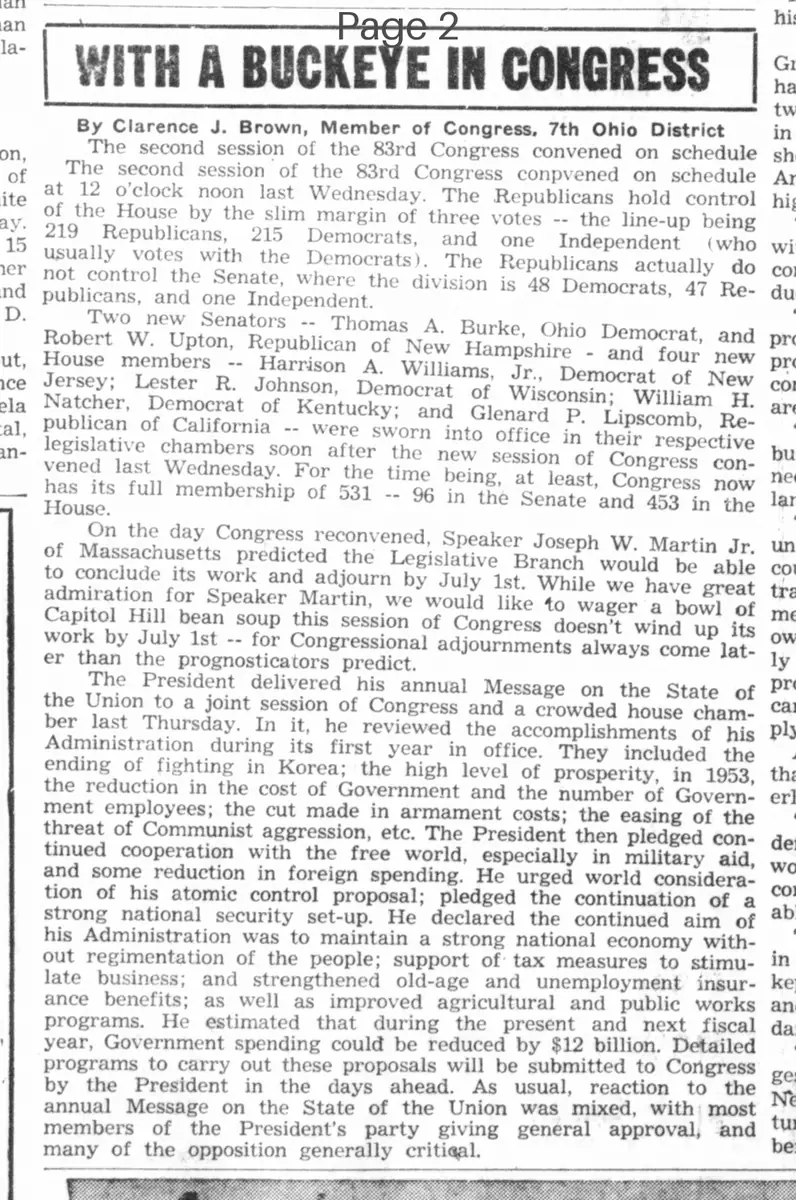
WITH A BUCKEYE IN CONGRESS
By Clarence J. Brown, Member of Congress, 7th Ohio District
The second session of the 83rd Congress convened on schedule
at 12 o'clock noon last Wednesday. The Republicans hold control
of the House by the slim margin of three votes -- the line-up being
219 Republicans, 215 Democrats, and one Independent
(who usually votes with the Democrats). The Republicans actually do
not control the Senate, where the division is 48 Democrats, 47 Re-
publicans, and one Independent.
Two new Senators -- Thomas A. Burke, Ohio Democrat, and
Robert W. Upton, Republican of New Hampshire - and four new
House members -- Harrison A. Williams, Jr., Democrat of New
Jersey; Lester R. Johnson, Democrat of Wisconsin; William H.
Natcher, Democrat of Kentucky; and Glenard P. Lipscomb, Re-
publican of California -- were sworn into office in their respective
legislative chambers soon after the new session of Congress con-
vened last Wednesday. For the time being, at least, Congress now
has its full membership of 531 -- 96 in the Senate and 435 in the
House.
On the day Congress reconvened, Speaker Joseph W. Martin Jr.
of Massachusetts predicted the Legislative Branch would be able
to conclude its work and adjourn by July 1st. While we have great
admiration for Speaker Martin, we would like to wager a bowl of
Capitol Hill bean soup this session of Congress doesn't wind up its
work by July 1st -- for Congressional adjournments always come lat-
er than the prognosticators predict.
The President delivered his annual Message on the State of
the Union to a joint session of Congress and a crowded house cham-
ber last Thursday. In it, he reviewed the accomplishments of his
Administration during its first year in office. They included the
ending of fighting in Korea; the high level of prosperity, in 1953,
the reduction in the cost of Government and the number of Govern-
ment employees; the cut made in armament costs; the easing of the
threat of Communist aggression, etc. The President then pledged con-
tinued cooperation with the free world, especially in military aid,
and some reduction in foreign spending. He urged world considera-
tion of his atomic control proposal; pledged the continuation of a
strong national security set-up. He declared the continued aim of
his Administration was to maintain a strong national economy with-
out regimentation of the people; support of tax measures to stimu-
late business; and strengthened old-age and unemployment insur-
ance benefits; as well as improved agricultural and public works
programs. He estimated that during the present and next fiscal
year, Government spending could be reduced by $12 billion. Detailed
programs to carry out these proposals will be submitted to Congress
by the President in the days ahead. As usual, reaction to the
annual Message on the State of the Union was mixed, with most
members of the President's party giving general approval, and
many of the opposition generally critical.
By Clarence J. Brown, Member of Congress, 7th Ohio District
The second session of the 83rd Congress convened on schedule
at 12 o'clock noon last Wednesday. The Republicans hold control
of the House by the slim margin of three votes -- the line-up being
219 Republicans, 215 Democrats, and one Independent
(who usually votes with the Democrats). The Republicans actually do
not control the Senate, where the division is 48 Democrats, 47 Re-
publicans, and one Independent.
Two new Senators -- Thomas A. Burke, Ohio Democrat, and
Robert W. Upton, Republican of New Hampshire - and four new
House members -- Harrison A. Williams, Jr., Democrat of New
Jersey; Lester R. Johnson, Democrat of Wisconsin; William H.
Natcher, Democrat of Kentucky; and Glenard P. Lipscomb, Re-
publican of California -- were sworn into office in their respective
legislative chambers soon after the new session of Congress con-
vened last Wednesday. For the time being, at least, Congress now
has its full membership of 531 -- 96 in the Senate and 435 in the
House.
On the day Congress reconvened, Speaker Joseph W. Martin Jr.
of Massachusetts predicted the Legislative Branch would be able
to conclude its work and adjourn by July 1st. While we have great
admiration for Speaker Martin, we would like to wager a bowl of
Capitol Hill bean soup this session of Congress doesn't wind up its
work by July 1st -- for Congressional adjournments always come lat-
er than the prognosticators predict.
The President delivered his annual Message on the State of
the Union to a joint session of Congress and a crowded house cham-
ber last Thursday. In it, he reviewed the accomplishments of his
Administration during its first year in office. They included the
ending of fighting in Korea; the high level of prosperity, in 1953,
the reduction in the cost of Government and the number of Govern-
ment employees; the cut made in armament costs; the easing of the
threat of Communist aggression, etc. The President then pledged con-
tinued cooperation with the free world, especially in military aid,
and some reduction in foreign spending. He urged world considera-
tion of his atomic control proposal; pledged the continuation of a
strong national security set-up. He declared the continued aim of
his Administration was to maintain a strong national economy with-
out regimentation of the people; support of tax measures to stimu-
late business; and strengthened old-age and unemployment insur-
ance benefits; as well as improved agricultural and public works
programs. He estimated that during the present and next fiscal
year, Government spending could be reduced by $12 billion. Detailed
programs to carry out these proposals will be submitted to Congress
by the President in the days ahead. As usual, reaction to the
annual Message on the State of the Union was mixed, with most
members of the President's party giving general approval, and
many of the opposition generally critical.
What sub-type of article is it?
Partisan Politics
Economic Policy
Foreign Affairs
What keywords are associated?
83rd Congress
State Of The Union
Republican Control
Democratic Senate
New Members
Eisenhower Message
Government Spending
Korea Ceasefire
What entities or persons were involved?
Clarence J. Brown
Joseph W. Martin Jr.
Thomas A. Burke
Robert W. Upton
Harrison A. Williams Jr.
Lester R. Johnson
William H. Natcher
Glenard P. Lipscomb
President
Editorial Details
Primary Topic
Opening Of The Second Session Of The 83rd Congress And Review Of The State Of The Union Address
Stance / Tone
Informative Reporting With Republican Perspective
Key Figures
Clarence J. Brown
Joseph W. Martin Jr.
Thomas A. Burke
Robert W. Upton
Harrison A. Williams Jr.
Lester R. Johnson
William H. Natcher
Glenard P. Lipscomb
President
Key Arguments
Republicans Hold Slim Majority In House (219 215 1)
Democrats Hold Slight Edge In Senate (48 47 1)
New Members Sworn In, Full Congress Membership Of 531
Speaker Martin Predicts Adjournment By July 1st, Author Skeptical
President's Message Reviews Korea Ceasefire, Prosperity, Cost Reductions
Pledges Cooperation With Free World, Atomic Control Proposal
Aims For Strong Economy Without Regimentation, Tax Stimulation, Improved Benefits
Estimated $12 Billion Spending Reduction